At the start of 1800, Americans were mourning the death of their first president, George Washington, who died on December 14, 1799.
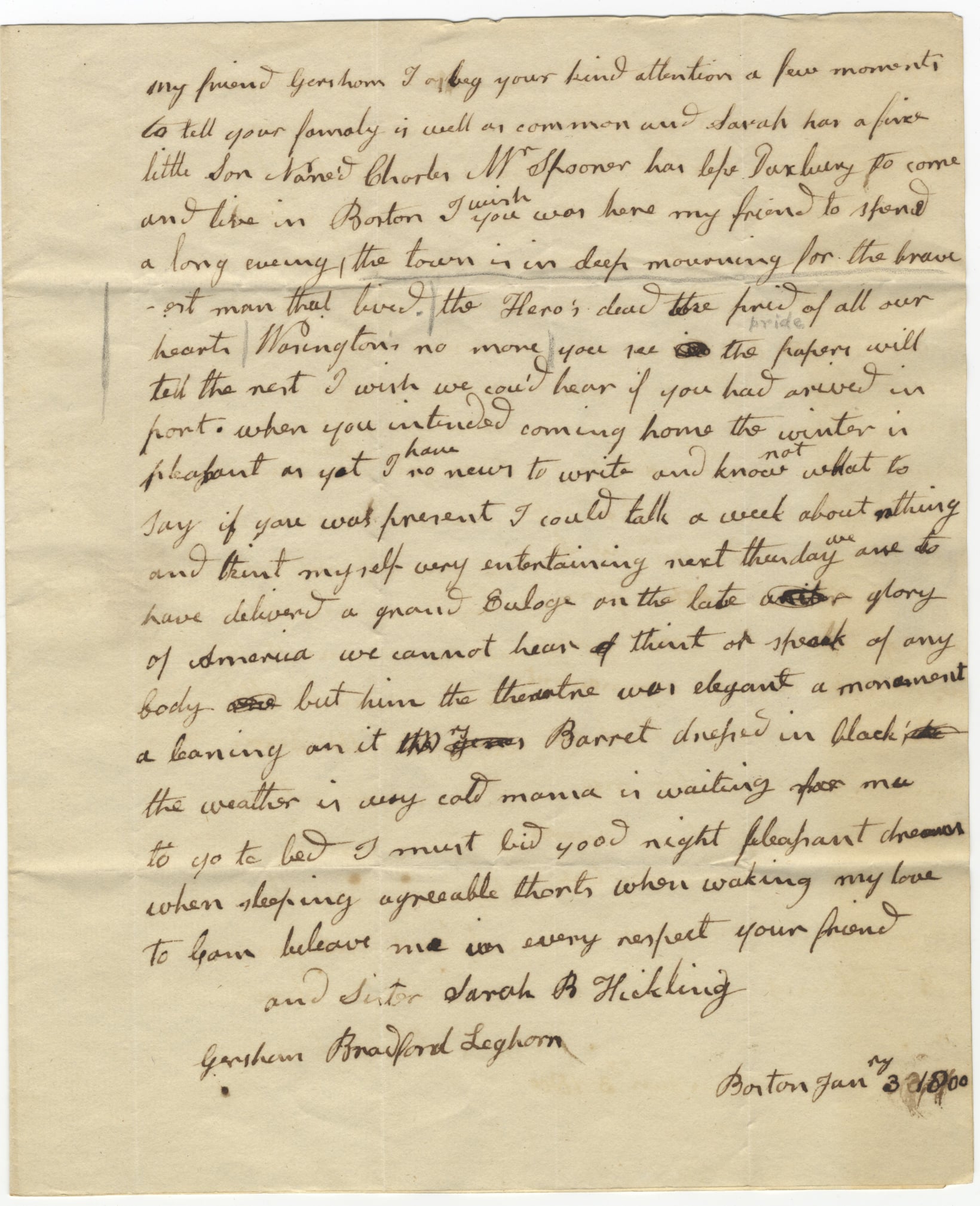
Because news traveled slowly, word of Washington’s death reached Americans abroad weeks later. On January 3, 1800, Sally Hickling of Boston wrote to her fiancé, Gershom Bradford, who was serving as First Mate aboard the merchant ship Industry in Leghorn (Livorno), Italy.
In her letter, Sally described the deep public mourning in Boston. She noted that the town was “in deep mourning for the bravest man that lived” and that a grand eulogy was planned. She observed that people could speak of little else.
At the time, the Industry was commanded by Gershom’s brother, Capt. Gamaliel Bradford, who was also Sally’s brother-in-law. Sally signed her letter “your friend and your sister,” reflecting the close family ties that already connected them.
Below is the transcription of her January 3, 1800 letter from the Bradford Family Collection, DAL MSS 024:
My friend Gershom I beg your kind attention a few moments to tell your famaly is well as common and Sarah has a fine little son named Charles Mr. Spooner has left Duxbury to come and live in Boston I wish you was here my friend to spend a long evening the town is in deep mourning for the bravest man that lived. The Hero’s dead the pride of all our hearts Washington no more you see the papers will tell the rest I wish we cou’d hear if you had arrived in port. When you intended coming home the winter is pleasant as yet I have no news to write and know not what to say if you was present I could talk a week about nothing and think myself very entertaining next Thursday we are to have delivered a grand Euloge on the late glory of America we cannot hear think or speak of anybody but him the theatre was elegant a monument a leaning on it Barret dressed in black the weather is very cold mama is waiting for me to go to bed I must bid good night pleasant dreams when sleeping agreeable thouts when waking my love to Gam believe me in every respect your friend And Sister Sarah B. Hickling
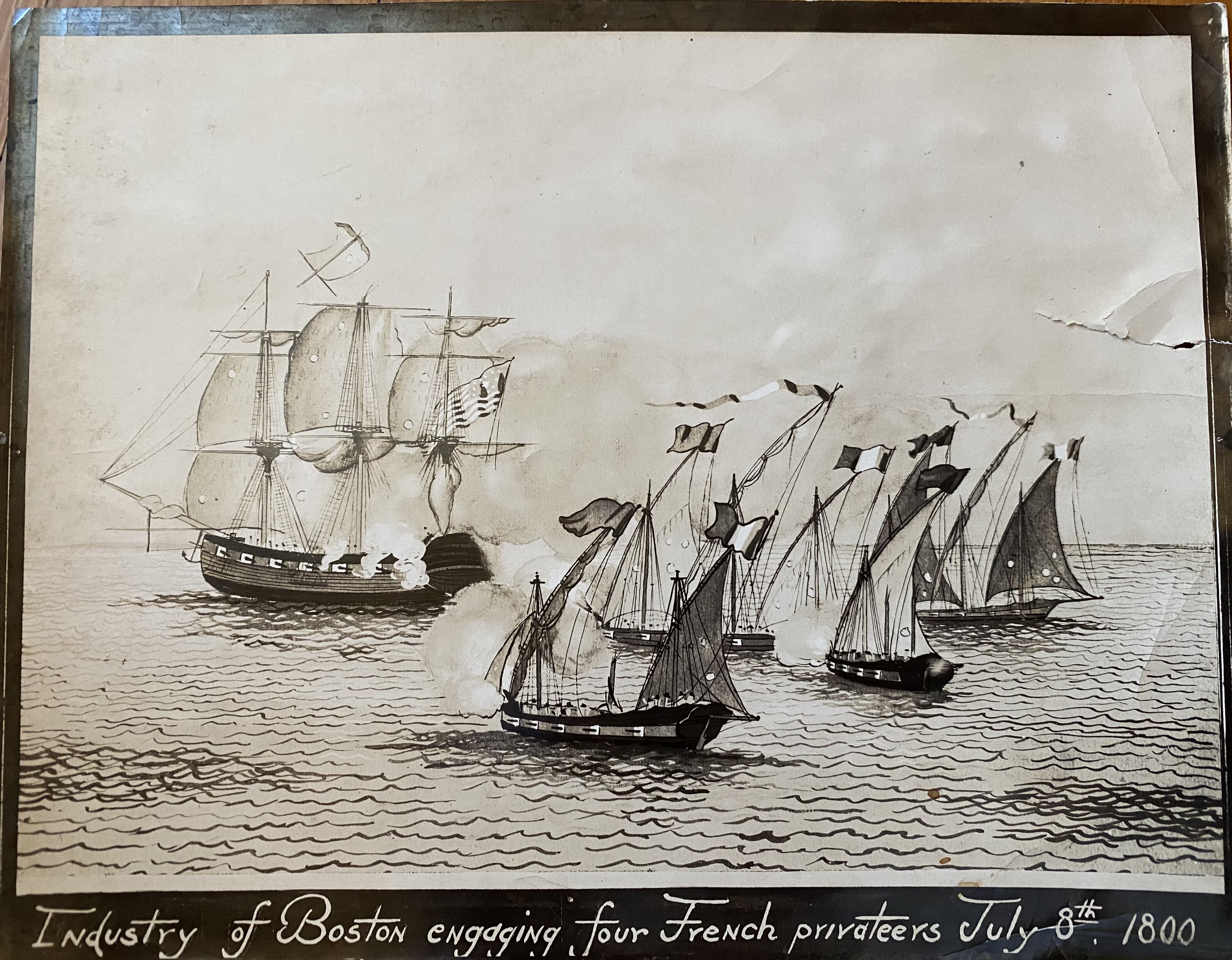
Later that same year, the Industry was attacked by French privateers near the Straits of Gibraltar. During a five-hour engagement, Capt. Gamaliel Bradford was severely wounded and lost his leg. Gershom assumed command of the vessel and successfully defended the ship.
Gershom and Sally married in 1802. In 1807, they built the home that is now the Bradford House Museum in Duxbury.
By Carolyn Ravenscroft, DRHS Archivist & Historian
The title of this article sounds like a YA murder mystery, and if I ever get around to it, it someday may become one. In the meantime, let me tell you about one of the oddest and most mysterious stories to come out of 19th-century Duxbury…
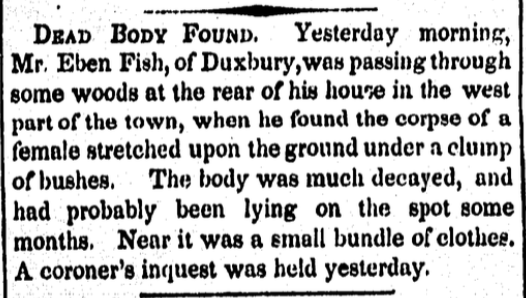
Boston Herald, Friday, Sept. 3, 1852
In 1852, Capt. Eben Fish left his house at 66 Franklin Street to gather berries for his wife, Ruth (Weston), who had just delivered a baby girl. While traipsing across his property, he discovered the body of an unknown woman. A brief news article from the time related the incident without much fanfare – and no other information ever came to light. 1852 was a different time, and an unidentified body simply remained a mystery.
Luckily for us, we have the diary entry of Edward Baker, a 21-year-old sailor at the time, home between voyages. Edward, or Ned as he was called, was a neighbor of Eben Fish. He had grown up in the Crooked Lane section of Duxbury, and had kept a diary since he was a boy.
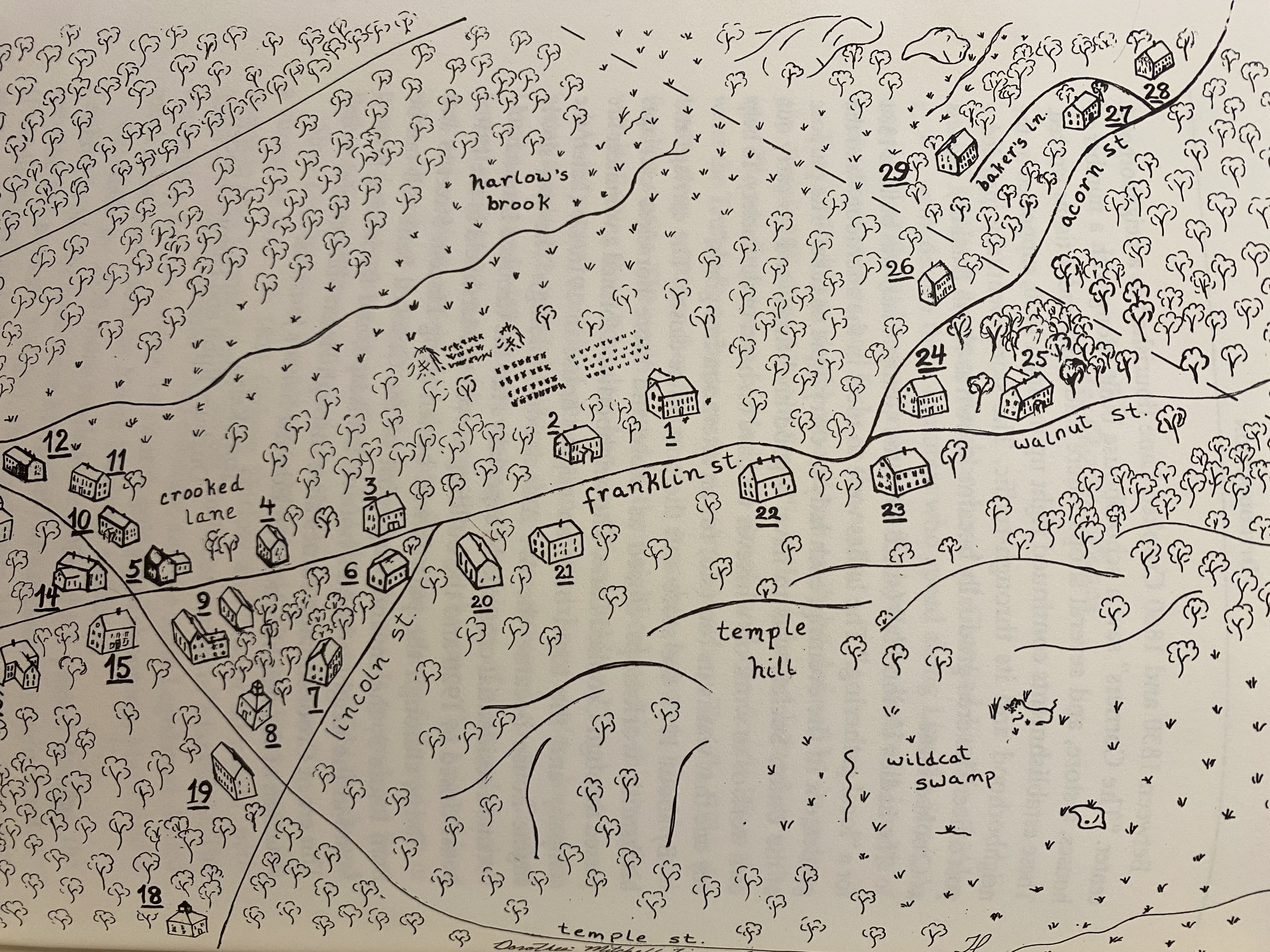
He gives us a much more detailed and disturbing account of what transpired in Wildcat Swamp:
Map of Crooked Lane/North Duxbury showing location of Wildcat Swamp (Eben Fish lived at #24, Ned Baker lived at #1).
Sept. 2, 1852 …Quite an incident occurred in our vicinity. Last night as Capt. Fish was over mending his fence in and around his swamp (wildcat swamp so called) and in pursuit of some dangleberries for his wife who by the bye is in a delicate situation, having given birth to a daughter on Tuesday last, he suddenly came upon the remains of a woman lying face down, and with her face in a pond of water. After passing a sleepless night at home, he started early this morning for the coroner, Major [Avery] Richards of Duxbury, who came up and accompanied by Capt. [Fish], Joseph [Fish]. and Mr. Dorr, and E. Prior, repaired to the place where she was seen lying, and here I think that the coroner grossly neglected his duty, for no jury was called, no inquest held, and of course, no cause assigned for her death, and furthermore, the coroner at first ordered a hole dug upon the spot, that they might shove the bones in without gathering them up, but it being found impossible to get earth enough out – as she lay in a pond hole – they repaired to the upland, where an excavation was made into which they conveyed it by some means, I know not what, and also threw in several (I think there were a number more than one) thus I heard it, bundles with dresses, etc. which were lying beside a tree close to where she apparently had died, and covered them all up together as they would have done the remains of a dog! She was dressed in a blue jean gown, farther I know not concerning her dress, it is supposed to be a woman whom Joseph Fish saw in that vicinity July fifth and who he says ran or walked off when she saw him, and I believe he did the same…
The above description differs in an important detail from the news account – Ned claims there was no inquest. He was not an eye-witness to the events, he received the information second-hand, but he seems pretty definite that the woman was unceremoniously buried on the spot. Who was this woman? Why the quick disposal of her body? There is a story here…but one for which we will never know the truth. But boy, do I have some wild speculations…
This article first appeared in the Lamplighter, Fall 2023
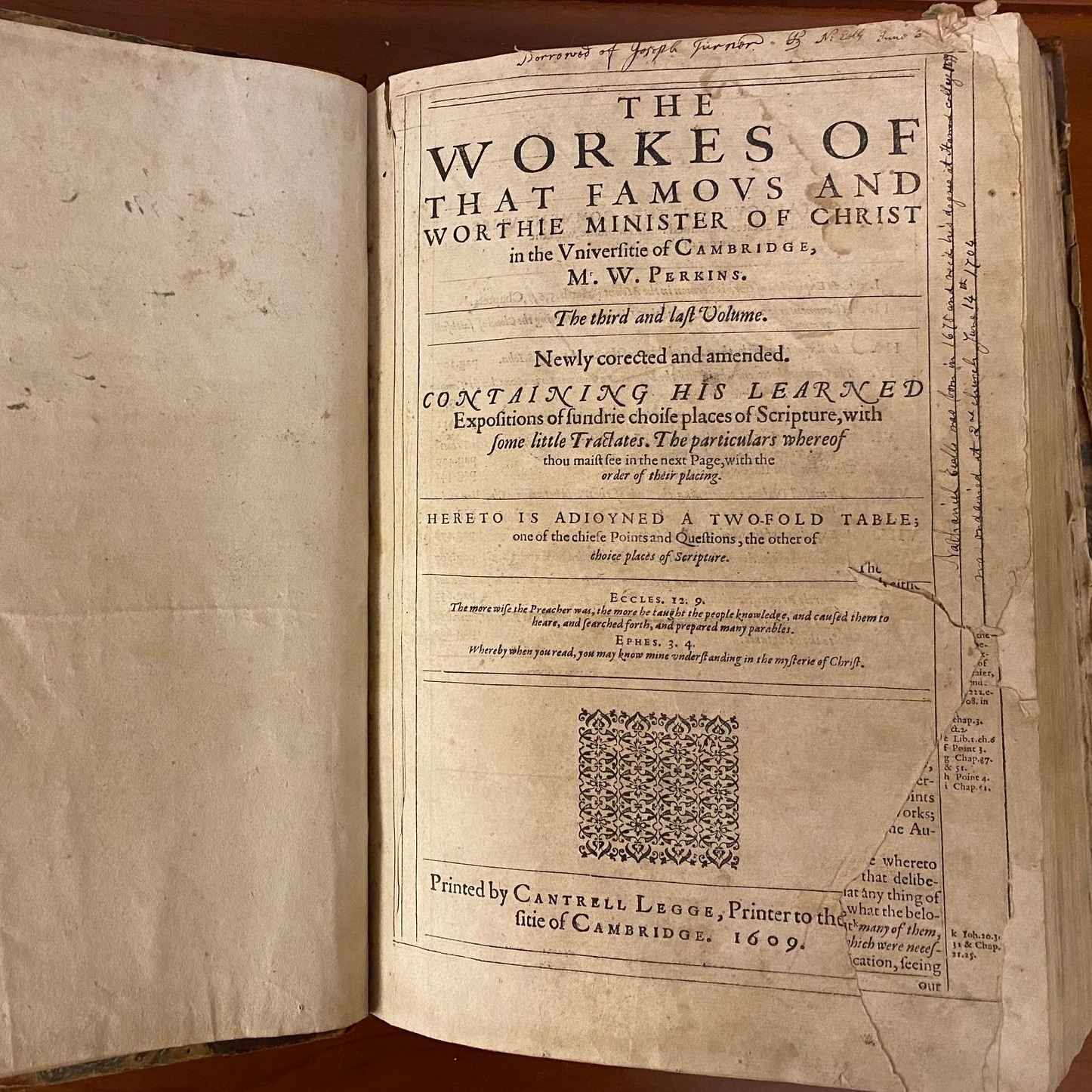
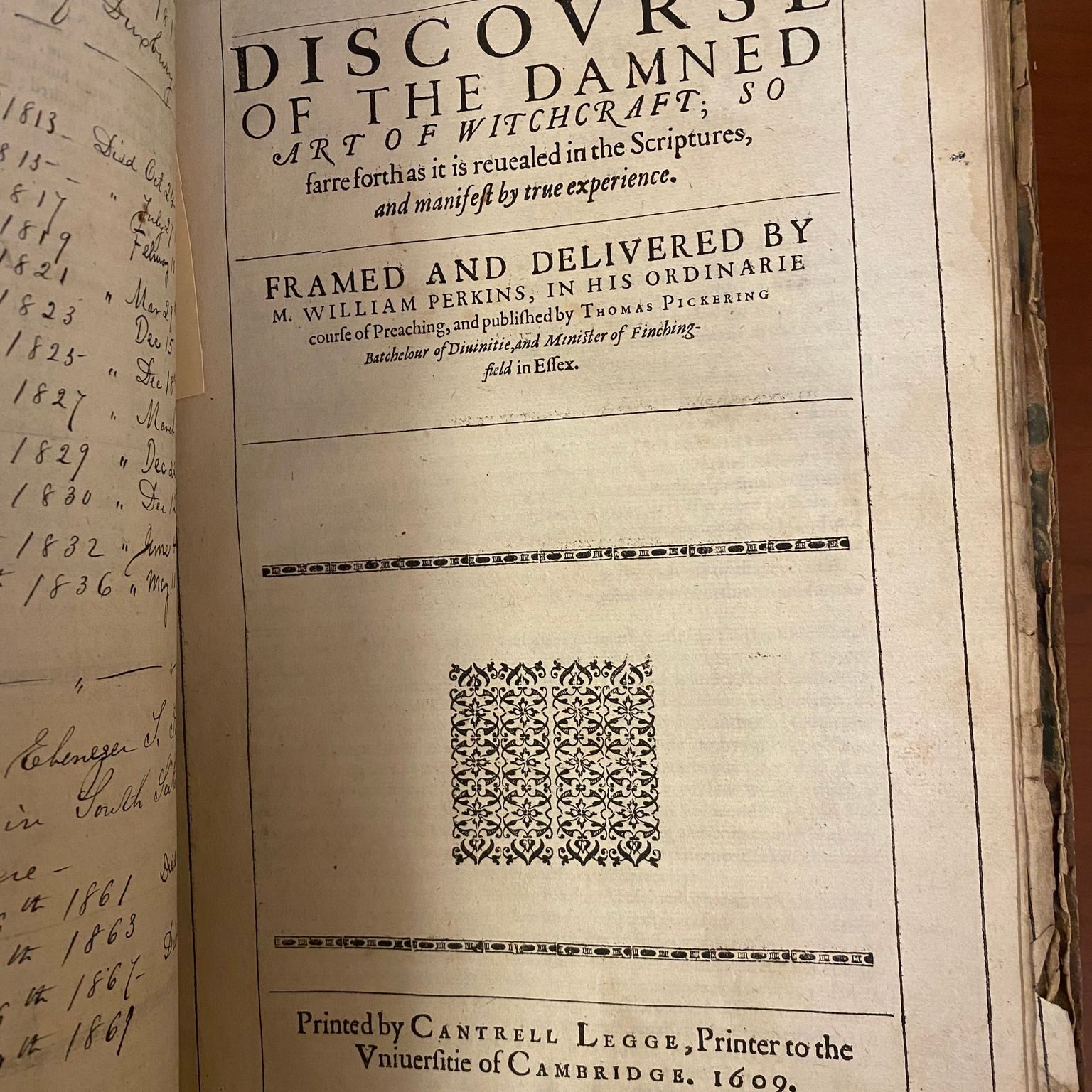
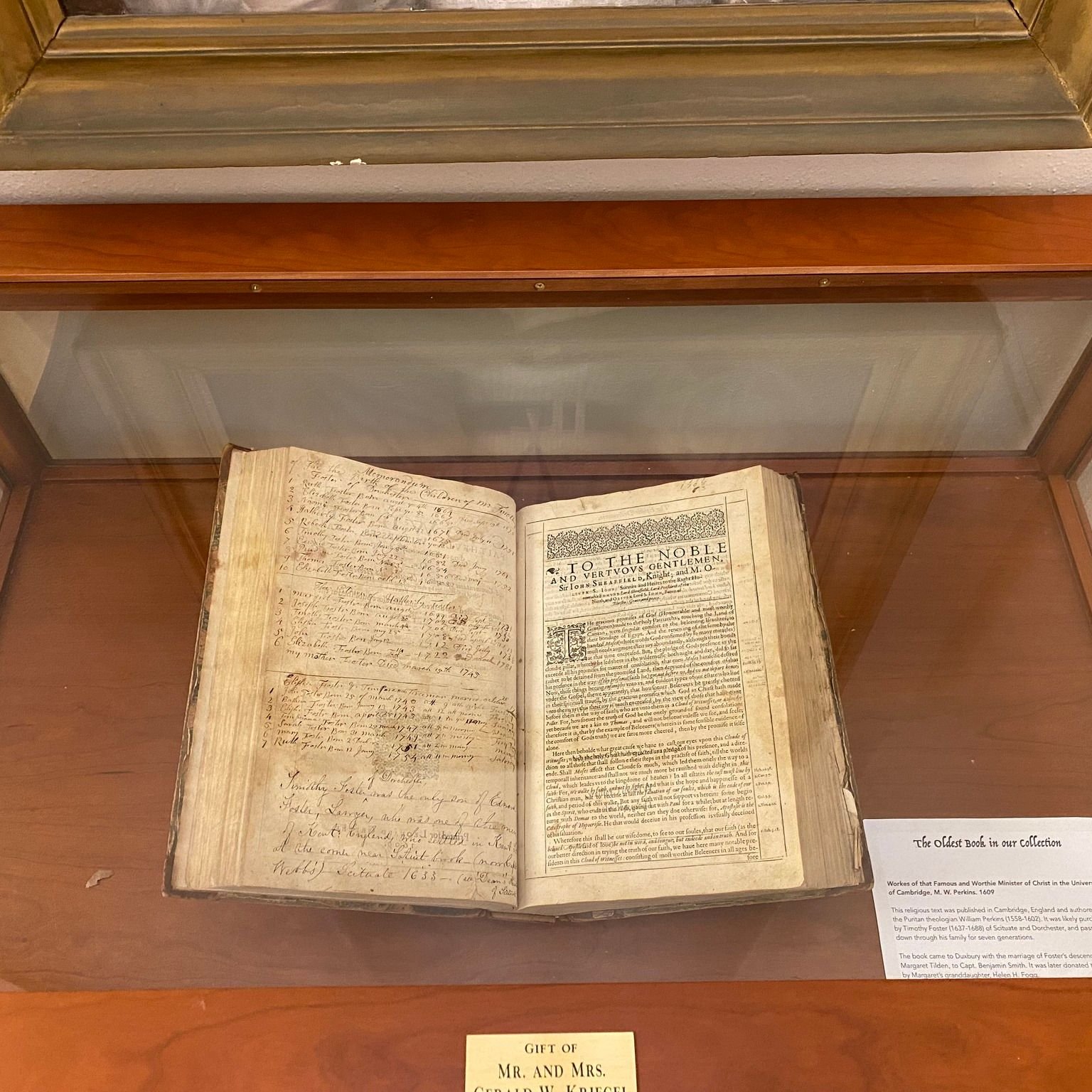
October is the perfect time to describe the oldest, and maybe spookiest, book in the DRHS’ Drew Archival Library’s vast collection. The Workes of that Famous and Worthie Minister of Christ in Universitie of Cambridge, M. W. Perkins. Published in England in 1609, the book is a compilation of the writings of the noted Protestant Reformation theologian Rev. William Perkins. The volume is large, measuring 12″ x 8.5″ x 2.5″, and is bound in leather with marbled end-papers. This is not, however, the original binding. The pages were cut down at some point, as evidenced by partially missing handwritten notes on the top margins of some pages.
The book’s almost 700 pages contain eleven commentaries on religious subjects by Perkins. Today’s reader would undoubtedly find the commentary A Discourse of the Damned Art of Witchcraft the most intriguing. Witches were not the stuff of fairy tales or legends in the 17th century; they were very real beings. According to Perkins, the practice of witchcraft was “rife and common in these our dais, and very many are intangled with it.” Perkins described witches as those who made a pact with the Devil. They could see into the future, use the black arts, and make wonders occur through charms and spells.
While the section on witches and how to expose them is fascinating, it is the book’s ownership and the hands through which it has passed over the centuries that interest me the most. A number of handwritten notes scattered through the pages tell the history of this book. Beginning with the very first page, we have the large, scrawled signature of “Benj’n Smith Jr. Duxbury.” This is followed on the next page with an almost equally large signature of Smith’s sister, Helen L. Fogg, with the note “from H. E. Smith, Feb’y 9th ’88.” With these two pages, we can place the book in Duxbury by the 1800s. Capt. Benjamin Smith Jr. (1814-1848) lived on Depot Street and is buried in the tomb on the corner of Tremont and Depot Streets. Hambelton E. Smith (1817-1892) was the Captain’s brother, who lived at 1043 Tremont Street when he gave the book to Helen L. (Smith) Fogg (1832-1909). It returned to Norwell with the Fogg family until the book was donated to the DRHS by Helen’s daughter.
Despite Benjamin Smith’s oversized flourish, the book did not originate with a Smith ancestor in the 1600s. It was gifted and loaned many times, and that is part of the fun, to piece out who owned it, where, and when. While we may never know who brought it to the New England colonies, our story begins with Deacon Joseph Turner (1649-1724) of Scituate, the son of one of the town’s founders. Turner wrote on a blank page about 3/4 of the way through the book, “Joseph Turner his book God give him grace to in it to look.” Perhaps he studied its pages upon hearing of the witchcraft trials in Salem in 1692. He loaned the book for a time to Rev. Nathaniel Ells Jr. (1677-1750). In 1698, Turner’s daughter Bathsheba married Deacon Hatherly Foster in Scituate. The book eventually made its way to Bathsheba’s son, Elisha Foster, who recorded three generations of Foster births within its pages, beginning with the children of his grandfather, Thomas Foster of Dorchester. This “Fosterization” of the book makes it appear that it had been in the hands of the Fosters since the 1600s, but these early births were written by Elisha in the 1750s. A later page includes the birth of Peggy Foster on August 5, 1772 at eight in the morning. Peggy would go on to marry Samuel Tilden. Their daughter Margaret Tilden (1791-1851) of Scituate married Capt. Benjamin Smith Sr. of Duxbury in 1812. The Smith’s children included the above mentioned Benjamin, Hambelton, and Helen. So, it is easy to trace more than 300 years of the book’s history from Scituate to Duxbury.
You can see the book by appointment at the Drew Archival Library.
This article first appeared in the Lamplighter, Fall 2022
In 1848, gold was discovered in California, and the country’s first Gold Rush was on. Thousands of people, both male and female, were infected with gold fever. Most hoped to strike it rich by mining, but some, more prudent, eyed the prospect of provisioning the prospectors. The booming city of San Francisco also needed laborers of all types to keep pace with its rapid expansion. The movement of so many citizens to the Pacific Coast tipped California into statehood in 1850.
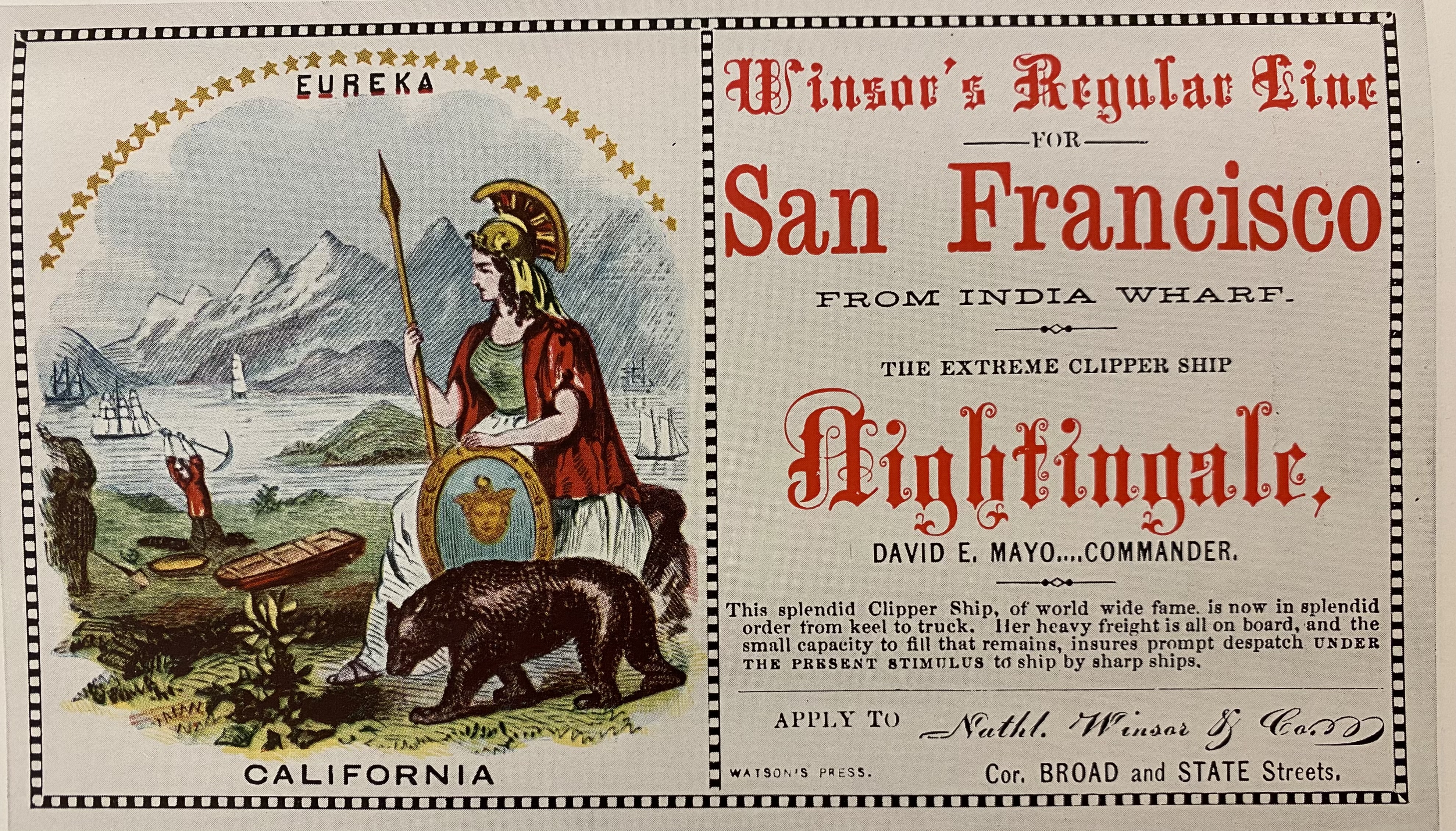
The “Forty-Niners” bought passage aboard ships bound for San Francisco individually or formed ad-hoc mining companies and leased entire vessels. The race to get to California energized the shipbuilding industry in Boston and New York as larger and faster clipper ships competed for speed records. The clippers of the Winsor Regular Line of Boston, owned by Duxburyite Nathaniel Winsor III, made numerous trips around Cape Horn with passengers. They, as well as other lines, often sailed with Duxbury captains and/or crew members.
Between 1849 and 1853, more than fifty Duxbury men (and a few women) set out for California. A young clerk, Eugene Sampson, wrote from Boston in Sept. 1849, “I see lots of Duxbury folks up here every day bound for California & should think by the appearance of things that one half of Duxbury was going.” [1] For those struggling in the town’s post-shipbuilding economy, the hope of finding gold was very tantalizing. Almost none struck it rich, at least not in the mines. Most returned East after a frustrating few years away from home. A quarter of those that went remained and became the first white settlers in communities all along the Pacific coast. For example, Alexander Sampson and Rufus Holmes were founders of Port Angeles, WA. Sadly, four of Duxbury’s Forty-Niners died, and one disappeared.
Barzillai Peterson of West Street was the only Duxbury man to return East with significant wealth. He found gold on the North Fork of the American River and then parlayed that winning into a successful freighting business between Sacramento and Shasta, CA. When he returned in 1852, he was rich enough to purchase Daniel Webster’s former estate in Marshfield. The lure of the West was too great, however, and Barzillai ended his days on his 380-acre farm in Sonoma County, CA.
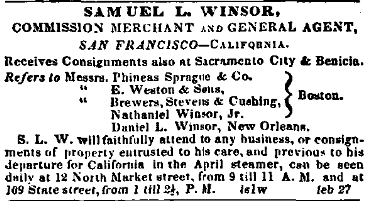
The Duxbury Rural & Historical Society’s headquarters at 479 Washington Street, built by Nathaniel and Hannah Winsor in 1807, has multiple connections to the Gold Rush through four of the Winsor sons. The aforementioned Nathaniel Winsor III was raised in the house, he later owned it and summered there once he moved to Boston. Another son, Capt. Charles F. Winsor sailed for the Winsor line and eventually retired to California, where he became the keeper of the East Brother Light in Richmond, CA. Son Samuel L. Winsor sailed to San Francisco in 1850 aboard the Cherokee and opened a store with his Duxbury friend, John S. Loring, provisioning miners. Before leaving Boston, he advertised his ability to take on consignments of cargo heading west. Finally, the youngest son, Henry Winsor, headed to San Fran aboard the Winsor ship Constantine, captained by Charles F. Winsor. He is rumored to have struck it rich in the mines, only to mysteriously disappear on his voyage home.
Duxbury Men (and 2 women) in the California Gold Rush:
This article originally appeared in the Lamplighter, Spring 2022
Ford’s Store on Tremont Street, c. 1890
When Duxbury’s iconic Nathaniel Ford and Sons store opened on Tremont Street in 1826, it was only one of many neighborhood “general” stores catering to a local clientele. Although the Ford Store would go on to be hailed as the country’s first department store, selling a wide variety of goods in its ramshackle and rambling buildings, it was never the only place to shop in town. The Ford family’s fame overshadows the dozens of other Duxbury proprietors who served the community throughout the nineteenth century.
Before the advent of the automobile, Duxbury was a town of villages where most daily tasks were accomplished within the confines of your neighborhood. Whether you lived in the charmingly named Tarkiln, Ashdod, Crooked Lane, or Tinkertown; the eponymously named Fordville, Chandlerville, or Gardnerville; or the practically named South Duxbury, you likely had a school, shops, and craftsmen within walking distance. That was very important when you made frequent forays on foot. When it came to shopping local in 1826, the year the Fords hung out their sign, there were at least five other general stores on the east side of Duxbury, each selling similar wares to their local patrons. Judah Alden’s store was on the corner of Tremont and Alden Streets, creating the hazardous bend in the road that we still live with today. Ezra Weston, aka King Caesar, had a store on St. George Street, directly across from the Wright Building. The Drews’ kept a store on Powder Point, William and Henry Sampson operated a shop at 318 Washington Street, and Sylvanus Sampson’s store was on Standish Street. There were, I am sure, instances when our 19th-century counterparts chose to trek longer distances to get better eggs, cheaper spices, or a more stylish bonnet, but for the most part, basic necessities could be had close to your front door.
Some items did require specialty shops or planned excursions. Fine thread for crewelwork and lovely embroidered ribbons were sold out of the front parlor of Matilda Peterson’s house on Surplus Street, for example. A trip to her shop was a treat fondly remembered by many of Duxbury’s young women. When even Matilda’s offerings did not suit, there was always Boston or Plymouth. The latest books, French wallpapers, fine silks, fancy carpets, etc. could all be had in the city’s many mercantile establishments. The daily packet boat could sail you to Boston and ship your purchases home to Duxbury. The stage coach could also take you, or you could place an order with the stage driver who would pick up what you needed. After 1845, you could also catch the train to the city from Kingston.
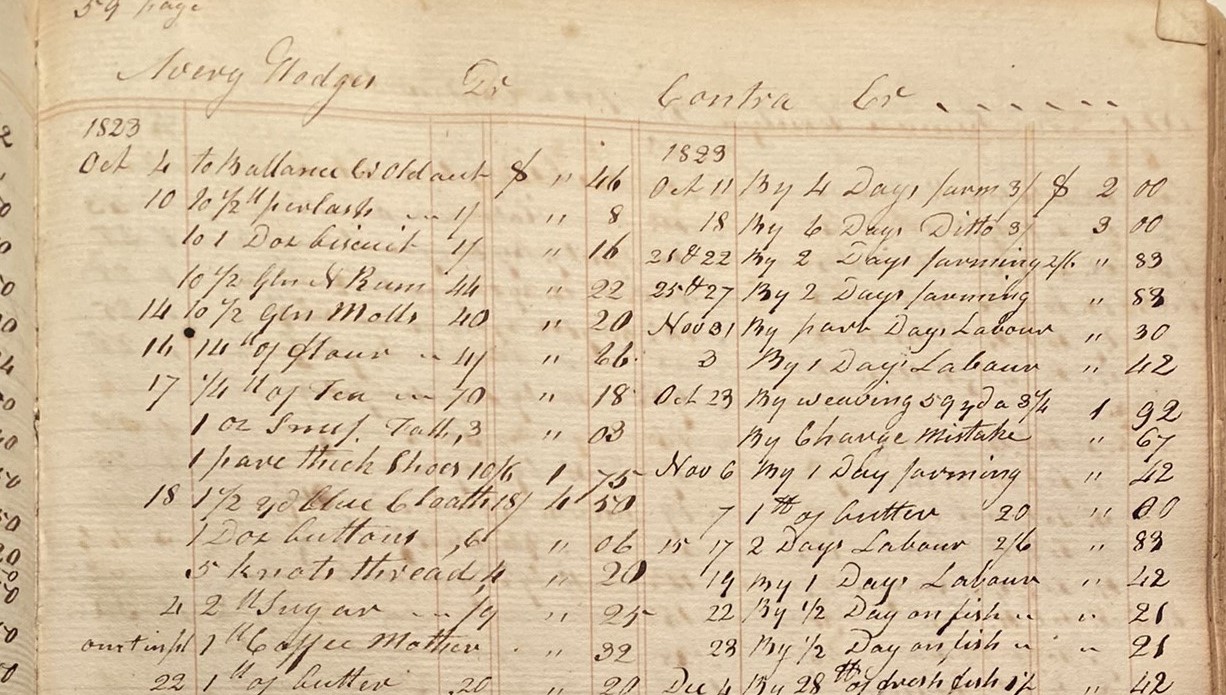
Ledger page from Sylvanus Sampson’s store showing goods purchased in 1823, molasses, rum, sugar, and [cotton] thread.
While many of the goods sold in 19th-century stores were locally sourced or imported from Europe and Asia, some of the staples were the products of Southern and Caribbean slavery. The Ford’s first sale included four gallons of molasses, fourteen pounds of sugar, one gallon of New England rum, and 1/4 pound of tobacco. The molasses, sugar, and tobacco were all directly produced by enslaved people. The New England rum was distilled also using sugar from the West Indies. While cotton cloth or thread was not part of this first sale, it was likely sold later in the day. This complicity between the Northern and Southern economies did not go unnoticed. When the anti-slavery movement grew in the North, forgoing such items was one way to show support for the cause. But, even staunch abolitionists like the Bradford family of our Bradford House Museum continued to purchase sugar, cotton, and molasses in the years preceding the Civil War, demonstrating how pervasive and necessary these products were.
Throughout the 1800s, stores would come and go, thrive and fail. Some owners would pack up and head west, hoping for better luck in a new boom town; some would change occupations altogether. Federal-era homes would become storefronts only to be converted back to residences by the next owner. The history of retail is an important part of Duxbury’s story and is often as interesting as that of our great shipbuilding wharves.
This article was originally published in the Lamplighter Newsletter, Summer 2016
Duxbury’s rich maritime history stretches back to the early days of settlement. There were some “firsts” here and there during our colonial days, including the first vessel built on Duxbury’s shores, but many of these early achievements went undocumented and remain in the murky past. There are later recorded milestones, however, that give Duxbury’s mariners a unique place in history. After the Revolution, Duxbury ships and sailors became the first Americans to enter ports around the globe. Four such stories can be found in the archival collections of the DRHS.
Samuel Delano Jr. was the son of a Duxbury shipbuilder. His successful career as a shipwright and seaman has always been overshadowed by the famous exploits of his older brother, Capt. Amasa Delano. Recent revelations, however, have assured Samuel’s place in history. In 1791, as a sailor aboard the brig, Grace, under the command of Capt. William Douglas, Samuel Delano became one of the first Americans to enter a Japanese harbor. Japan had been closed to Westerners for over 150 years when the Grace arrived in Koshimoto alongside the American brigantine, Lady Washington, under Wareham, MA’s Capt. John Kendrick. The log kept by Delano relating to this adventure was donated to the DRHS in 2007 by the Hoyt family, and it contains his rare first-hand account. [1] You can read the log here.
Painting by Laurence Bradford, copied from a Liverpool jug, DAL.MSS.024
Almost a decade after Delano’s voyage, the American ship Industry entered the port of Ancona on the Adriatic Sea, flying the stars and stripes. On March 9, 1800, Capt. Gamaliel Bradford wrote his wife Elizabeth, “…in this port we have had the honor of displaying the first American flag ever to be seen here – the people have been very curious to visit our ship, and I am constantly fatigued with questions about our country which they appear to have a very imperfect idea of.”[2] The voyage would end badly for Capt. Bradford. Four months after he penned his letter to Elizabeth, the Industry was attacked by French privateers in the Straits of Gibraltar. During an hour-long battle, Gamaliel was wounded in the thigh and disabled. His brother, First Mate Gershom Bradford, took command and repelled the enemy. Gamaliel’s wounds were such that his leg was amputated. He survived the surgery and continued his maritime career. His brave brother, Gershom, built our Bradford House museum at 931 Tremont Street.
In 1824, eleven-year-old Jacob Smith traveledaboard the brig Globe with his father, Capt. Jacob Smith Sr. He visited many ports, including Malaga in Spain, Elsinor and Copenhagen in Denmark, and Stockholm in Sweden. But it was in St. Petersburg that he made his mark as the first American child to visit the Russian court. Perhaps because the United States was viewed as an untamed wilderness, he was considered such a curiosity that “Baron Stiglitz took him home to show his wife, so she might be convinced he was white all over.” Jacob went on to have a very successful life at sea before settling down in Westford, MA, as a gentleman farmer and civic leader.
Parade float, 1937
Finally, there is Ezra “King Caesar” Weston’s brig Smyrna under the command of Capt. Seth F. Sprague. In 1830, the Smyrna became the first American vessel to be granted permission to sail into the Black Sea by the Ottoman Empire. The DRHS has the log book of this historic voyage in which Capt. Sprague wrote, “Received my ferman to pass the Bosphorus Sea, the first was ever granted to the American flag.” A day later, he recorded, “5pm pass the point of the Bosphorus and entered the Black Sea, there is beautiful vileges [sic] as you pass up the Bosphorus.” [3] The Smyrna’s voyage has long been celebrated in Duxbury. During the Tercentenary in 1937, a float commemorating the event was part of the parade.
[1] Amasa and Samuel Delano Collection, DAL.MSS.014 [2] Bradford Family Collection, DAL.MSS.024 [3] Capt. Seth F. Sprague Collection, DAL.MSS.104
The portrait of Capt. Elijah Soule has hung over my desk at the DRHS’ Drew Archival Library for 14 years. Despite being painted by a mediocre unknown artist, Elijah is rather dashing in his navy blue sailor jacket and gold loop earring, ready to issue an order to his crew through a speaking trumpet. His shirt was initially open at the collar, but an odd pink bow was added later – perhaps to mitigate his rakish energy. His death of “Java fever” in Canton, China, at age 36 lends him a tragic and romantic air.[1] Combine the above with the fact that he was raised only a few doors down from my former Duxbury house, and you can see why he was one of my favorite local characters. Imagine my dismay then, when I discovered that Elijah wasn’t all I thought him to be. Lesson learned, you can’t judge a book by its cover or a person by a painting.
Elijah Soule (1798-1834) was born on what is today known as Marshall Street in Duxbury. He was the youngest of William Soule and Priscilla Sampson’s six children. Like two of his brothers, Elijah became a master mariner, a typical occupation for capable Duxbury men during the town’s 19th-century shipbuilding heyday. He probably went to sea as a youth or young man and rose to the rank of captain by his 20s. He was commanding Levi Sampson’s Duxbury-built brig, Arctic, when it was sold to the Baltimore merchant James Phillips in 1827. A letter sent to Soule at the time indicates that he was concerned this sale would end his tenure aboard the Arctic.[2] However, we know that Soule continued working on the vessel. Sadly, we also now know that he was involved in moving numerous enslaved men, women, and children from Maryland to New Orleans, to be sold to the cotton plantations of the Deep South. This transference of enslaved labor between states is often referred to as the “Second Middle Passage.” As the insatiable demand for labor on southern plantations grew, many enslavers from the mid-Atlantic states profited by selling their slaves to the southern market. If a merchant vessel had space, it would take on these forced and unwilling passengers. According to custom house records, the Arctic accounts for 7% of enslaved entering into New Orleans in the 1820s.[3]
Was Elijah Soule and the Arctic alone among Duxbury men or Duxbury-built ships in this endeavor? Obviously not; we know the vessel Gustavus, owned by Nathaniel Winsor Jr, also transferred enslaved to Savannah, GA, at least once. More will undoubtedly come to light with further research.
Newburyport Herald, March 13, 1835
As for Elijah, in 1833 he took command of the 358-ton Aurelius, newly built by Thatcher Magoun in Medford for Boston merchants John Brown, Isaac Schoefield Jr., and Richard Soule. Richard Soule was Elijah’s cousin, and this kinship likely made him captain. On New Year’s Day, 1834,the Aurelius left Boston for a voyage to Charleston, SC and Liverpool, England. By April, the Aurelius was cleared to leave England, bound for Canton via Batavia (Jakarta). Soule must have picked up his fever in August 1834 at his stop in Batavia, because after arriving in China, he died on September 17th. The ship returned to the US under the command of a new captain named Stoppard, laden with tea, cloth, and lacquerware to be sold in America.
This summer, Elijah Soule’s portrait will be on display at the King Caesar House for our exhibit East Meets West: Asian Influences in 19th Century American Life. While he will grace the wall of the gallery to highlight Duxbury’s involvement in the China Trade, it is incumbent on us to remember his full career and the North’s complicity in the Southern economy.
[1] Duxbury Vital Records describe Soule’s cause of death as “Java fever.” This term simply means he died of a tropical fever contracted in Java (Indonesia).
[2] Thomas Lamb to Elijah Soule, Feb. 1827, DAL.MSS.090, Drew Archival Library
[3] Schermerhorn, C. (2015). The Business of Slavery and the Rise of American Capitalism, 1815-1860 (p. 58). Yale University Press
The oft-told rumor that Truman Capote wrote Breakfast at Tiffanys on Clarks Island is only slightly more popular than the rumor that he wrote In Cold Blood while there. Which, if either, is right?
In the summer of 1959, the poet Sarah Wingate Taylor (owner of Cedarfield on Clark’s Island) wrote in her daily journal, “I devoured on sight a review of Breakfast at Tiffany’s. Capote, from first report of his coming to Clark’s Island, has seemed to me a total anomaly. How could he fit into this quiet land, this island so rich in Nature that it engulfs and drowns the brittle sophistication of which, it seems to me, Capote is a sprig. Yet from Jean and Esther both come expectations that I shall be entertaining Truman Capote at tea.”
Truman Capote stayed on Clark’s Island in the summer of 1959 – a year after the publication of Breakfast at Tiffany’s. The murders that would become the subject of In Cold Blood had yet to take place. Sadly then, we must put to rest the idea that Capote authored either of his most famous works during his summer sojourn here.
Did Sarah Wingate Taylor meet and entertain him? Not really. They saw each other a couple times in passing. One of his dogs got loose and scampered down to Cedarfield and had to be retrieved. During their brief conversation, Capote mentioned that he found the island quiet. Despite both being authors, they seemed to have ignored one another.
Taylor did offer this description, “…a bit about Truman Capote. He will not return, had found Howard’s house cold…the Larson’s grandsons talk with Capote when he suns in the Cove…Capote tells the boys he is writing a book about Russia.” [According to his editor, Capote was working on A Daughter of Russian Revolution, which was never finished]
The following is a memoir written by Duxbury native, Pauline Winsor Wilkinson (1836-1924). Pauline was the daughter of Capt. Gershom and Jane Winsor and was born on Powder Point Ave. When she was four years old her father was lost at sea off of Cape Hatteras, leaving her mother with five children to raise alone. In 1859 Pauline married Isaac Otis Wilkinson, a Boston merchant and friend of her brother’s. Although they resided on Rutland Street in Boston’s South End, Pauline was a frequent visitor to her hometown. The Wilkinsons, with their three children, moved to Berkley, California in 1876. Sadly, Isaac died the following year. By 1890 Pauline had returned east and was residing in Brookline. In her final years she lived in the household of her son, Crayton, again in California.
Pauline Winsor Wilkinson wrote her memoir in 1921, when she was 85 years old. It is a wonderful picture of Duxbury during its shipbuilding days.
OLD DUXBURY
In looking back at Duxbury eighty years ago [1840s] one sees a great change. In those days the town was occupied only by the natives and life there was simple and plain. Once in a while it would be startled by some scandal or a runaway match, but on the whole it was very respectable and remarkably free from squalid poverty or disreputable places. It was long before the era of good roads and they were so sandy that as the heavy four-horse yellow stagecoach made its daily trips to Boston the sand came up on the wheels and fell over on the other side, and it took all day to make the trip. I remember of making it once with my mother to visit my grandmother, who lived in West Cedar Street, Boston.
We stopped at the Halfway House for dinner and a short rest and to change horse, then journeyed on again. the coach was run by “Sprague & Jones” alternately, both of whom lived on Harrison Street in the house still owned by some of Mr. Jones’ family.
There was a wooden bridge over the Blue Fish River, and we who lived on the Point listened to hear the four horses come clattering over it in the evening.
Mr. Jones was not only stage driver, but he did errands as well, as there was no express. I remember going to his house with a sample of green silk from which a dress was being made and asking him to get eight yards of guimp for it about so wide, and the next night when he returned he brought an exact match. He said he could remember about forty errands without a memorandum, but beyond that he had to write them down.
Later the railroad from Boston to Plymouth was built, with a station at Kingston, and the old stagecoach ceased its daily trips to Boston, but it made a morning and afternoon connection with the train at Kingston.
Old Stage on Washington Street
The big stagecoach was later superseded by a “schooner” as it was called, a long black three-seated carriage with two horses – less cumbersome and less expensive to run, no doubt, but far less stately and picturesque.
The Point, below Blue Fish River, and the village, were almost like two separate towns, and we of the Point considered that the “court end.” In the eighteenth-century Mr. Ezra Weston was the richest man in town and very autocratic, so acquired the name of King Caesar. It is a tradition that he spelled coffee “kauphy.” He owned all the land on Powder Point and built and occupied a large cottage-shaped house, said to have a secret passage and stairway – but I will not vouch for the truth of that.
It was his son Ezra, I think, who built and occupied the fine large house in which the original landscape wall – paper on the parlor is still preserved [King Caesar House Museum, 120 King Caesar Rd]. He had a large family but after the death of his son Alden in the house stood empty for several years.
In 1886 Mr. Frederick Knapp bought the place and established a boy’s school [Powder Point School for Boys], for which he built a large building, also used in summer as a hotel, and called the Powder point Hotel. It was after he owned the place that King Caesar’s old cottage was burned and an imitation of it built on the same spot.
The Westons built and owned a large fleet of ships and fishing schooners, and Weston’s wharf was a busy place. They also had a store next to the Cushman place [St. George Street]. The house which is now the Public Library was then on the opposite side of the street next the store, and occupied by some of the Weston family.
Gershom Weston, son of Ezra, had a large place and house now known as the Wright place, and kept many different carriages and a colored driver, but the high “buggy” which he drove himself seemed to be constantly on the road. He was a leader in the Temperance cause and had a speaker’s stand in the woods near Round Pond and frequent meetings. He had a yacht, the only one at that time, though the bay was dotted with small sail boats. There was no bridge to the beach, and most of the boats were kept at the Old Cove, and put up for the winter in the boat houses which are now used for bath houses. In those days there were no girl swimmers, they only waded in, but the boys disrobed and plunged in for a swim to “Harrifoot.” There were salt works on the low hill above the Cove and a large windmill, much like the pictures of the Dutch windmills. Mr. Nickerson operated it, and lived in the house now occupied by Mr. Ray Swift’s family [42 Cove St]. One of his daughters, Miss Harriet Nickerson, kept a private school in a small school house that stood on a sandbank on Cove Street between the houses of Mr. William and Mr. Henry Paulding [48 and 66 Cove St.], both of whom worked in Drew’s shipyard (afterwards Paulding’s) which was between the Drews’ houses, where the Steel cottage now stands [no longer standing]. Drew’s wharf opposite was also a busy place. Every house had blinds and after the early morning they were all closed to keep out the flies and mosquitoes which were so plenty that every inch of paint had to be scrubbed with soap and water. We had long poles with a pad on the end with which, while one held the lamp high, we killed all the mosquitoes we could see on the ceiling and walls before going to bed, and then they sang round our ears just as we were going off to sleep, or came in the wee sma’ hours when we were sleeping out soundest, and we found ourselves covered with mosquito bites in the morning. There was no plumbing. A wooden spout led from the kitchen sink to an open drain outside, and we had a big hogshead at one corner of the house to catch the rain-water, so it was no wonder we had mosquitoes and many cases of typhus fever. The fall house cleaning was a terrible ordeal. Every piece of furniture was moved out of each room in turn, the carpet taken up and put on the line a beaten, then turned about, the worn places put out of sight and the best part put where the most wear came. There were no carpet sweepers, and vacuum cleaners undreamed of. Carpets were swept with brooms which raised clouds of dust. How the men dreaded and hated house cleaning time! They had to eat off the kitchen table, couldn’t find their clothes, and sometimes had to sleep in another room.
10 – 36 Powder Point Ave, c. 1910
The seven houses facing the water were occupied by (1st) Mrs. Sampson [6 Powder Point Ave], who had a son Henry and a lame daughter, Nancy Cooper, who walked with a crutch; (2nd) Mr. William Ellison and Mr. John Hicks who kept the Westons’ store [10 Powder Point Ave]; (3rd) the small cottage, by Mr. Cushman [14 Powder Point Ave], (4th) by Mr. Nathaniel Weston, grand-father of Dr. Emerson, the present owner [22 Powder Point Ave]; (5th) Mr. Reuben Drew and his son Capt. William Drew’s family, since known as Mrs. Taylor’s boarding house [30 Powder Point Ave]; (6th) Mr. Reuben Drew also built the next house in 1806 [36 Powder Point Ave]. Then came the shipyard and beyond that Mr. Charles Drew’s house, since known as Captain Adams’ place [52 Powder Point Ave]. I was born and as a child lived in the second Drew house next the shipyard, which was lively then. My mother was allowed to take all the chips she wanted for kindling and once or twice a week we children went out with a big basket to get them. Those big oak chips freshly cut, I can smell them now!
The men who worked there were very orderly, self-respecting townsmen – Petersons, Holmes, Cushmans, Soules, Pauldings. We never heard any loud or foul language and they worked early and late. The large logs for the ships were brought to the shipyard in ox teams – sometimes two and even three yoke of oxen, and our firewood was always drawn by oxen. There were two or three men in town whose only business it was to saw wood. Every house had its woodshed in which the winter supply was neatly piled, oak and pine.
We loved the sound of the axes and hammers, and watched the progress of the vessel building until launching day came when the school was dismissed and people from all around came to see her glide down the ways into the water, the boys on deck cheering and yelling. As soon as she was finished and off another keel was laid. The boys almost lived in and on the water and very many became so fond of its they shipped on the vessels, and in time rose to take charge and in time rose to take charge, and so the town was full of sea captains who sailed the Seven Seas, often taking their wives with them, so they were quite a travelled set, and more intelligent and interesting than the inhabitants of most small inland towns. Each captain had a painting of his favorite ship, and they all brought home pieces of furniture, rich goods, ornaments, curios, etc., making their houses attractive; and most of their families lived in Duxbury the year round, so it was not the deserted looking place in winter that it is now. There were lights in the houses until the modest hour of nine thirty or ten o’clock, but no lights on the streets, and when there was no moon we always carried a lantern if we ventured forth in the evening. Nearly all of them kept a “girl” for general housework at $1.50 a week, but the ladies made their own pies and cake, preserves and pickles. Wages rose slowly and when they got to $3.00 a week, many of them gave them up, considering that altogether too much. Quilting parties were may. The little girls all sewed patchwork and when there were enough “squares” to cover a bed and “tuck in” they were sewed together, then six or eight ladies were invited to the “quilting”, after which a bountiful supper was served.
Cracker Tavern pictured in center
When the sea captains were at home they drove about town with a gay horse and bright new chaise from the livery stable of the Tavern in the village, kept by one of the Winsors – now the O’Brien House [corner of Washington and Winsor, no longer standing], I think. A chaise was a one-seated covered vehicle with only two wheels and rocked as we rode. Some of the boys who had gone into business in Boston and came down occasionally for a dance or a two -weeks vacation dubbed the Tavern with the name of “The Cracker,” because at every meal they had on the table the large soft crackers that were always used in clam or fish chowder. Clams were plenty then and used only by townspeople who lived largely on clam, fresh and salted fish, lobster, ells, eggs and home-made pork or corned beef in winter. The clam chowder of those days! The clams were large and white rich in flavor, and we often made our dinner on it, with a piece of mince pie afterwards. Almost everybody had a pork barrel in the cellar, a barrel of potatoes, one or more barrels of apples, which we ate freely, and heaps of winter vegetables, cabbages, onions, beets, etc. We always had a barrel of flour, a big bucket of sugar, rye and corn meal, a big demijohn of molasses and one of vinegar, spices, etc., so storm as hard as it might, we had plenty to eat in the house. Then one of the upper windows and a friend, Mrs. Ichabod Sampson, and her daughter Lizzie came prepared to spend the night with us, bringing a pie of loaf of cake with the, and around a bright coal fire and lamp we passed a long and merry evening waiting for the storm to abate before going to bed. If it lasted a day or two they stayed until it was over. those Duxbury days of my girlhood are pleasant to look back upon.
There was a shipyard nearly opposite the Drews’, on the left of the bridge going up the hill, which belonged to Levi Sampson who lived in the large house on the hill, known later as the Hollis House [615 Washington Street]. The post office was next that kept for years by old Mr. Faunce, who lived nearly opposite. His son, Zenas Faunce, had a large blacksmith’s shop at the bridge where now his daughters have a house on the same spot.
In the house directly opposite the Post Office Mr. Joshua Hathaway lived [598 Washington] and had a paint shop near it; next that Mr. Swift’s harness shop, where he made or repaired harnesses and carriages. It had a large raised platform back of it where the carriages were rolled in and out. There was no such thing as a drugstore or Apothecary’s, as they were then called, but each Doctor kept his medicines in his office and carried some about with hi.
There were two doctors in town; Dr. Porter, who had a large practice, going far and near, his old horse jogging on often while the doctor took a nap. He made long calls, often staying for dinner or supper where he happened to be. His wife, too, was very prominent, being very kind to the sick or poor. They had a family of one daughter, Jane, later Mrs. Bancroft, and six sons who all went to California and settled there [The Porters’ house is the site of the Percy Walker Pool].
Smith/Wilde House, built 1822. 45 Cedar Street
Dr. Wilde lived in the house now owned by Mrs. Sidney Peterson [45 Cedar St], formerly belonging to Captain Jonathan Smith, whose daughter the doctor married. Some of their grandchildren are still living in town, I believe.
There was a gristmill next the blacksmith shop, run by Mr. Ichabod Alden, who once let some of us children go and put our hands in the warm yellow meal as it fell into the hopper, but we were a little afraid of him so ghostly in his white frock covered with meal dust, as were his hair, whiskers and eyebrows. Later there was a gristmill on the opposite side of the bridge, over which there was some wrangling, and I think it was moved to Millbrook and has long since fallen to decay.
There were four churches. The present Unitarian Church, which replaced the old one with square pews and turn-up seats, which were slammed down when the congregation sat down after the long prayer. People carried footstoves or hot bricks, as there was no other means of heating.
The old Methodist church (now the Episcopal Church) in which there came to be great disagreement, and Squire Sprague and some others seceded. Mr. Sprague nailed up his pew and gave money towards building a new church, called then the Wesleyan Church, now the Congregational or Pilgrim Church.
The Universalist Church, which stood a little further along on Washington Street, but was taken down, and Captain Daniel Winsor bought the land and took it into his place, then very nicely kept, but now for many unoccupied and neglected.
The Point schoolhouse stood next the “spar soak” which the Rural Society bought later and cleaned out the decayed logs and refuse, and placed old Dick’s monument there, which formerly stood on the Weston land and was erected to perpetuate the memory of a favorite horse.
How little the Westons thought that their land would ever be covered with modern houses and become like a suburban town – a Newton-by-the-sea, as some one aptly called it. The newcomers who ha built up the Point with their pretty homes and destroyed the old-time grassy hill where we used to go for a walk to gaze out on both ocean and bay, think they have discovered Duxbury and the beauty of its quiet little bay with the ebb and flow of its water. But they know nothing of the fishing schooners that went out regularly and brought us fish, and the packet that plied between Duxbury and Boston, bringing lumber and supplies for the stores, which kept drygoods and groceries, whale oil, which we burned in our lamps, hogsheads of molasses, and lozenges and stick-candy. This building which you use for the Historical Society was one of them, and here men used to congregate in the evenings around the stove and spin sea yarns, or discuss news of the outer world, which drifted into town slowly, as few took a daily paper. There was Ford’s store in Millbrook, John Alden’s on the left as you turn into Tremont from Alden Street, Sam Stickney’s ice cream shop, where Sweetser’s now is, the same store in the village, and one, I think, at Hall’s Corner. But for little daintier laces or ribbons, when we were getting ready for the Thanksgiving Ball where we wore short sleeves with lace sewed on our short gloves and a bow of bright ribbon, we walked across the pastures to Miss Matilda Peterson’s. she had one front room in her house on Surplus Street, used as a shop, which was very quaint, but not more so than herself, a spinster tall and thin, with her reddish hair in puffs at the sides and a cap with ribbons perched on top of her head, no teeth, her dress scant and old-style even for those days.
There was a school called the Union School which I attended at one time, that was later made into a chapel for the new Episcopal Society which Miss Lucy Sampson was instrumental in establishing in Duxbury. The village Schoolhouse stood, I think, where the present one is, also the one at Millbrook.
It was early in the forties, I think, that Miss Rice came and opened a private school under the auspices of Miss Mercy Frazar in the upper part of the house since known as Mrs. Hammond’s, later on the Fortescue’s a pair of stairs going up on the outside [56 St. George St]. That house and the one opposite were built by Mr. Samuel Frazar who had a shipyard and launched vessels into the millpond [47 St. George St]. Later his son, Amherst Frazar, owned them and his mother and youngest daughter, Mrs. Evans, lived there until the mother’s death. She lived to be over ninety. Later the house was known as the Howard’s who took boarders may summers.
Miss Rice was about twenty years of age, a graduate from a West End public school in Boston, bright and tactful. She made companions of her scholars and soon won their love and devotion, for she brought to them an entirely new element. She developed their imaginations with wonderful stories, some of which she made up as she went along; some were classical myths, which were new to them. She had a class in astronomy and took them out in the evening to study the stars, boys ad girls together – a very popular class. Mr. Livermore was the pastor of the Universalist Church at that time (the last, I think) to whom she became engaged, and left her school and Duxbury, and soon became Mrs. Mary A. Livermore and a very prominent woman, contemporary and friend of Mrs. Julia Ward Howe, Miss Abbey May, also Mrs. Judith W. Smith, all of whom were leaders for then unpopular movement for woman suffrage. Mrs. Smith, now ninety-seven years old, is the only one who has lived to see its final adoption by the nation. Mrs. Livermore wrote a very pleasant account of Duxbury and its people in her autobiography.
After Miss Rice left, Mr. Stephen N. Gifford opened a private school in Masonic Hall. He had a knack of imparting knowledge and inspiring his pupils with a desire to learn, and kept good books on his table which we might borrow when we had good lessons and retire into the woodroom to read. For several winters where were Lyceum lectures in the basement of the Wesleyan Church, for which he got many of the lecturers, Anson Burlingame, a Mr. Otis, and Judge Russell among them, all young and cultivated men, the Judge an intimate friend of his. He was afterwards sent to the Legislature, then was clerk of the Senate, which office he held for nearly thirty years. He was instrumental in getting the railroad from Boston via Cohasset to Duxbury, and interested also in getting the monument to Myles Standish on “Captain’s Hill,” as it was always called. Years before he took his scholars down there and pointed out the cellar of Standish’s house that was burned, and taught us to reverence the Pilgrims.
Always when we went to Plymouth, which was seldom, as it took nearly all day, we went into Pilgrim Hall religiously and pored over the relics of the Mayflower people, their guns and armour, spectacles, pocket books, and crude house keeping implements, or some little personal belonging of one of the women, with a kind of awe. I have always wondered that as a people we gave so little thought to that small brave band, who for conscience’ sake came to this desolate shore in the dead of winter where there were only savages, who might be cannibals for all they knew, and planted a new nation which has grown to be the richest and most powerful because it was planted by Godfearing people of sterling worth and honestly. May our leaders come to a realizing sense of that and, as this is their tercentenary year, perhaps they may be reminded of them and their high purpose, and strive to emulate their good example.
Town Hall and Partridge Academy
It was about that time, I think, that Mr. George Partridge left money to the town for an Academy, and in 1844 the Partridge Academy was opened and Mr. James Richie was the first teacher, and a good one, much respected and loved by his pupils a few of whom he fitted for Harvard College, they being apparently more ambitious than Duxbury boys of the present day. For three years through rain and shine, slush and snow and ice, my sister and I walked the long distance, unless picked up by some kind neighbor. We carried our luncheon in a tin pail, and no mince pie nowadays, though much richer, ever tastes like the big pieces of cold mince pie that came out of that pail, with raised cake full of raisins.
Later Mr. Gifford bought what was Mr. Henry Thomas’ [4 Cedar Street] that family having moved to Boston after their little son Wentworth was drowned in the millpond. Mr. Thomas had for years the care of the Daniel Webster place in Marshfield, which he bought from Mr. Thomas’ father. As a young girl I remember of standing on the wall of Dr. Wild’s place and see the procession go by escorting Mr. Webster from the station in Kingston to his home in Marshfield. It was after one of his great speeches in Congress and the people turned out to do him honor. He rode in a barouche and without his hat, bowing his acknowledgements to their cheering and waving of flags, his large dark eyes, swarthy skin and weary look still lined in my memory. Not very long afterwards, in 1852, we attended his funeral at his home. People came from far and near in every kind of conveyance. It was a warm October day and the casket was placed under the big elm three near the house, where he used to sit so much when at home. The railroad station not far from his place was called Webster Station. His family has died out, the property fell into other hands, the name of the station was changed to Green Harbor, so all trace of the great man has gone from this vicinity.
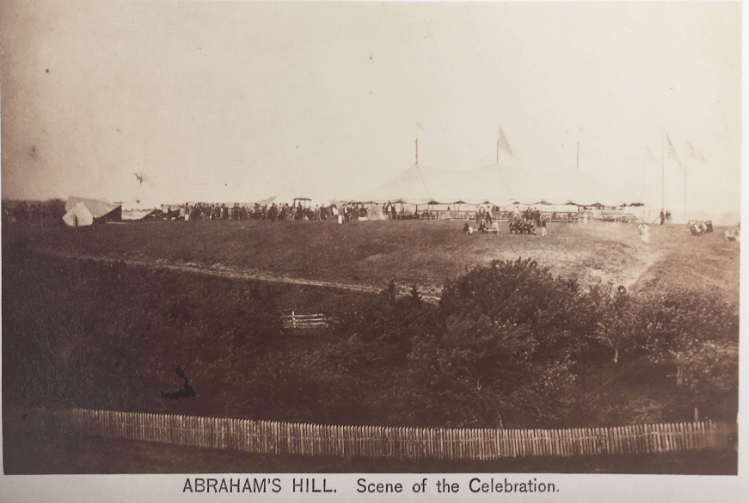
When the French cable landed on Duxbury beach there was a great celebration and we thought it would build up the town, but except for a few new families it went on about the same. Some of the young men connected with it coming from France and England married Duxbury girls and settled down in the town, becoming as much a part of it as the natives.
Scene of the celebration, from The Landing of the French Atlantic Cable, 1869
It was a custom in the summertime for the women to lie down after the midday dinner and have a nap. Every blind was closed in every house and the town looked deserted. The about four thirty or five o’clock the parlor blinds were thrown open and the town was awake and ready for visitors, as “calling” was very much in vogue.
It was on such a day that my fate rode into town. It was a hot July day and we lay stretched out on the bed, the music of the hammers in the shipyard lulling us quickly to sleep, when suddenly we were wakened by the sharp summons of “get up and dress quickly, for Fred Sampson has brought his friend, Mr. Wilkinson to see you.” “Oh, can’t you excuse us?” “No, they didn’t come to see me, and you girls must come down just as quickly as you can” and she was gone. We never thought of disobeying our mother, so we arose at once and much against our wishes went down when I met my fate – fortunately a happy one.
Bath rooms were unknown. Every house had its pump in the kitchen sink, or out of doors, and all the water had to be carried up stairs and down. Sewing machines had not been invented and there were no ready-made garments even in the city stores. Little girls were all taught to sew, and women were kept busy with socks and the children’s scarves and hoods, and had little time for gadding about. But I think there was much more family life than at the present time, more cozy evenings around the evening lamp and reading aloud, though there were no town libraries then. Sometimes we played old Maids, Everlasting, or Dr. Busby, checkers of backgammon. Later Euchre came in.
Then, as now, we had a Fair in August in the Academy Hall, which was planned and captained principally by Mrs. Daniel Winsor, who set us all at work, whether we would or no, and the result did her and all the ladies credit. One was for an organ for the Unitarian Church when they made $1000. And the very handsome and substantial cemetery fence was paid for in that way, the whole town being interested and working for that.
The dear old cemetery! So quiet and retired from the gaiety and bustle of the summer life; where so many of our dear ones lie, as they drop away one by one. And many who left the town even twenty-five or thirty years ago come back to lie in that quiet peaceful place, where only the wind among the pines and the song of birds break the stillness. It is a hallowed spot that we old timers all love.
In my girlhood days the Unitarian Church was well filled in the summer. In July and August the well-to-do people had relatives and friends come from Boston and other places to visit them for a few weeks, and then the town was wide awake and lively, boating, riding, picnicking and tea parties. As a grand wind-up of the season there was a Parish party to which young and old went and danced the round dances, cotillion, Hull’s Victory, Virginia Reel; such pretty, friendly parties; white-haired men and ladies in caps, young married people, engaged couples, and young men from Boston and other places who had heard of or met some of the Duxbury girls. That was on Friday night and Saturday was the big picnic to Brant Rock. There was but one house there then, an old-fashioned farm house not far from the rock. All sorts of vehicles were put in commission and young people and old went to that. We had clam and fish chowder, fried fish right out of the water, lobster, huckleberry pies and cake, and many other good things but we noticed the chowder was served in large white bowls very like the wash bowls upstairs! On Sunday the big church was full. After the service the vestibule was like a reception, people greeting and parting, as most of them left the next day, though a few stayed on to enjoy the warm, hazy days of early fall.
There were many peculiar people in town, real characters, about whom one might have written tales equal to some of Miss Wilkins’, funny but pathetic stories of country people. There was Mary Ann Alden, a direct descendant from John and Priscilla, who sat in a north ‘wing pew’ at church and during the long sermon of Mr. Moore, watched out for all the young people and visitors in town and made her peculiar and cutting remarks about them afterwards.
Lois Brewster, in one of the southing pews, made her observations also, and at one time when there were three new engagements in our set, hurried down the church steps and tapped me on the shoulder, saying “I like the looks of your young man best of them all.”
Bidley Soule a giant of a man in size, slouching and dirty, but with keen wit, who put the puzzling epitaph on his mother’s gravestone “The chisel can’t help her.”
In the winter we retuned the visits our relatives and friends and got our taste of life in the city and suburbs, our first acquaintance with theaters, opera, concerts, etc.
Once on coming home in the Spring we left Boston on the 6thor 8thof April just as it was beginning to snow. When we got to Kingston, only the mail carriage with one horse was there to meet the train as the storm was so bad. With some difficulty we got as far as Hall’s Corner, when the driver said he could take us no further as the drifts were so deep between there and the village, so we had to spend the night at Mr. Charles Soule’s at the corner.
Lyman and Emma Drew’s Boarding House at 152 Marshall Street.
The Point boys skated on a pond at the Eagle Tree, since called Wright’s pond. If any girls attempted it with their brothers’ skates they were called tom-boys. But they slid on the ice and went coasting on sleds. The sleighs went juggling about, and once in the winter, usually, a big sleigh-ride was gotten up to go to Cohasset or Hingham and have a supper. They went in a big boat – shaped sleigh that held about twenty people. They chose a moonlight night, danced after supper, and came home long after midnight, waking up people along the road with their singing and the jingling of the sleigh bells. There were no houses on what is now the Standish Shore, the last house being Mr. Marshall Soule’s later known as Mrs. Lyman Drew’s [152 Marshall St]. She took summer boarders and first attracted people to that part of town. Mr. Drew at one time had a dancing school in Masonic Hall. He played violin well and always played at the dances.
Mr. John Wilde had a singing school in Duxbury for years and in those days the young people of a neighborhood in the summer evenings collected on the doorsteps – there were no piazzas – and sang together the popular songs, all joining in heartily, being not so critical as now, though one or two were the acknowledged leaders.
As each set of young people grew up the summers were kept lively and enough people lived here the whole year to make some sociability in the winter time. It was in the seventies that the ladies of the Unitarian Society bought a building Brooks stable and express office, fitted the lower part for their sewing room with kitchen, etc., and made a hall with a fine floor for dancing upstairs. It was called Duxborough Hall.
They had a janitor and on Saturday nights gave ten cent parties which were very popular, informal and lively. For some time it was the only hall. The ladies enjoyed their meetings with a luncheon and did good work. But gradually they died or moved away until so few were left the meetings were given up. A larger hall, Mattakeesett, was built for dancing or movies on the lower floor. Finally Miss Hathaway generously bought Duxbury Hall and presented it to the Unitarian Society for their Parish House and in the winter months they hold services there.
What is now Mrs. Horace Soule’s house formerly stood down nearly on the shore, occupied by a Peterson family, and was called Hautboy Castle, though what gave it that name I don’t recall. Mr. Nathaniel Thayer of Boston, who came with his family one summer to board at the Howard’s discovered the sightliness of its present situation and had it moved there, remodeled, (piazzas, etc.) in the seventies and occupied it several summers. Then Mr. Train came with his family of lively young people, when tennis was introduced and raged here. The place is still in the Train family, being owned by the youngest daughter.
Duxbury is changed, perhaps, for the better. Now it has its yacht club, its tennis courts, and its golf links, its tea houses and gift-shops. The roads are good and automobiles fly hither and thither constantly. More and more the old houses are being bought and remodeled and new ones built with electric lights and every convenience.
The ship-builders and sea captains, the Westons, Frazars, Drews, Sampsons, Winsors, Soules, Winslows, Freemans, Thomases, have passed on. The town is full of new names. Monied men have come here and bought up land and houses, rents are raised so that people of moderate means, who remember the old time charm of its pure air and warm sea bathing, its restful quiet and informality, find it hard to get a place. Circumstances have taken me far from it. To revisit it now I should feel like Mr. John Porter who went away when he was a lad of nineteen and came back after twenty-five or thirty years of life in California. When someone asked him if he found many of his old friends and acquaintances he replied, with tears in his eyes, “I find most of them in the church yard.” Yes, the old town has changed, probably improved – but in recollection and association it will always be the dearest spot on earth to me. If the time ever comes when the earth sidewalks with grassy edges are replaced by asphalt with stone copings, I am thankful I shall not see it. It is the Old Duxbury I remember and love.
Berkley, California April 1921 Pauline Winsor Wilkinson
On May 17, 1843, Mary Cushman wrote her husband, Capt. David Cushman, “Mr. W is building a new house for Black Bill & Frank (by the way, Frank has got him a wife) it stands or rather it is going to stand back of the Widow Peterson’s.” The house Mary Cushman was referring to is the double house at 35 Pine Hill Lane.
35 Pine Hill Lane, Duxbury, MA. Built by Gershom B. Weston in 1843
“Mr. W” was Gershom Bradford Weston, easily one of the wealthiest men town. He was the son of Ezra “King Caesar” Weston, II and in 1843 was the co-owner of the Weston fleet of merchant vessels, along with his two brothers. Gershom’s estate was on St. George Street and included a grand house that would one day be known as the Wright Estate (torn down in the 1960s to make was for Duxbury High School). Weston employed a number of staff, including African Americans, Bill Sherburne (coach driver) and Frank Pride. It was for them that he built a house on his property. The house remained as part of the Weston and later, Wright, estates before being separated out in the mid-20th century.
Frank Pride, c. 1890
Frank Pride, Jr. (1818-1896) was born in Salem, MA, the son of Frank Pride, a sailor from Kingston, and Mary Munson of Salem. On April 2, 1843 he married his first wife, Ann Benson of Framingham – it is Ann that Mary Cushman is referring to in her letter. Although no death record has been found for her, she must have passed prior to 1849, when Frank married his second wife, an Irish immigrant named Bridget Galvin. Frank and Bridget later purchased their own cottage on Powder Point Ave. There is only one account that mentions the Pride’s interracial marriage, in a reminiscence of her childhood in Duxbury, Mary Chilton Steele wrote, “the strangeness of a marriage between a white woman and a colored man never seemed to have received comment or notice.” They had no children. Frank appears as a farmer or farm laborer on most census records.
William H. Sherburne (1814-1862) was born in Charlestown,MA. In 1843 he was already married to Hannah Fuller (1821-1845) and his second child was on the way. Hannah was another member of Duxbury’s black community- she was the daughter of David Fuller and Hannah Williams. Prior to her marriage she had worked for the Ford family, the owners of Ford’s Store, where she helped take care of their children. After William and Hannah married, they built their own home own home at 1112 Tremont Street, but sold that property in 1842. Sadly, Hannah died in 1845 of consumption at age 23, leaving William with two little daughters, Hannah and Ann. She is buried behind what was then the Methodist Church on Washington Street. Her epitaph reads, “my husband and my children dear, I now can leave without a tear.” William remarried in 1849, perhaps a cousin of his first wife, Mary Ann Williams, and had three more children.
A sad occurrence happened to the Sherburne family in 1856 (they may not longer have been living at 35 Pine Hill at the time). According to Ruth Ann Ford, “[Hannah] married William [Sherburne] the black coachman of Gershom B. Weston who lived not far away. She lived several years then died of consumption, like so many of her people, leaving two little children. It is sad to remember the dreadful fate of the little girl who was burned to death, having been left in the house with a fire by a step mother whom we feared was not kind to these children. This little Annie is sorrowful remembrance to me as I watched her lingering between life and death in her agony.”
The Boston Herald reported on Friday, Feb. 1, 1856, “On Monday night about 10 o’clock, Miss Sherburne, daughter of W. H. Sherburne, of Duxbury, after retiring for the night got up and went to the closet for some food, and while there accidentaly caught her night clothes on fire and was burnt so badly, that she died about six hours.”
It is quite possible that David Fuller (1788-1870), the father of the aforementioned Hannah Fuller Sherburne, also resided for a time at 35 Pine Hill. The 1850 Cenus Record shows him living next door to Gershom B. Weston, which would have been the right location for the house. David Fuller (1788-1870) was married to his third wife, Sylvia Prince, at that point. There is more to be said about Sylvia Prince in a future post.









 Drew Archival Library