The Civil War Homefront

Charlotte Bradford (1813-1890)

Carolyn Ravenscroft, Archivist
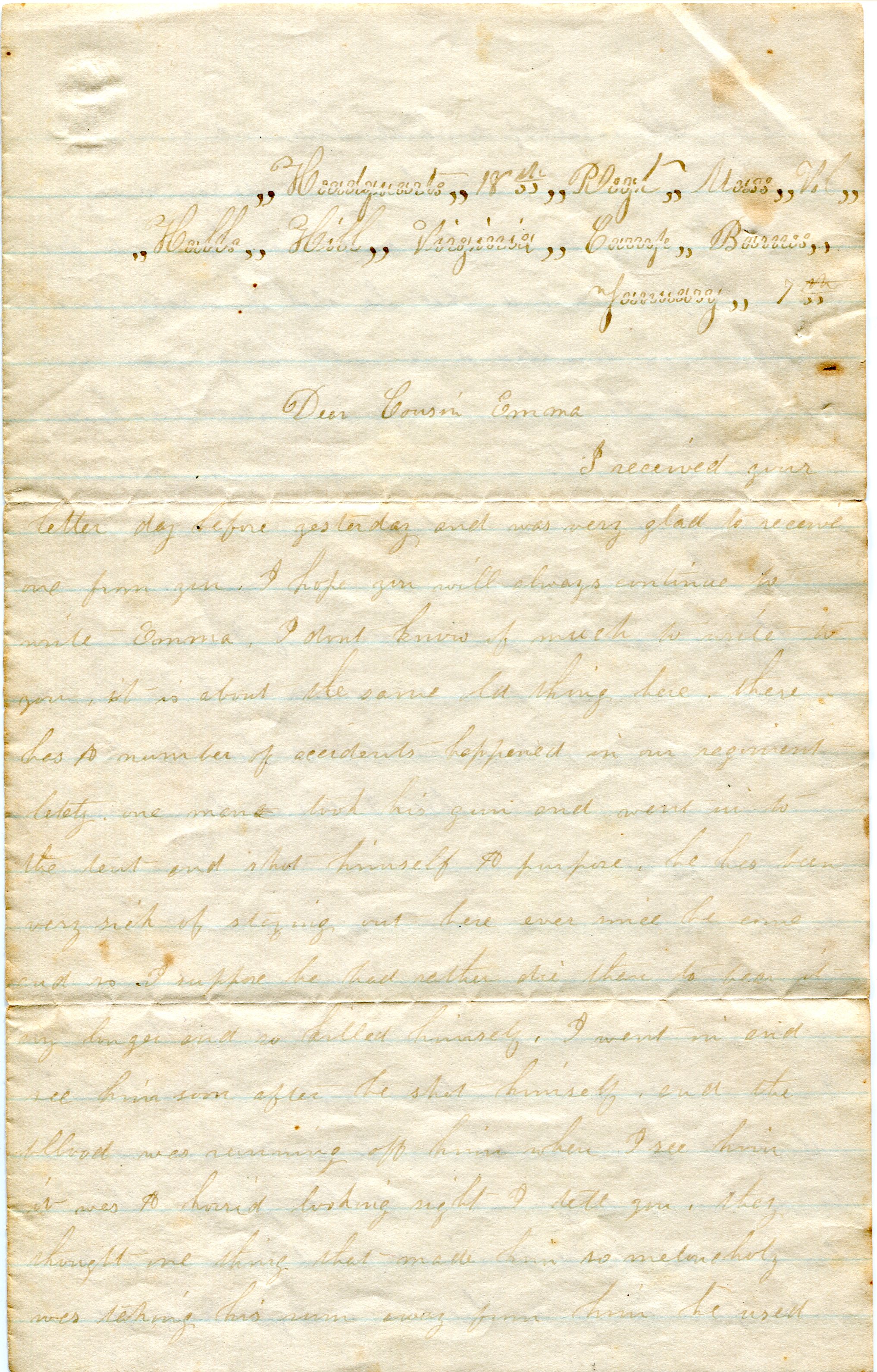
Although the battles during the Civil War raged in the South, the thoughts of every Northerner were never far from the front.  Any first-hand account of the war was eagerly repeated to family and friends through visits and correspondence.  During the late summer of 1861 Duxbury native Charlotte Bradford shared information she had gathered about the recent battle at Bull Run with her sister, Maria, then living in Yellow Springs, Ohio with her husband, Claudius.  Charlotte wrote her sister of Dr. Josiah Bartlett’s experience assisting the wounded (Bartlett was a doctor and the husband of the Bradford’s cousin Martha).  She also described the travails of a family friend, Frank Frothingham, who had fought in the battle with the 5th Massachusetts.  Interspersed with the gruesome details of the war, were more homely accounts of day to day activities in Duxbury, such as “working for the soldiers” in the Methodist Vestry and entertaining house guests.

In future blog entries we will learn more of Charlotte Bradford as she heads off for Washington, DC to begin her career as a Civil War nurse.  The following, however, is a letter written months before she considered leaving for the South.

Duxbury, Aug. 18, [1861]

Dear Maria,

I intended to have written you long before now but we have had so much company and so much to do, and I have been so tired, that I had no chance to do it.  The middle of July Lizzie Ripley and Sarah E[llison] came down.  Lizzie spent a week.  Her mother [Sarah Alden Ripley] was coming the next week, but I had a lame knee and had to put off their visit.  The most of that week and the next we went to the Methodist vestry to work for the soldiers.  The 1st of August E[lizabeth] and I went to Abington.  There was very fine speaking there, but the seats in the ground were so wet that we came home most awfully tired…Ezra Ripley[i] has gone to Fortress Monroe. He is lieutenant of one of the companies.  How unfortunate our troops should have been beaten twice.  I am afraid it will not be quite so easy for the North to conquer as they have boasted.  Josiah [Bartlett] took a trip to Washington and was present at the Bull Run fight and assisted in dressing the wounds at the hospital at Centreville.  Frank Frothingham[ii] is here.  He was in the battle in the Mass. 5th Regiment.  They had nothing to eat from Saturday night till Monday noon.  They marched 8 miles in the morning into the battle, then 45 miles or more Sunday night and Monday morning, arrived in Washington wet through in a drenching rain, and Monday night 45 of them slept in a kitchen with a brick floor and only 2 windows which had to be kept shut on account of their being so wet with no change of clothing.  It must have been dreadful. In the morning an acquaintance found Frank in a high fever and took him to a friend’s house where he was cared for.

Mother sends her love to you and Claudius and says she wants to see you very much.  Give my love to Claudius.

Your affectionate sister,

Charlotte

This article originally appeared on the Duxbury Rural and Historical Society’s Duxbury in the Civil War blog.


[i] Ezra Ripley was the son of the noted Transcendentalist and Bradford cousin, Sarah Alden Bradford Ripley. The Ripleys lived in the Old Manse in Concord, MA.  Ezra Ripley enlisted as a 1st Lieutenant on 24 July 1861 at the age of 35 in Company B, 29th Massachusetts Infantry.  He died of disease on July 28, 1863 in Vicksburg, MS.

[ii] Frank Frothingham was from Charlestown, MA. He enlisted, at the age of 23, in the 5th Massachusetts, Company K for 30 days from May 1, 1861 until July 31, 1861.  He then served with Company A, 33rd Infantry Regiment as a Lieutenant and with Company I, 3rd Massachusetts Calvalry as a Captain.  He was mustered out of the Army on June 5, 1865.

4th of July – 1850 Style

Letter from Eugene Sampson to Daniel Sampson, June 21, 1850

Carolyn Ravenscroft, Archivist

Apparently, “boys will be boys” even in 1850.

In preparation for a bang up 4th of July celebration in old Duxbury, a group of teenage boys were soliciting funds to purchase a keg of powder in Boston.  The plan was to ship the keg to Duxbury and  “make that cannon behind Swift’s Shop ring.”  The price of the keg and shipping was $3.00 and any contribution, no matter how small, was welcome.

The young man behind the scheme was Eugene Sampson (1833-1901), the nephew of one the wealthiest and most influential men in town, Hon. Seth Sprague.  In 1849, at the age of 16, Eugene left his home in Duxbury to board at 31 Somerset Street in Boston.  He was employed in the counting rooms of Sprague, Soule & Co (dealers in grindstones and plasters) located at No. 7  T Wharf.

Somerset Street, Boston in 1860 from Boston Public Library’s collection.

Eugene often wrote to his Duxbury cousin, Daniel Sampson (1832-1893), of his life in the city and inquire about friends at home – especially the girls. He also described all there was to see and do.  The California gold rush was on and Boston was bustling with young men (many from Duxbury) heading west.  Gene would typically get to bed at two o’clock in the morning and sleep until past breakfast.

Eventually, Eugene slowed down and became a much more respectable member of Boston society. In 1857 he married Martha Gilbert of Dorchester. The couple had five daughters.  Census records indicate he became the treasurer of a cotton mill.  His cousin, Daniel, became a ship’s captain and married Ada Gifford of Boston.

The Drew Archives have 5 entertaining letters from Gene, a.k.a “Stinking Pork” to his cousin, Daniel, a.k.a. “Fud.”  The following describes the 4th of July plans:

Boston, June 21st 1850

Fud,

We are trying to get money enough to buy a keg of Powder which will take $3.00 to pay freight and all.  Two of us have subscribed $1.75 and if you will contribute any where between 12 ½ cts and $1 it will be gratefully received, we will make that old cannon behind Swift’s shop ring.  If you think that you will contribute any thing, you can let me know by Monday’s mail and pay me when I go home.  Do not say any thing about it to anybody else.  Ichabod Sampson sent me $1 towards it but you must not let him know that I wrote to you or that you have heard any thing about it.  Be sure and answer Monday and not wait any longer because we must get all that we are going to before Thursday.  Now be sure and write Monday no matter how small you put in it will help us along, the larger the better.

 Nothing new to write,

Hot as the Devil here

 From your friend

Eugene

 If you know of any body else that would give anything why you may ask them, but I had rather you would say nothing about it.  Direct the letter to the care of Sprague Soule.

I would love to know what became of the keg of powder and the boys’ Fourth of July celebration.  I am certain it went off without a hitch…I mean really, what could possibly go wrong?

The Dower of Olive Wadsworth

On a spring day in 1822 young Olive Wadsworth married her distant cousin, Ahira Wadsworth, in Bristol, RI.  Both the bride and groom hailed from Duxbury so it is a bit of a mystery as to why they chose to marry out of state but perhaps Ahira, a merchant, had reason to be in that port.  Olive was 20 years younger than her new husband and must have felt a bit daunted at the prospect of entering his house, already the home of his  children by his first wife, Deborah Sprague, who had died nine years earlier.

The house to which she entered was a lovely two story Colonial located on Washington Street.  It was large and elegant with eight rooms and intricately carved woodwork.  The house was used for both living quarters and as a store.  Life must have been fine for Olive until five years into her marriage when Ahira went bankrupt.  The Wadsworth’s property was seized and sold off.  The house was sold to Capt. Martin Waterman and much of the adjoining land bought by Benjamin Holmes.

When Ahria died in 1867 Olive sued both the Watermans and the Holmes for her dower rights – something she claimed she did not relinquish to creditors in 1827.   An agreement was drawn up between Rufus, son of Benjamin Holmes, and the widowed Olive regarding the land:

The following are the bounds of the Dower of Olive Wadsworth in all the real estate of Rufus Holmes of Duxbury, as agreed upon by the parties Sept. 17th 1867.

To wit.  Begin at the NW corner of Andrew Stetson’s garden in George Partridge’s line; thence, in said line, N 75 1/2 W about forty rods to the corner, then S 12 W, as the fence now runs, Eleven rods & five links to a post & stake, then S 75 1/2 E to a stake by the said Stetson’s garden fence, then by said fence N 12 E eleven rods & five links to the first bound.  And said Holmes is to have a right to enter upon said Dower land to remove, for his own use, all the growing crops, now thereon, and shall furnish a convenient way to said Dower land, to said Olive, if he objects to her passing over his rye now growing on the same.

Ten years later, in 1877, Olive sold off the rights to her small holding to Rufus Holmes for the sum of $25.

Martin Waterman’s widow’s agreement was much more severe.  According to former Duxbury Town Historian, Dorothy Wentworth, “Lydia Waterman, widow of Martin, had to share her home of 40 years with Olive Wadsworth, widow of Ahira.”  The house was literally split in two by an imaginary line running down the center of the house.” The 1880 US Census confirms that Olive did indeed take up residence in the house.

Olive lived a long, and we hope somewhat happy life.  She and Ahira had six children: Harriet, Henry, Horace, Helen, Hamilton and Harrison.  She clearly liked the letter “H” (Ahira’s six children by his first wife have no such naming scheme).   Three of her children, unfortunately, died young.  In her widowed years she lived with her son, Hamilton, who was a shoemaker. She died in Boston in 1883, at the age of 85.

The above transcribed Dower description and the real estate deeds of the Holmes family were recently donated to the Drew Archival Library by Arthur Beane.

Charlotte Bradford vs. Louisa May Alcott

Charlotte Bradford (1813-1890)

Carolyn Ravenscroft, Archivist

During the Civil War Charlotte Bradford of Duxbury traveled to the South to become a nurse.  She worked for a time aboard the Transport Ships (“Floating Hospitals”) organized by the United States Sanitary Commission and later worked in Washington, D.C. area hospitals under Dorothea Dix.  During her tenure as a nurse she kept a daily journal and wrote numerous letters home.

One of her most interesting letters is to the Editors of The Commonwealth (c. 1863), a Massachusetts newspaper.  In it she describes her feelings toward Louisa May Alcott’s recently published serial, “Hospital Sketches.”  Charlotte was none too pleased with Alcott’s description of life in a Union Hospital.

What is particularly interesting about this critique is the fact that Charlotte most probably knew Miss Alcott, or at least of her.  One of Charlotte’s cousins was the Transcendentalist, George Partridge Bradford, who was a great friend of Broson Alcott.  Her other cousin was Sarah Alden Bradford Ripley, the owner of the Old Manse in Concord and Alcott neighbor.  Perhaps Charlotte did not know that Tribulation Periwinkle, Louisa’s pseudonym in Hospital Sketches, was actually Alcott.

The copy of the letter in the Drew Archival Library is incomplete.  There is at least one page missing.  I have not verified if the letter was actually sent or whether the Editor’s chose to publish it.  Charlotte’s description her hospital work, soldiers and diet is a bit different from what we read in her diary.  Although she claims to have a good appetite in her letter, it was, in fact, not very good.  She was a vegetarian and dispised the Army rations she was forced to eat.  She also came up against surgeons on more than one occassion and was dismissed from the Armory Square Hospital for insubordination.  Her time in Washington was difficult and often times far from the rosy description she gives to the Editors. Despite her own tribulations, however, Charlotte obviously did not like anyone anyone speaking ill of the conditions publicly.

The following is Charlotte’s copy or rough draft of her letter to The Commonwealth.

Mr. Editor,

Your paper of the 19th was handed me today and it is so seldom that I see one from Mass. that I greeted it as a friend from home.  “Hospital Sketches” on the first page caught my eye, but I read it with no little pain and was tempted to give you a sum of my own experiences, it has been so different from the feeling expressed there.  I have been a nurse in hospitals in and near Washington for nearly a year and have heard much said about self denial and sacrifice, but I have had no sympathy with that at all.  My motives for coming and here were not, I am sorry to say, of the self denying sort.  I had no great idea of the good that I could do for I have no doubt there is many a woman at the North who would be glad of the privildge of coming who could do more and better than I can.  I came simply from the love of taking care of the sick and my interest in the war and so perhaps was better prepared to offer [?].  I must say that I cannot recall a year of my life that I have passed more pleasantly.  It is not, I think, that I have ben favored in the choice of hospitals for I have served in six different ones, including some of the worst as well as the best.  I have eaten off tin plates nothing but army rations and sometimes without a knife or fork but what of that?  I fared the same as the soldier and preferred that to partaking of the nicer victuals from the surgeon’s and stewards tables.  But I am blessed with a good appetite and it was rather and amusement and difficult to realize that I was sitting in the cellar of the Capital eating off an unwashed table or eating in this primitive style in its magnificent rooms above stairs.  Let no one criticize even that hospital too severely.  It was a temporary one in a building entirely unsuited to the purpose excepting in its fine and spacious rooms for the beds, but when it comes to perparing food for 1000 men best no one find fault untill he has been behind the scenes and seen what it invovles.  A hospital is a vast machine that requires a great many springs to be put in motion before it works evenly and smoothly.  In Armory Square Hospital which Miss seems to consider a model I have not a year since had the better part of many a meal from not going a the first sound of the bugle. I have eaten after the surgeons as well as before an found how essential it was to my comfort that they should be punctual at their meals.  A word in regard to the bread.  I know that the aeratated bread is used somewhat and that, when a day or two old is certainly much like sawdust but the army bread that we get in Washington is certainly excellent and superior to most homemade bread.  But what are such petty annoyances to one who has the priviledge of going into a ward in the morning and meeting the smile of welcome that greets her.  I have always heard it said that men did not know how to be sick, had no patience, but I was soon convinced of the fallacy of that doctrine.  I never saw such patience and fortitude as shown by our soldiers indeed the cheerfulness and even fine spirits of the soldier is almost proverbial.  I have in my mind’s eye a young man who had lost altogether the use of his lower limbs, could not even sit up in bed, but as he lay on his back or leaned on his elbow, his face was radiant with smiles.  I at first thought he must have heard some pleasant news.  I shall never see him again but if ever I am sick and inclined to be impatient I believe that face will be a lesson to me.  Then how pleasant to go round with the dressing tray and as one after another receives the refreshment of clean water and bandage to watch from day to day the gradual healing of the wound and listen to their kindly, pleasant talk for they are all your friends.  The sorrow is  that of the hundreds that I have watched and tended I shall probably never see ten again but I have met some curious instances showing that the smallest act of kindess is appreciated.  A young man came one day and spoke to me whom I did not recognize “you may perhaps remember” said he “I am the one whom you gave 2 soda crackers one day ’cause I could not eat my dinner.”  And let me say that though I do not doubt there is a great profanity in the Army yet in hospital I have rarely, except in delirium, heard a soldier utter an oath and in these few instances it was always followed by “I beg your pardon I did not know you were there” showing the respect of our people for women.  I must not forget the pleasant though sadder task of administering to the wants of the sick.  To bathe the aching head and moisten the fevered lips or even to speak a kind word are trifles but they are a solace to the weary, worn out soldier.  I have seen the tears glisten in more than on manly eye…

Charlotte Bradford’s diaries and letters are part of the Bradford Family Collection.  She lived her entire life, other than her three years in Washington, DC, in her family’s home on Tremont Street (The Gershom Bradord House).

Duxbury & The Old Manse

The Old Manse

Carolyn Ravenscroft, Archivist

Today I was fortunate enough to spend the day in Concord touring some of my favorite places – The Old Manse, Orchard House and Sleepy Hollow Cemetery.  For those of you who don’t know, Duxbury has a strong connection to Concord and the Transcendentalists.  Sarah Alden Bradford Ripley, the one-time owner and resident of the Old Manse (and landlord of Nathaniel Hawthorne) was the daughter of Gamaliel Bradford and niece of Gershom Bradford.  Gamaiel and Gershom were married to sisters (Elizabeth and Sarah Hickling) making their children 1st cousins twice over.  Our Bradford Family Collection contains correspondence between these cousins.

Gamaliel Bradford built the beautiful yellow federal-style home on Tremont Street and his brother, Gershom, built his more modest home directly across the street (the Gershom Bradford House is currently owned by the Duxbury Rural and Historical Society).  As a girl, Sarah Alden Bradford Ripley lived right here in Duxbury. When Gamaliel and his family moved to Boston, the cousins continued to visit each other throughout their lives.

If you have never been to the Old Manse, it is certainly worth the trip.  I would also urge you to visit the Gershom Bradford House to see another chapter in this amazing woman’s life.