
By Carolyn Ravenscroft
This article first appeared in the Lamplighter, Fall 2022
In 1848, gold was discovered in California, and the country’s first Gold Rush was on. Thousands of people, both male and female, were infected with gold fever. Most hoped to strike it rich by mining, but some, more prudent, eyed the prospect of provisioning the prospectors. The booming city of San Francisco also needed laborers of all types to keep pace with its rapid expansion. The movement of so many citizens to the Pacific Coast tipped California into statehood in 1850.
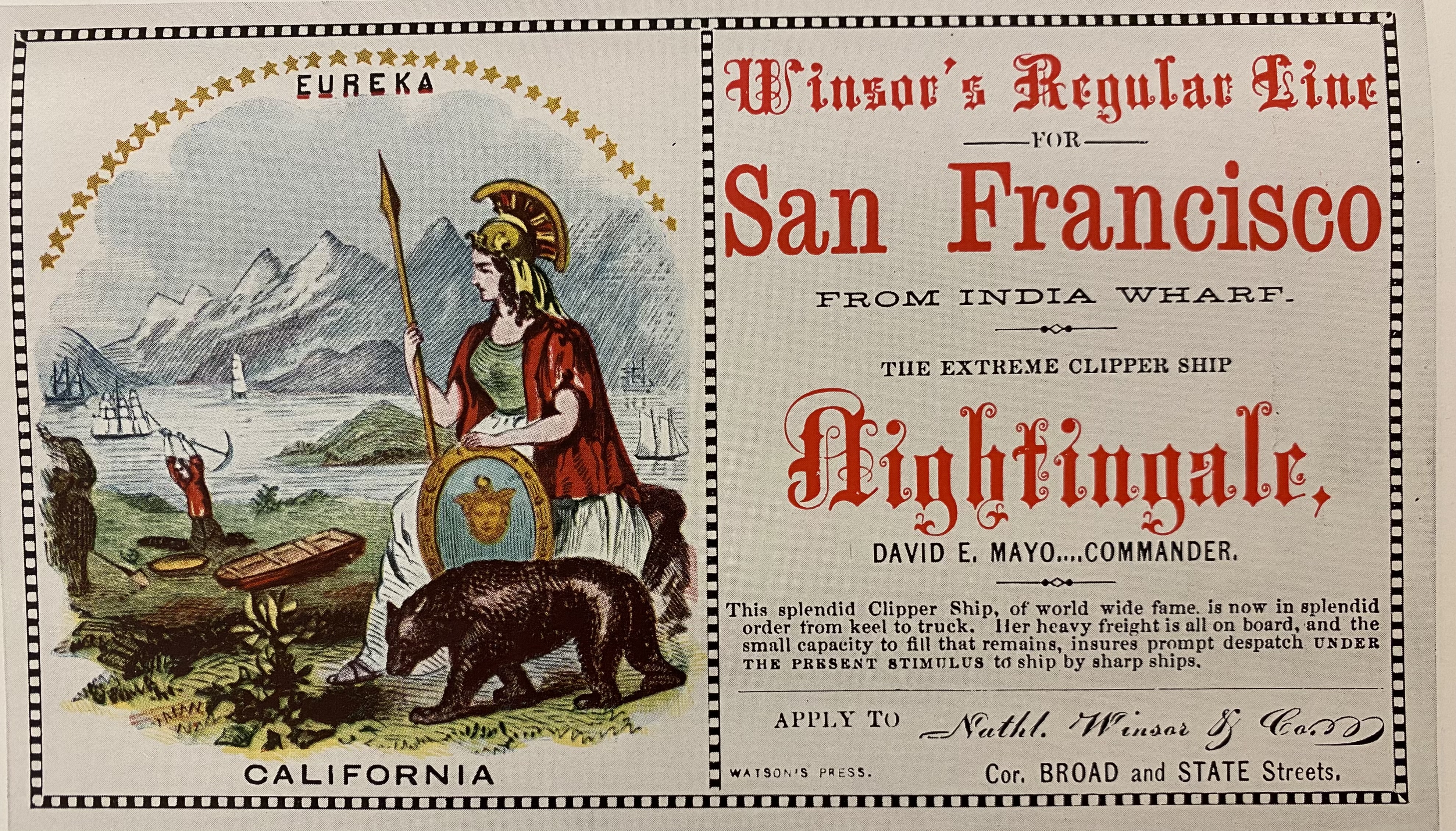
The “Forty-Niners” bought passage aboard ships bound for San Francisco individually or formed ad-hoc mining companies and leased entire vessels. The race to get to California energized the shipbuilding industry in Boston and New York as larger and faster clipper ships competed for speed records. The clippers of the Winsor Regular Line of Boston, owned by Duxburyite Nathaniel Winsor III, made numerous trips around Cape Horn with passengers. They, as well as other lines, often sailed with Duxbury captains and/or crew members.
Between 1849 and 1853, more than fifty Duxbury men (and a few women) set out for California. A young clerk, Eugene Sampson, wrote from Boston in Sept. 1849, “I see lots of Duxbury folks up here every day bound for California & should think by the appearance of things that one half of Duxbury was going.” [1] For those struggling in the town’s post-shipbuilding economy, the hope of finding gold was very tantalizing. Almost none struck it rich, at least not in the mines. Most returned East after a frustrating few years away from home. A quarter of those that went remained and became the first white settlers in communities all along the Pacific coast. For example, Alexander Sampson and Rufus Holmes were founders of Port Angeles, WA. Sadly, four of Duxbury’s Forty-Niners died, and one disappeared.
Barzillai Peterson of West Street was the only Duxbury man to return East with significant wealth. He found gold on the North Fork of the American River and then parlayed that winning into a successful freighting business between Sacramento and Shasta, CA. When he returned in 1852, he was rich enough to purchase Daniel Webster’s former estate in Marshfield. The lure of the West was too great, however, and Barzillai ended his days on his 380-acre farm in Sonoma County, CA.
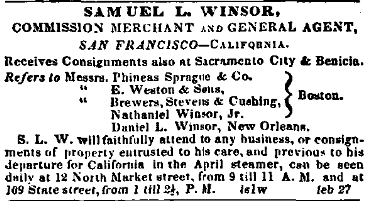
The Duxbury Rural & Historical Society’s headquarters at 479 Washington Street, built by Nathaniel and Hannah Winsor in 1807, has multiple connections to the Gold Rush through four of the Winsor sons. The aforementioned Nathaniel Winsor III was raised in the house, he later owned it and summered there once he moved to Boston. Another son, Capt. Charles F. Winsor sailed for the Winsor line and eventually retired to California, where he became the keeper of the East Brother Light in Richmond, CA. Son Samuel L. Winsor sailed to San Francisco in 1850 aboard the Cherokee and opened a store with his Duxbury friend, John S. Loring, provisioning miners. Before leaving Boston, he advertised his ability to take on consignments of cargo heading west. Finally, the youngest son, Henry Winsor, headed to San Fran aboard the Winsor ship Constantine, captained by Charles F. Winsor. He is rumored to have struck it rich in the mines, only to mysteriously disappear on his voyage home.
Duxbury Men (and 2 women) in the California Gold Rush:
- Alden, Samuel Briggs
- Baker, Lysander
- Bartlett, Henry
- Alden Howard
- Bradford, Daniel
- Cummings, Hiram
- Cushing, Nathaniel
- Cushing, Nathaniel E.
- Cushman, Henry
- Dawes, Josephus
- Delano, Winslow T
- Doane, Sylvia T
- Drew, George W
- Drew, Caroline P. Reed
- Faunce, Charles E.
- Faunce, John
- Frazar, Thomas
- Holmes, Ellis
- Holmes, Rufus B
- Hunt, Edward Gray
- Jones, Parker 1849
- Josselyn, Albert
- Lee, Henry
- Loring, John S
- Peterson, Barzillai
- Porter, George
- Porter, John T
- Ripely, Samuel E
- Roland, Henry C.
- Sampson, Alexander
- Sampson, Alfred
- Sampson, Erastus Jr
- Sampson, George F
- Sampson W [possibly Walter H]
- Soule, Enoch
- Soule, Henry
- Soule, Otis
- Southworth, Capt. Winsor
- Southworth, James A
- Wadsworth, Dura
- Wadsworth, Henry
- Weston, George C
- Weston, John
- Winslow. Roland C.
- Winsor, Charles Frederick
- Winsor, Eden
- Winsor, George Hepburn
- Winsor, Henry
- Winsor, Henry O
- Winsor, Hiram G.
- Winsor, Samuel L
- Winsor, Walter E
- Winsor, William W.
- Wadsworth, Eden
[1] Cushman Family Collection, DAL.MSS.033
 Drew Archival Library
Great article Carolyn! What do you think happened to Charles Winsor on his way back to Duxbury? Ship wreck?
Ashley
>
According to his great-niece, he disembarked in the West Indies and was murdered, his money stolen. Now, how she would have known this is the greatest mystery. There is no evidence he found gold or was murdered.