
PHOTO GALLERY/VIDEO: Duxbury Rural and Historical Society leads tour of Mayflower Cemetery.
Author: drewarchives
First Hand Account of USSC’s Role at Gettysburg

Frederick Newman Knapp (1821-1889)
Carolyn Ravenscroft, Archivist
The Drew Archives is very fortunate to house the large Bradford Family Collection – a collection that, I may have mentioned once or twice before, contains thousands of items and spans over two hundred years. A goodly portion of this collection relates to the Civil War – a number of the family fought or were involved in some way, including, of course, the army nurse and diarist, Charlotte Bradford. The collection also contains letters from another key Civil War figure – Frederick Newman Knapp, the Special Relief administrator for the USSC in Washington, DC. Knapp was not only Charlotte’s boss while she was a Transport Ship nurse and the matron of the Sanitary Commission’s Home for Soldiers, he was also her niece’s husband. We are lucky to have his papers here, especially those that directly relate to his work in the USSC.
The following is a letter by Knapp in Frederick City, MD to his parents in Walpole, NH, written almost two weeks after the Battle of Gettysburg. Knapp was in charge of seeing supplies made their way to the battlefield and ensuring that the army had what it need to care for the wounded. It is remarkable in its detail as Knapp recounts the confusion in orchestrating such a large-scale relief effort. For any scholar of the Sanitary Commission, this letter sheds light on a little discussed aspect of the USSC’s overall operations and certainly brings to life one of its most faithful servants. As the transcriber of this letter, however, I have to say that Knapp’s writing is challenging. He has perhaps the worst penmanship of any of the 19th century figures in the Drew Archives. He was an educator for most of his life but obviously was not concerned with having a “good hand.” If you would like to know more about his life, a recent article in Historical Digressions gives a nice overview.
Frederick City, July 16, 1863

Portion of letter written by Knapp to his parents on Sanitary Commission letterhead. Annotations in pen were made by Knapp’s nephew, Gershom Bradford.
Dear Father and Mother,
All well. This has been a busy week with me or a busy ten days. Nothing like it since the York River work when we had to fit out Hospital Transports at a days notice. The work has been to get supplies of all sorts with least possible delay to Gettysburg, all then to Frederick: at Gettysburg to meet terrible needs: at Frederick to be prepared for what might be even greater needs in case of a battle which might come off at any moment at Hagerstown or in the region of which Frederick would be the safe base of supply. In getting stores and Relief Agents to Gettysburg we had to meet the difficulty of getting a blocked Rail Road – single track with cars by hundreds loaded with wounded in the one direction and supplies for 20,000 men in the other – so that we not merely had to meet immediate needs but keep a supply, if possible, of two days ahead. The result has been most gratifying & successful, and repaid all labor two hundred fold. “Special Orders” & special messengers and teams by turnpike – and supercargoes and constant personal presence at points of shipping goods have secured results which I felt at first could not be made. Not a train left Baltimore for Gettysburg for some days that did not take from 25 to 300 cars of our supplies – estimate only by tons – a number of entire carloads direct from Philadelphia or Boston transferred from Phila Road to the Northern Central Road (thence by branch road to Gettysburg) but most of the supplies carted from across Baltimore to Central R.R. Depot – 100 or 200 tons at a time. Then beside the general supplies there were the answering the requirements of Special demands by telegram & letter from Dr. Douglas at Gettysburg – such as “send me 1000 loaves of bread – 40 barrels fresh crackers – ten relief agents, six carpenters, six cooks – 100 yds oil silk –and entire outfit for first class Relief Station – including tents, stoves, supplies, etc. – all by first train up from Baltimore if possible.” We have every day for a week sent to Gettysburg (and one time 2 loads daily) an “arctic car” load of fresh supplies ½ ton each of poultry, mutton, butter, fresh vegetables, etc, etc. Some days two (2) car loads – until at last a telegram from Gettysburg cried “hold, enough” (except the arctic supplies). Meantime horses and wagons & saddle horses & harnesses, etc. etc. had to be selected & bought & drivers & wagon-masters selected and bought and started off (in last week I bought & fitted out the nine wagons & 18 wagon horses & five saddle horses). Then came the necessity to send goods to Frederick in anticipation of a great battle in this region – Mr. Olmsted went to Frederick and immediately telegraphed “push on supplies with all possible dispatch by every means in your possession.” So new telegrams to Philadelphia & N. York & Boston had to be sent telling what we wanted via one car load a day for each place besides express loads. These supplies arriving had to be carted over to the Frederick Station, loaded – disentangled from [?] stores and got through – all the material for first class Relief Station including tents, etc. etc. cooks & men got & sent – with wagons & horses, etc. Meantime bills had to be paid and all the agents at work kept straight…Since Monday week we have received there at Baltimore between 80 & 90 telegrams all to be attended to and I have made purchases of horses, wagons & supplies in sums from one dollar to 500 amounting in total to $18,000 – and kept it all straight. So you can see why I haven’t written you any long letters – and though it has involved so much work I can assure you I have enjoyed it greatly and was never better in my life…Josiah Bellows is recovering at the cars which bring the wounded from Gettysburg to Baltimore – a wagon & two [unreadable] & 3 or 4 others in each train to give the water & care for them. We also take all these cars at Baltimore and purge them & put fresh straw, etc. & water & ice & crackers, etc. This we do by special request of Major [unreadable] staff in charge of transporting the wounded. I bought fifty water coolers (for ice) in one day for the cars.
Must close – I have gone over this to show you the Comm are at work – the Relief they have given at Gettysburg is immense…
Your affectionate son, F.N. Knapp
New Acquisition of Rev. John Allyn’s Sermons
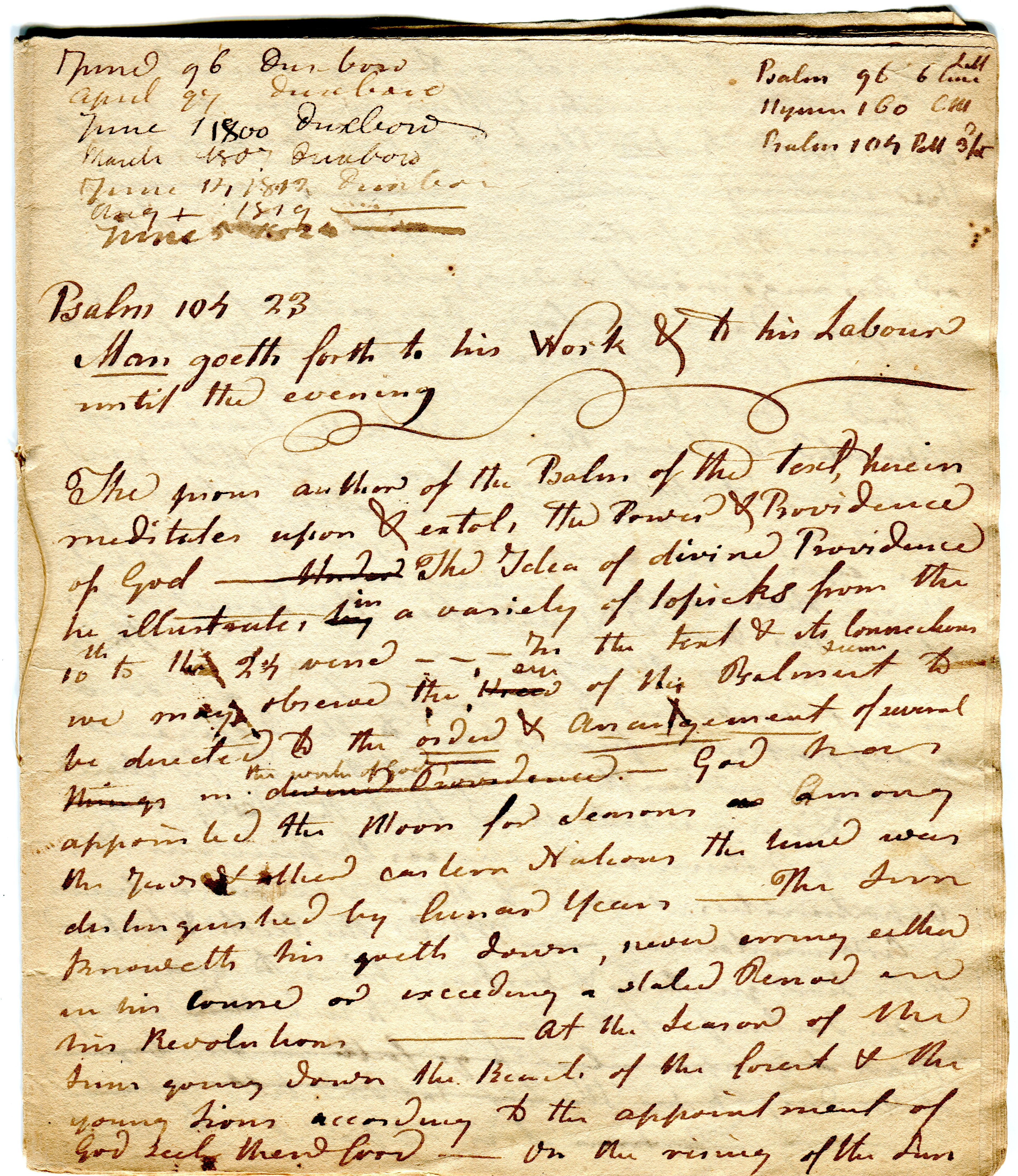
Sermon of Rev. John Allyn, delivered April 1796 in Duxbury.
Carolyn Ravenscroft, Archivist
In a town as old as Duxbury, there are many men and women who can claim a prominent place in its history. Founders such as John and Priscilla Alden; shipbuilders Ezra “King Caesar” Weston I and II; master mariner and author Amasa Delano; and stage actress Fanny Davenport, are only a few names that come to mind. However, all towns have their less heralded, though equally significant, citizens and Duxbury is no exception. Rev. John Allyn (pronounced Alline) falls into this second category. Rev. Allyn was the minister of the First Parish Church for 45 years, from 1788-1833. While the majority of his tenure was peaceful, Allyn was part of a controversy at the end of his career that divided the town and had repercussions for decades after his death. Recently the Drew Archival Library received a gift of over fifty of the Rev. Allyn’s sermons from his descendants, Faith Stimson and Emily Sugg. These sermons will help to illuminate the life of a man who was such an integral part of the community during the early 19th century.
Rev. Allyn was born in Barnstable, MA in 1767 and educated at Harvard College, earning his A.B. in 1785. He received his A.M. in 1788, the same year he was ordained as Duxbury’s minister. Three years later he married Abigail Bradford. The couple settled into a lovely home at 1043 Tremont Street, an easy stroll to the First Parish Church. The church to which Rev. Allyn would have walked was not the large Greek Revival structure we see today, but a smaller, squarer building painted a light yellow. This meeting house, built in 1787, only a year before Allyn’s arrival, was more in keeping with the limited means of the post-Revolutionary Duxbury, a town that had yet to reach its shipbuilding zenith. In addition to his ministerial duties, Allyn ran a school from his home.
The contemporary accounts we have all indicate that Rev. Allyn was kind and a bit eccentric. It is not hard to imagine him as the disheveled benevolent scholar. According to his son-in-law, Rev. Convers Francis, Allyn possessed a peculiar imagination and often avoided the “beaten track of thought.” During conversation he loved to “throw his thoughts out in a desultory and startling manner.”[1] Unfortunately, this often led to him being misconstrued. He could also be rather unorthodox in his methods, once dressing as a ghost to scare a family, who had disavowed the existence God, back into believing.[2] The pupils boarding at his school called him uncle and recalled many happy times in Duxbury under his tutelage. They received discipline only from his daughter, Abigail, never from Allyn himself. Perhaps the most famous of his students was a young Abigail May, the mother of Louisa May Alcott.[3]
Despite years of faithful service, Rev. Allyn’s tenure as minister in Duxbury had a final, dark chapter. Allyn was afflicted with a premature ageing of both is his mind and body. I am sure a modern-day physician could find a diagnosis based on contemporary evidence, but for the sake of this article, it is enough to say that he found himself incapacitated during much of his later years. In 1825 Allyn asked that the congregation hire a co-minister to assist him in his duties. This would allow him to live out his waning years in the community he loved and continue to preach to his flock at least part of the time. However, it would also force the congregation to pay two salaries. Had his request come a decade earlier, perhaps there would have been no discussion on the matter but a number of changes had occurred that left the First Parish Church and the town divided over this request.
The Second Great Awakening that had been sweeping the country had caused some to leave the Unitarian pews of the First Parish Church for the newly formed Methodist and Universalist churches that had been built Washington Street. The number who left included some of wealthiest men in Duxbury at the time including Hon. Seth Sprague. This exodus coincided with disestablishment of the Churches of the Standing Order.[4] Prior to the disestablishment everyone had to pay a tax to support the sanctioned town church whether you were a member or not. After the disestablishment, men like Sprague were no longer beholden to help fund the First Parish Church, resulting in a loss of revenue. With enough money to spare, a second minster may have incited little comment. A tighter budget, however, caused many within the church, including a young fledgling politician named Gershom Bradford Weston, to demand the resignation of Allyn and the hiring of a new full-time minister.

Monument erected in 1861 to the memory of Rev. John Allyn in Mayflower Cemetery, Duxbury, MA.
What came to pass is not a pretty commentary. Because Allyn was still so beloved by many the congregation, a co-minister, Rev. Benjamin Kent, was hired to assist him. Kent moved with his young family into a house built for them at 992 Tremont Street. But, for the next seven years both Kent and Allyn constantly battled with the faction within the First Parish Church that disagreed with supporting two salaries. Of the conflict, Sarah Bradford, who was related to Kent and therefore not unbiased, wrote to her daughter, “we are all in trouble, the Parish won’t pay two and we fear Mr. Kent will leave us, every one is for Mr. K but Dr. A won’t quit. I don’t know what we shall do…the Parish is in a sad state…”[5] The fight took a toll on both ministers. By 1833 Kent had been carted off to an insane asylum and Allyn was dead.[6] Years later, during another controversy within the First Parish Church, Kent wrote a letter from his Roxbury home declaring that Gershom Bradford Weston was the cause of his temporary insanity and Allyn’s death.[7]
Rev. Allyn was buried in the tomb of another prominent Duxbury leader, Hon. George Partridge. Hiswife and daughter were forced to sell their home and move from town. In 1861 those who recalled him fondly raised a monument to their former minister and teacher in the Mayflower Cemetery which reads:
To the Memory of John Allyn, D.D.
Who was for 45 years the learned
able, and honored minister of the
Congregational Society in
Duxbury. Born at Barnstable Mass
March 21, 1767 Died at Duxbury
July 19, 1833
In a succeeding generation some
of those who in early life shared
his kindness, profited by his
counsels and were impressed by
his truthfulness testify their
gratitude and reverence by this
Memorial stone.
[1] Convers Francis, Memoir of Rev. John Allyn of Duxbury. See also, Justin Winsor, History of Duxbury (Crosby & Nichols: Boston, MA), 1849 p. 209
[2] “A Ghostly Visit” in Duxbury Budget (Duxbury Rural Society: Duxubry, MA), 1900, p. 20.
[3] Edmund Burke Willson, Memorial of John Clarke Lee (Salem Press; Salem, MA) 1879, p. 10 and Eve LaPlante, Marmee & Louisa: The Untold Story of Louisa May Alcott and Her Mother (Free Press: New York), 2012, p. 26.
[4] Massachusetts broke the ties between church and state with the disestablishment of the Standing Order in 1833. However, individual parishes ended the relationship earlier, Duxbury did so in 1828.
[5] Letter from Sarah Bradford to Maria W. Bradford, April 21 [1833], Bradford Family Collection, Drew Archival Library. Maria W. Bradford’s husband, Claudius Bradford, was Benjamin Kent’s brother-in-law.
[6] Letter from Sarah Bradford to Lucia A. Bradford, May 5, 1833 in Bradford Family Collection, Drew Archival Library, “Mr. Kent has been in the insane hospital now nine days, his insanity came on by degrees until one day before he was carried to the hospital when he was perfectly crazy.”
[7] Letter from Benjamin Kent in Reply of a Committee of the First Parish in Duxbury, Massachusetts to the Public Answer of Hon. Gershom Weston, (Boston: C.C.P. Moody), 1851, p. 41. Kent also contended that there was no shortage of funds during his ministry to pay two salaries.
The Day the Cable Came to Town

Cable House with trench dug for cable still visible. Telegrapher George Green is just visible under the trees in the front of the house. He marked his upper bedroom window with a black dot.
Carolyn Ravenscroft
Many of you are no doubt are familiar with the Landing of the French Atlantic Cable in Duxbury in 1869, but for those of you who have never heard the tale, gather ‘round…
Once upon a time, before smart phones and email, before telecommunications, before even Marconi’s wireless, there was only one way to communicate immediately to those far, far away – cable telegraph lines. You may not be surprised to learn that Samuel Morse, of “Morse Code” fame developed and patented the first electric telegraph machine in the US in 1837. But, interestingly, the code for transmitting messages could just have easily been called the “Vail Code” since Morse’s assistant, Alfred Vail, was responsible for it, but such is life when you’re not the boss. By 1861 almost every point in the United States, from California to New York, was connected via wire. So long Pony Express, hello telegram.
As amazing as connecting the vast North American continent by wire was, there was still a more daunting feat to be accomplished, a transatlantic cable. With a Victorian can-do attitude and an initial $1.5 million in capital, businessman Cyrus F. Field, along a group of backers, set out to make the world a bit smaller. It took five attempts and over ten years before the ship, Great Eastern (read more about the ship), successfully laid a 2,000 mile-long cable across the ocean floor from Ireland, bringing it ashore in Newfoundland in 1866.
Once Great Britain and North America were connected, the French sought to have their own exclusive means of transatlantic communication. As with the Anglo line, the French Atlantic Telegraphic Company used the now tried and true Great Eastern. The French cable was approximately 3,500 miles long – beginning in Brest, France it would travel to the “southern edge of the ‘Grand Banks’; thence to the French island of St. Pierre off the south coast of Newfoundland and thence down past Cape Breton Island and Nova Scotia to Duxbury.”[1] On June 21, 1869 the Great Eastern, accompanied by the ships Chiltern and Scanderia set out on their voyage. Just over a month later, on July 23, 1869 the cable was landed on Duxbury Beach at Rouse’s Hummock.
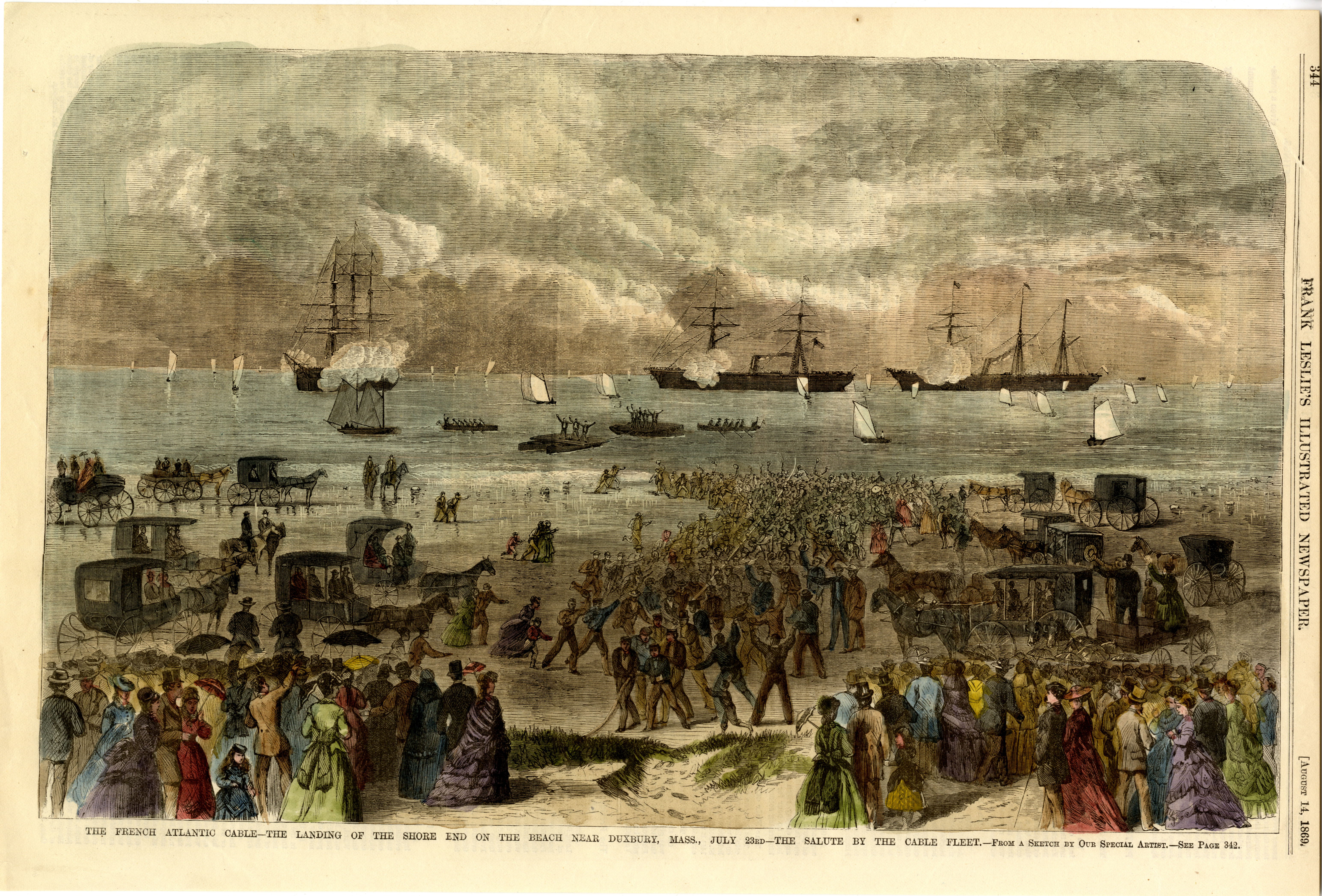
Landing of the Cable from Frank Leslie’s Illustrated
It was a time of great celebration in Duxbury. A tent was erected on Abrams Hill with a view of the Hummock. Six hundred guests, including dignitaries from around the state, nation and world converged to wine, dine, listen to speeches and most importantly, to see first hand the wonder of sending and receiving messages from across the sea. Included in the festivities were Mayor N. B. Shurtleff of Boston and President of the Massachusetts Sentate, George O. Brastow.[2] Cannons of the Second Massachusetts Light Battery were fired, streamers and flags flew and for a moment the eyes of the world were on this sleepy seaside town.
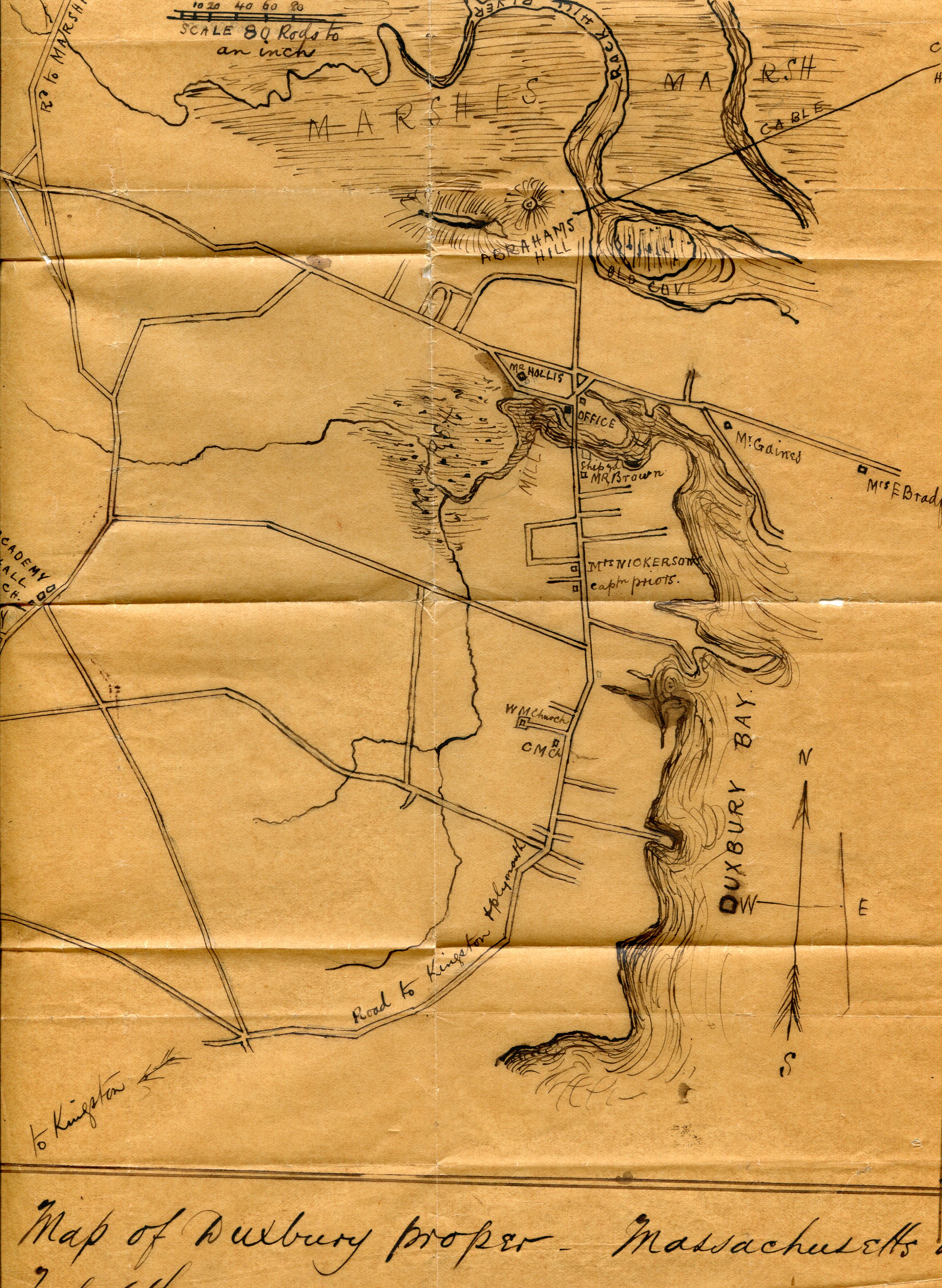
Map showing the cable route into Duxbury, drawn by telegraph operator George Green, 1869.
The eventual terminus for the cable was the former Duxbury Bank building on the corner of Washington and St. George Streets. As you can imagine, the early years of the cable office were quite busy and required trained operators, many of whom, like Englishmen Robert Needham and George Green, immigrated to Duxbury along with the cable. Later, Canadian William Facey, the amateur photographer responsible for one of our most-used photo collections, came to work here. These men became some of Duxbury’s most civic-minded residents. After a few years the French Atlantic Cable Company was brought under the fold of the Anglo-American Telegraph Company and later, in 1911, became Western Union. Over the years other transatlantic cables took away Duxbury’s prominence and business waned. Duxbury’s cable house closed after WWII.
Today the stately home on the Blue Fish River that once housed the cable office is a private residence. It is still alternately called the “Bank Building” or the “Cable Office” by folks in town…okay, that’s probably not true, it’s called that by a handful of people, including me, but nobody knows what I’m talking about when I say it. Now you do.
If you would like to learn more about the French Atlantic Cable, you can visit the Drew Archives and view the Robert Needham Collection (DAL.MSS.043), the French Atlantic Cable Collection (DAL.MSS.044), read telegrapher George Green’s own copy of Landing of French Atlantic Cable with his notes, or see the images in the William Facey Collection online at http://www.flickr.com/photos/drewarchives/sets/72157626060922690/
[1] Franklin K. Hoyt, The French Atlantic Cable 1869, Duxbury Rural & Historical Society, 1982. p. 8
[2] The Landing of the French Atlantic Cable, Boston, Alfred Mudge & Son, 1869.
How Myles Standish Lost His Head

The Duxbury Rural & Historical Society recently acquired this photograph of sculptor John Horrigan with Myles Standish’s head, 1930.
Carolyn Ravenscroft, Archivist
Myles Standish was known to have a hot temper but it was not until 1922[1] that he truly lost his head. Shortly after noon on a sultry August day an electrical storm caused lightning to strike the 116-foot monument dedicated to the former military leader of the Pilgrims. The bolt from the sky caused Myles’ head and arm to topple to the ground.
There was no great push to replace his missing granite anatomy so Myles stood headless over Duxbury for four long years. In 1926, a new head was created by Boston sculptor John Horrigan[2]. Unfortunately the old lightening damaged legs could not support their new addition so back to the quarry it went, along with an order for stronger lower limbs.[3] Finally, in 1930, an almost completely remade Myles Standish was placed back atop his perch (his outstretched arm and possibly torso are the only remaining parts of the original statue).
While the damage to its statue was catastrophic, the beheading of Myles Standish was only one in a series of misfortunes suffered by the Monument – and some would say it continues to suffer. The Monument was conceived not by a Duxbury resident but rather by J. Henry Stickney of Baltimore, an admirer of Capt. Standish. The land atop Captain’s Hill, formerly owned by Standish, was deemed the most appropriate spot to place a memorial. Architect Alden Frink’s design called for a 100′ monument topped with a 14′ statue (with two feet between the parapet and the statue, making it 116′ total). Garnering support and enough money to begin the project, the cornerstone was laid on October 7, 1872, with much fanfare and even Masonic ceremonies, in front of 10,000 onlookers. But, after an expenditure of $27,000 the monument was still only 72 feet high. Interest and money waned and it stood half complete until a second wave of donors saw the monument finished in 1898. When you look at the two shades of granite, you can tell exactly where construction originally halted.
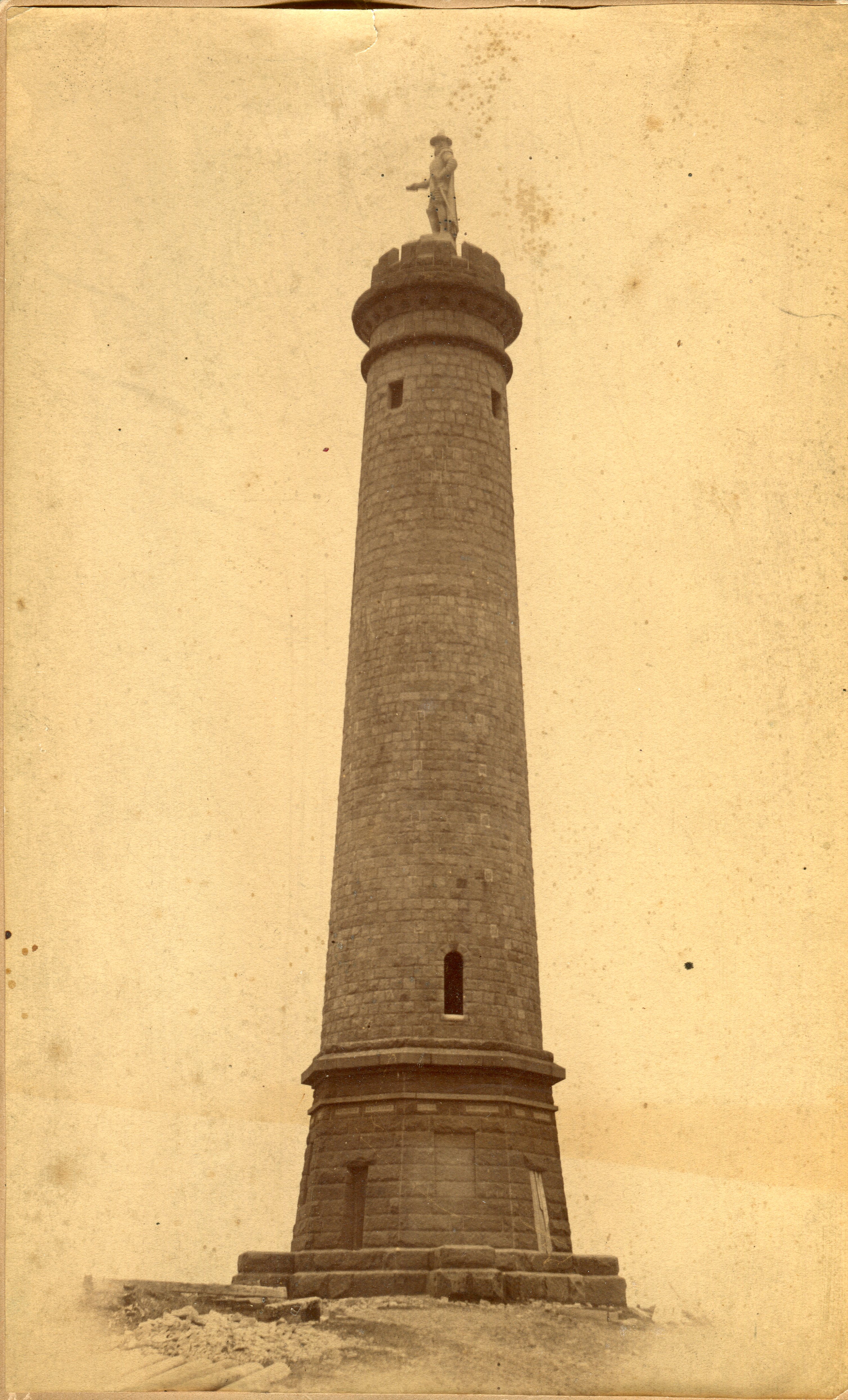
Standish Monument, c. 1900
By 1920 the Monument and statue were in disrepair. Dr. Horton, the President of the Standish Monument Association, sought $10,000 from the State for repairs and landscaping. According to Thomas Weston’s autobiography, the State could offer no assistance unless it acquired the monument. After persuading the Association deed the land over, a bill was signed by Gov. Calvin Coolidge, allowing for Massachusetts to become its owner and caretaker. [4] Thus, when Myles lost his head, the State got the bill.
Today the State still gets the bill, but with so many other pressing responsibilities, the upkeep and opening of the Myles Standish Monument has become a bit overlooked. Despite this, however, Myles, with his reconstructed head and body, still stands tall.
[1] “Bolt Beheads Myles Standish Statue on Duxbury Shore,” Boston Sunday Globe, August 27, 1922. This date has been misreported over the years as 1903, 1920 and 1924. However the actual storm hit on August 26, 1922, two years after the State of Massachusetts took control of the monument from the town.
[2] S. J. Kelly of Boston designed the original statue. It was sculpted by Stephano Brignoli and Luigi Limonetta of Bayeno, Italy using granite from Maine. The Monument was designed by architect Alden Frink.
[3] The lower legs were left at Horrigan Granite Co. in Quincy and later ended up in Halifax.
[4] Excerpt from the autobiography of Thomas Weston in Don H. Ross, “The Mystery of Captain Myles Standish’s Legs”, 2001, p. 12.
The Accounts of Ardelia E. Ripley Hall
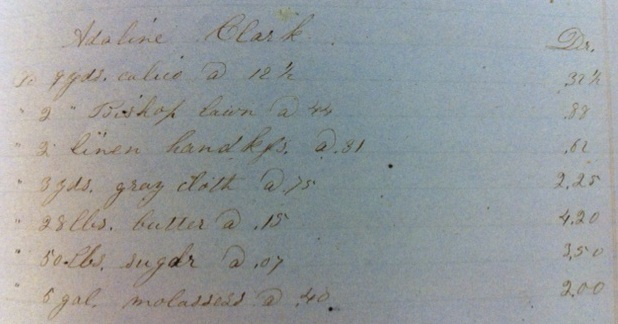
Page of Ardelia E. Ripley’s Practice Account Book, 1856.
Carolyn Ravenscroft, Archivist
In 1856 seventeen-year-old Ardelia E.Ripley (1839-1899), the daughter of Samuel E. Ripley and Sarah Cushman[1], was a student at Partridge Academy in Duxbury. Her Common School Book-Keeping Being a Practical System by Single Entry; Designed for the use of Public Schools by Charles Northend (1853) can be found at the Drew Archives. It is a wonderful example of how students learned the art of basic accounting. While we have numerous day-books and journals used by adults of the period, it is unusual to see one that demonstrates the learning process. Practice books are often thrown away long before they make it into an archival collection.
What I find fascinating about the book is what it tells us about society in the 1850’s. Here, in neat script, is a full listing of all the items a person might consider purchasing along with their cost. Duxbury was no longer the prosperous shipbuilding mecca it had once been, but that did not mean its inhabitants didn’t still pine for kid gloves and cashmere. Using her classmates and relations as fictitious “customers” Ardelia itemized a veritable Ante-bellum wish-list. Classmate Frederick Bryant, for example, lavishly spent $6.00 on “1 pair of pantaloons for my hired man” but also more sensibly required coarse salt at 1 ¾ per pound, and even a “white wash brush” for $.63. Girlfriends like Josephine Thomas bought “muslin de laine ($.31 per yard), 2 skeins of silk ($.08).” Ardelia’s young cousin, Walter F. Cushman, required a “silk handkerchief ($.50) and a cravat ($1.50).” Older family acquaintances also made it into her accounts, Capt. George P. Richardson was a regular customer, buying “kid gloves ($.75), 29 yards of carpeting ($21.00), a satin vest ($3.25), 1 yard cambric ($.10) and ½ dozen buttons ($.03)” all in one day. In total Ardelia kept her account book for four months, had eleven customers and over 150 entries with hundreds of line-items. While I have not vetted the prices she ascribed to them, the items themselves are a boon to any researcher interested in knowing what was available to purchase in America at that time.
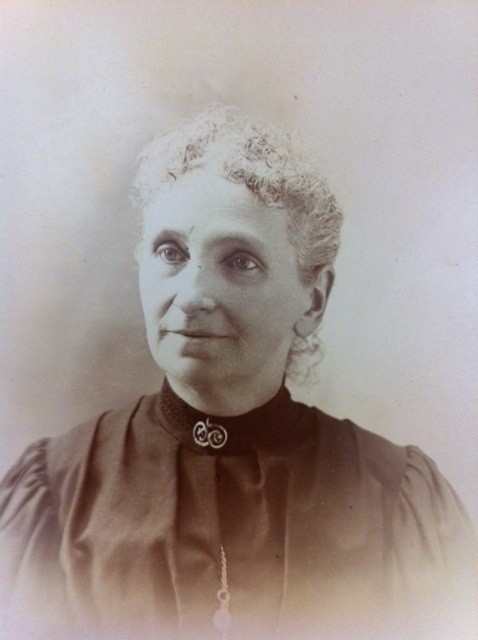
Ardelia E. Ripley Hall (1839-1899)
Almost equally as fascinating to me are the people Ardelia Ripley chose to include in her assignment and how they fit into Duxbury history. For example, friend Joseph E. Simmons, who’s name is one of the most prominent in the accounts, would one day die in the Civil War at the Second Battle of Bull Run (see the Duxbury in the Civil War article). Captains George P. Richardson and Daniel L. Winsor were prominent civic leaders. Walter F. Cushman grew up to marry Ardelia’s daughter, Lucie. In 1860, Ardelia herself would marry the keeper of the Gurnet Light House, George H. Hall, and have six children. Her son, Captain Parker J. Hall, was one of the most colorful people to ever live in Duxbury (more on him in a future post).
[1] The home of Samuel E. and Sarah Ripley was described in a 1925 The House Beautiful article entitled “The Little Gray House with the Pale-Green Door: One of the Aristocrats of the Cape Cod House.” Ardelia inherited this house and passed it on to her youngest daughter, Lura Cushman Hall.
The Opposite of a Love Letter

Portrait of Lloyd Granville Sampson by Cephas Thompson, 1832.
I had fully intended to share a love poem or letter today from one of our collections in honor of Valentine’s Day. But what I found instead was simply too good to pass up. In 1829, when he was just 21 years old, Lloyd Granville Sampson (1808-1838) penned an essay and poem about the joys of being a bachelor. He obviously could not see 3 years into the future or he would have known he would be leaving the “state of single blessedness” by marrying the lovely Mary Winsor. I wonder if she had any inkling of his views on marriage?
Sampson cannot be credited with his turn of phrase. The term “Single Blessedness” was used at the time to describe the lives of women who opted out of marriage. There were benefits to being a spinster in the 19th century that often outweighed those of matrimony for sure – a single woman could own her own property, run a business and sign contracts, things a married woman could not do by law. They could also come and go as they pleased and live an independent life, if they had the financial means, of course. There were also the dangers of childbirth and overbearing husbands to consider. So, remaining unattached was an attractive option (think of our fabulous Bradford Sisters of the Bradford House museum).
It seems Sampson was in favor of his own version of single blessedness. Based on his other witty writing we can assume the following is a bit tongue-in-cheek. I hope you enjoy this very un-Valentine’s day post.
Written in behalf of the fraternity of Bachelors
Know all to whom these presents my come that I am a Bachelor, that I have lived long in a state of “single blessedness” and in that state I shall die. I know not how happy a matrimonial life may be, yet I know how peaceful is that of a Bachelor. The former may be pleasing, the latter is well known to me to be so. The double man may avoid many evils, the single man is sure to avoid one. In short I know of no life so well calculated for the comfort and care of man as a single one, when evening comes and the sun has quietly gone to rest, it is then the state of single blessedness is most dear to me. Then there is a comfort in running over past events long gone by, and a delight in anticipating the future. The Bachelor goes to his “round-a-bout” and takes his care, look at him as he sits with his head inclined upon his elbow puffing a friendly cigar, he has not a scolding wife no disobedient child no few cents for milk, no yelping brats to distract and perplex him, but goes to his bed a quietly as the sun faces the west. True it is the single man will have not long train to follow him to his “last home” no tears from a “better half” to wet the turf which covers his grave – yet for all this I am a Bachelor – the troubles of the double man will come upon him while the single man is at ease and without care. When the storm beat upon our casements and the winds whistle round our dwellings, then the troubles of the married man should be recollected. While the Bachelor sits peacefully by his fire “now and then” disturbing the burning embers with the friendly poker. The one may experience many anxious hours for a son at sea or for the indisposition of a child, the other is free from all these anxious hours and a deal of leisure to “patch stich [sic] and darn”
A single life the life for me,
How, dearly I do love it,
Free as the air I’ll live & die,
If I leave no heir behind me.
The man without a wife is blest
His life is one continued rest
Free from family, care & strife
He’s merry and happy without a wife
Journal of Adeline Baker now online
The journal of Adeline Baker has been transcribed and is now available under our Journals tab.
Adeline Baker (1829-1856) grew up in the Crooked Lane neighborhood in North Duxbury, near the Marshfield line. As a neighbor of Daniel Webster, the great statesman’s death shook her community. She picked the day of Webster’s funeral to begin her diary:
October 29th 1852
A more beautiful morn than this could not be desired even by the most fastidious. And a great event has this day taken place in our own quiet county of Plymouth in our own sister town, Marshfield. And event which will not only be pondered upon in its minutest details by our whole Nation, but the World will hear of it.
This day, this twenty-ninth of October Eighteen Hundred & Fifty-two, the mortal remains of Daniel Webster have been committed to the silent tomb…”
After such a lofty start, Adeline’s diary settles in to a more simplified tone. She records her visits, chores and family events. Perhaps the most significant event in her own life came on January 6, 1853, the day she married William N. Jameson. Weddings were not the extravagant affairs they are today. Adeline’s entry of that day is rather matter of fact, “This day has been rather a hurrying time. Jameson came over this afternoon. Daniel and Edward came home tonight. Father and Mother, Daniel, his wife, Edward, Levi, Wallace and Amanda all went to Mrs. Alden’s to see me married.” The couple moved to Plymouth where Jameson owned a store and Adeline kept up her journal until April, 1854.
Unfortunately, any happiness she had as the wife of a young merchant was short-lived. Jameson died of consumption in 1855 and Adeline returned to her parent’s house. She died the following year at the age of 27.
Adeline Baker’s journal is part of the Capt. Edward Baker Collection (you can read Edward’s Civil War diary on his Facebook page ). Her journal spans almost two years and is wonderful glimpse into the day-to-day life of a young, 19th century woman.
A Christmas Letter from Paris
Carolyn Ravenscroft, Archivist
In 1850 Seth Loring Sprague (1825-1897), the nephew and adopted son of Seth and Welthea Sprague of Duxbury, was studying abroad. He wrote a letter from Paris to his uncle on Christmas Day after hearing mass at the Church of St. Rochelle. France, during the holiday season, would have presented a far different spectacle from what the young New Englander had ever experienced before. The Unitarian and Methodist Churches that he had attended in Duxbury did not place much emphasis on the Christmas holiday during the early 19th century. It is not surprising then that Seth Loring Sprague did not spend too much time describing the sites he was seeing. His uncle may not have approved of him reveling too much. What is surprising, however, is how laboriously young Seth justified his expenditures to his uncle, one of the wealthiest men in Duxbury at the time. Perhaps this letter gives us a glimpse into the personality of the elder Hon. Seth Sprague – a man seemingly concerned with the cost of everything, right down to the last sous.
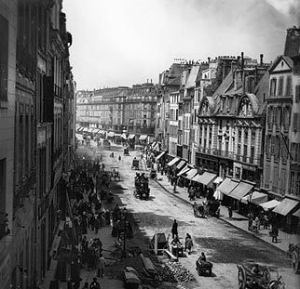
Paris, 1850-1870
Paris, Dec 25, 1850
Dear Uncle,
It is Christmas today and I have just come from the Church of St. Roch where high mass was performed. The church was crowded and it was difficult to get inside but I made little progress by degrees and finally came as far as the pulpit in the middle of the church. The music was very fine and this church is celebrated for its fine music, there being many Opera singers who sing here. Tonight at twelve o’clock I shall go to the cathedral of Notre Dame and witness the ceremony and hear the music there.
Your letter of the 10th of November I recieved on Friday a day or two after I wrote you my last letter Dec 12. The steamer had a longer passage than usual. I recieved also a newspaper the Boston Atlas on Sunday after I recieved your letter.
Before I received your letter I had decided to write the next one to you about money affairs, and I will commence that subject from my first arrival at Antwerp.
I arrived at Antwerp on Tuesday, July 2nd having twenty pounds which I got in New York. This lasted during my stay in Antwerp, my journey to Colgne, voyage up the Rhine to Geneva in Switzerland. Here I drew or rather borrowed from Mr. Budington twenty pounds, as I then had no letter of credit. When I started from Antwerp I had no thought of going to Switzerland and thought that twenty pounds would be sufficient. But when I was at Frankfurt I went on to Heidelberg and then to Baden Baden and was going to return, but Mr. Budington persuaded me to go on. I told him I did not think of going to Switzerland when I left Antwerp and had not money enough and therefore could not go. He said that would make no difference, he would lend it to me and Mr. Crafts said the same. Having then much good credit I continued on. I thought it was very good credit for such short acquaintance. I then wrote to Baring & Brothers giving him the following names of the places I intended visiting. Geneva, Milan, Amsterdam, Paris.
I received my letter of credit at Berne in Switzerland. We did not go to Milan as we had not the Austrian visa. On our arrival at Amersterdam I went to Mssrs Hope & Co and drew twelve pounds. I gave my note to Mr. Budington and when he arrived in London he obtained the twenty pounds from Baring & Brothers. I then came to Paris [Seth includes a lenghthy description of his funds and expenditures]…
I expect now to remain in Paris until the last of June and then go to London. I may spend July or not go until July and spend August. So the great part of the rest of my months will be spent in Paris. My expenses here are something near three hundred francs a month. I pay for my room forty francs per month. The expense for clothes are about the same as in Boston which I have not reckoned in to the account. If I purchase many books that also is extra. Concerning postage, new paper is 7 sous. I think I wrote you in one of my first letters that all letters were double which weigh more than one quarter of an ounce. The first letter I wrote you on that very thin paper consisting of two sheets to a letter were single, weighing less that 1/4 ounce. Two sheets of this paper, such as this letter is written on would be close to double postage. Your last letter of two sheets was a double one and the postage of it was three francs. Greene & Co change 1/2 or 1 franc for sending it which makes the postage 4 francs for a double letter. The postage for a single letter from there to the United States is 1 1/2 francs or thirty sous and I am obliged to pay for all the letters that I send as well as for those I receive. A letter to England does not require to be pre-paid if it goes by the way of Enlgand, as by Liverpool steamers. There is a steamer or steamers that run between Hause and New York and a letter sent by them does not require to be prepaid entirely. One pays only twelve sous, the rest of the postage is paid in America. So you see letter writing is rather expensive for me for I must pay the postage both ways. I wrote you in my last or one before the last that Greene & Co charged for four letters that I have received twelve francs; two were single and two double or weighed over 1/4 oz. If you direct to No. 35 Rue de Tournon my letters will cost less.
As for my plans for the future, they are something like this, which I submit to you. I propose to remain in Paris until June or July and then go to London as the Exposition continues there for several months. I shall get underway in French and in my medical courses in the spring and I think it would be better not to break them off by going to London in first of May. The month of July I might spend in London, England. I should like on some account to spend three months in Dublin – Aug, Sept, Oct. November would be a good month in which to go to Rome. In December return to Paris and spend the winter. When I know more about it I will write you. What do you think of that plan? I do not propose to travel extensively. I should like to go to Rome, Venice, Naples, Milan and Florence, all in Italy. In England, London, Liverpool, Edinburg, Dublin and wander al little away the heaths of Scotland.
Yours affectionately,
S. L. Sprague
I received Aunt Sprague’s lette in very good season last Tuesday 24 Dec and will answer it in two or three weeks.
I want to hear all about the fair, and I presume you will write all the particulars. I hope you made some money by it, as much as you want.
200 Years Ago Today…well, yesterday
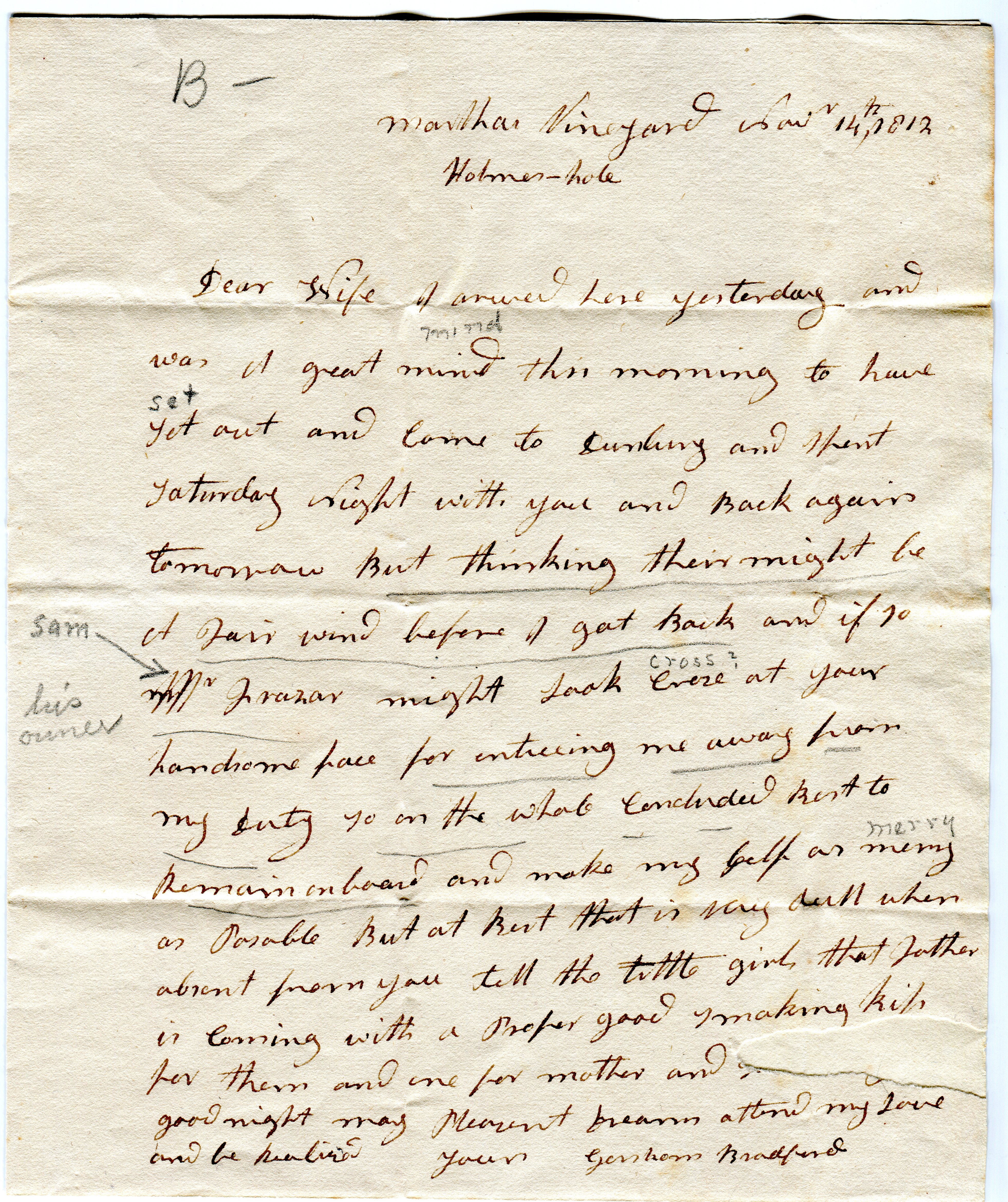
Capt. Gershom Bradford (Martha’s Vineyard) to his wife, Sarah Hickling Bradford (Duxbury, MA), November 14, 1812.
The largest collection by far held at the Drew Archival Library is that of the Bradford Family. It spans 200 years, has hundreds of letters, photographs, shipping papers, journals, etc, etc. It is the go-to collection here when I need to know anything about Duxbury history – each generation of the family was heavily involved in social movements, town politics and, dare I say it, gossip. So, when I thought it might be fun to scan something from 200 years ago today, I immediately went to see what a Bradford had to say. The following is a brief love letter Captain Gershom Bradford (1774-1844) penned to his wife, Sarah Hickling Bradford (1772-1861), before heading to Boston aboard the brig Patriot. The Captain was away quite a bit as a master mariner during their early marriage. At the time of this letter Sarah would have been pregnant with their fourth daughter, Charlotte (the Civil War nurse).
You will notice the “B-” written atop the scanned image. Much of the Bradford correspondence was graded by descendent, also named Gershom Bradford. The B- might seem a poor grade for such a lovely little note but, given the length and topics of other letters, it was probably a fair assessment in his eyes.
Martha’s Vineyard
November 14th, 1812
Holmes-hole
Dear Wife,
I arrived here yesterday and was at great mind this morning to have set out and come to Duxbury and spend Saturday night with you and back again tomorrow but thinking there might be a fair wind before I got back and if so Mr. [Samuel] Frazar might look cross at your handsome face for entreeing [sic] me away from my duty so on the whole concluded best to remain onboard and make my self as merry as posable [sic] but at best that is very dull when absent from you tell the little girls that father is coming with a proper good smaking [sic] kiss for them and one for mother [page torn] goodnight may pleasant dreams attend my love and be realized
Yours, Gershom Bradford
 Drew Archival Library