Tsk, tsk, Mr. Weston

Ezra “King Caesar” Weston II (1772-1842) was one of Duxbury’s most prominent 19th century citizens.  He ruled his vast ship building empire from his stately home on Powder Point.  But even Ezra Weston was not above the law.  In 1834 a warrant was issued for Mr. Weston’s arrest. It seems he was selling distilled liquor and allowing it to be consumed in his shop.
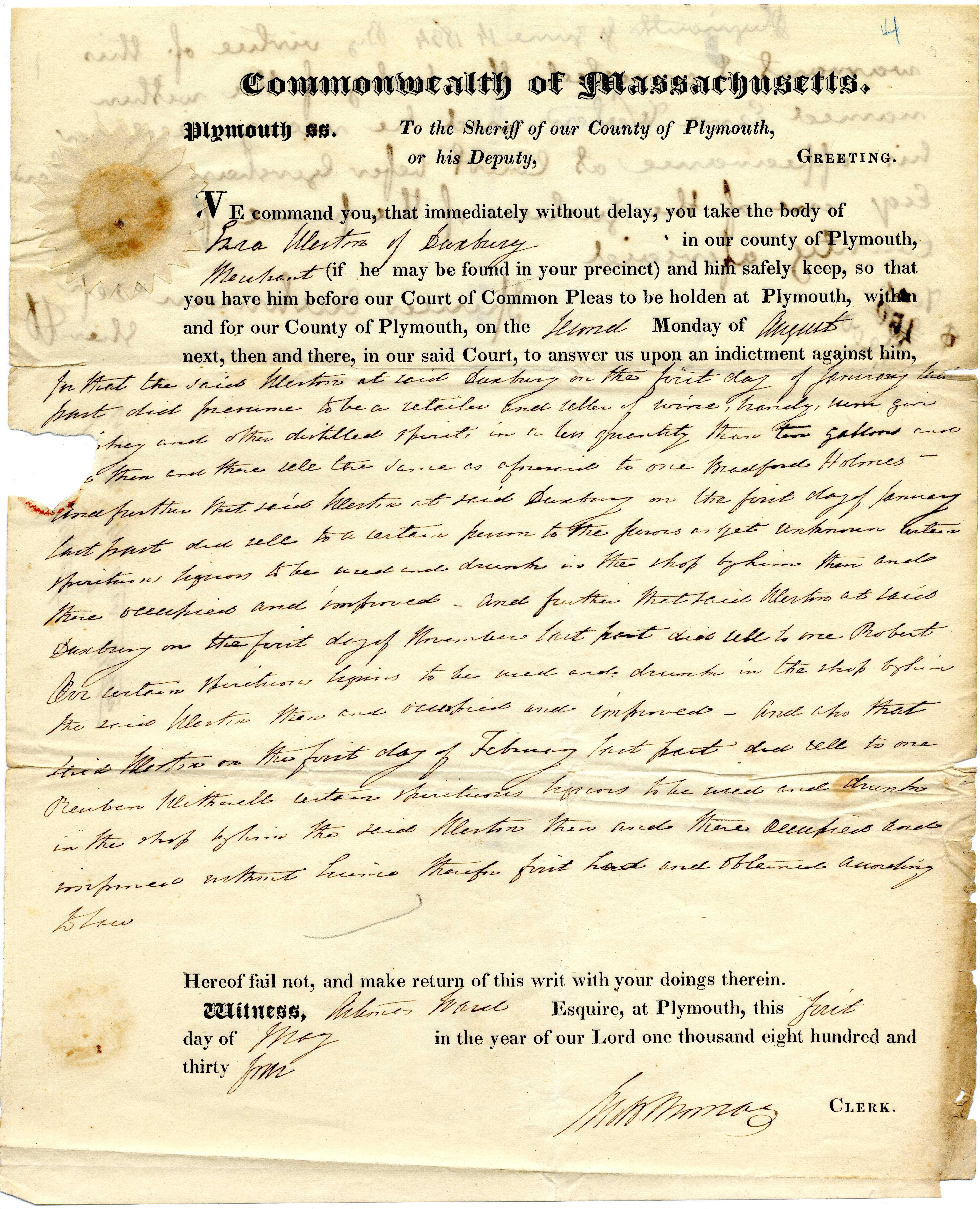
Ezra Weston Warrant, 1834

According to Massachusetts law at the time, “no person shall presume to be a retailer or seller of spirituous liquor in less quantity than 28 gallons, unless he is first licensed as a retailer of spirits…” (I assume the 28 gallon limit distinguished wholesalers/importers from retailers).  You also needed a license if you were running an establishment that served alcohol.  Three witnessed instances of a sale were considered sufficient to indict.  In Weston’s case, Bradford Holmes, Robert Orr, Reuben Witherell and one other person were seen purchasing and drinking spirits on the premises. 

On June 14, 1834 Deputy Sherrif Spencer Cushman “arrested” Weston and had him appear before one of the Justices of the Peace in Duxbury, Gershom Bradford Weston. It must have been a comical hearing as G. B. Weston was Ezra’s son.  Ezra Weston paid a fee of $200 and promised to appear in court.

Whether or not King Caesar’s case ever went to trial, whether he was found guilty or made to pay a fine, I simply do not know.  If you would like to visit the scene of the crime, however, the King Caesar House is open for tours in the summer.
The Story of Antoinette Knowles

If you believe “there are no coincidences,” then here is a tale for you. 

A couple of months ago Mattie Ali, the Chair of the DRHS’ Costume Committee, asked me to find out anything I could about a 19th century girl who possibly lived in town.  Mattie had a dress in the Costume Collection that had a curious tag sewn inside.  Although the dress had been owned by Margie Sampson, the tag indicated that it had once been worn by “Antoinette Knowles.” 

After reviewing the Census Records, Vital Statistics and other genealogical material, I found that Antoinette Knowles was indeed a native of Duxbury.  She was born Jan. 18, 1837 to Samuel Knowles and Lucia Ann Sampson (this connection made her Margie Sampson’s cousin).  In 1862 she married George Frederick Tileston of Boston.  Shortly after their marriage, George was killed in the 2nd Battle of Bull Run on Aug. 29, 1862.  Two months later the couples’ only child, also named George, was born.  

The widowed Antoinette lived with her parents in South Duxbury and can be found with her son in the 1870 and 1880 US Census Records.  She died on Feb. 11, 1899 and is buried in the Mayflower Cemetery. 

I sent Mattie this information and closed the book on Antoinette Knowles…until just the other day.  As I was preparing material to show the local Brownie and Girl Scout troops I began looking through our identified cased photograph collection.  The collection is currently uncataloged so there is no easy way to search it – the process involves delicately opening each case to see who is inside.

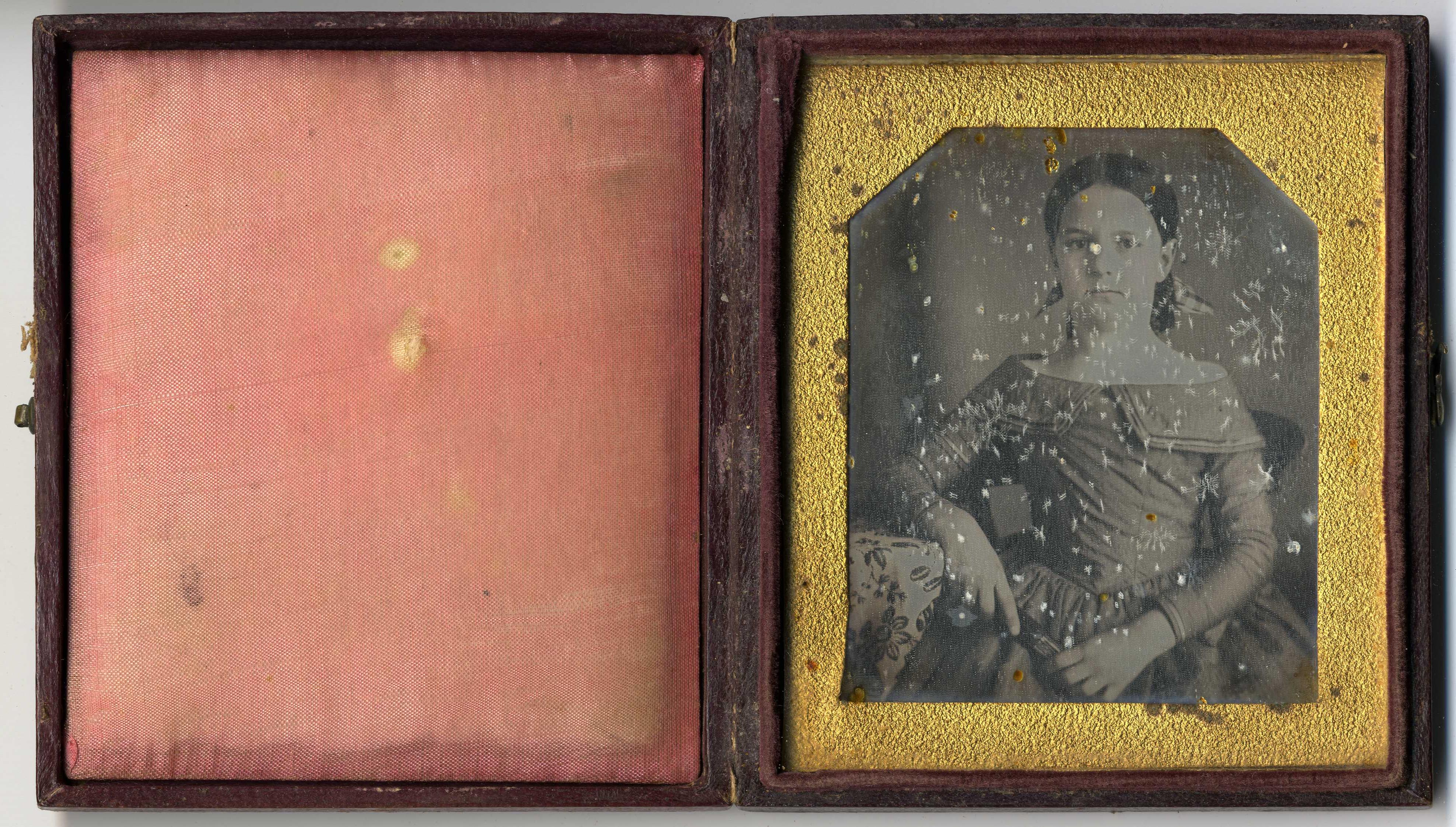
Antionette Knowles, c. 1845
Antoinette Knowles, c. 1847

I was specifically searching for daguerrotypes of young girls.  Almost immediately I came across one – a young girl sitting, holding what appears to be a fan.  Based on the simple design of the gold frame I surmised that the photograph was a particularily old example.  As I read the tiny, folded piece of paper identifying the subject of the image I almost fell over.  It was “Antoinette Knowles, born Jan. 1837.”

 There are no coincidences.

A Gift to Longfellow.

Oh, I do love a good mystery!  If you check out our SMALL COLLECTIONS link on the right and click on Henry Wadsworth Longfellow you will see that we have two letters by the venerable poet.  One of the letters is actually a very brief note sent to Duxbury resident, Lyman Drew, in 1879.  In it, Longfellow refers to a gift he has just received from Drew that was once in “the hand of the brave, old Puritan Captain.”

Could Lyman Drew have sent a relic from Myles Standish to Longfellow in honor of his poem “The Courtship of Miles Standish?”  Or was it an artifact that had once belonged to Longfellow’s Duxbury ancestor, Peleg Wadsworth?

This may take a bit of sluething on my part but I am hoping to come up with an answer soon…stay tuned…

Sea Fencibles? What?

I like to think that I know a thing or two about early American history but every once in a while something comes along that makes me say “what?”  Just such a thing happened today as I was cataloging one of our smaller collections.  I came across a folder entitled “Sea Fencibles.”  Contained within were two documents – a letter written by Duxbury’s own Judah Alden in 1817 and a Certificate given to a Mr. Jones (1823).  Both documents referred to Sea Fencibles.  

So, what exactly is a sea fencible? It is pretty much what you might guess based on the sound of the words.  Sea Fencibles were companies of men formed for the defense of the seaboard.   The term was originally used by the British during the Napoleonic Wars.  Americans began using Sea Fencibles during the War of 1812, ironically against England. They were usually comprised of 107 men, all of whom had been employed in the maritime trades prior to the War.  

The letter in our collection refers to a cannon that was lent to the town of Duxbury during the war to be used by the Sea Fencibles (it was returned to Charlestown after the hostilities were ended). 

So there you have it.  I hope you enjoy the addition to your vocabulary.

Small Collections are coming!

Over 25 small collections, and we do mean small, have recently been processed. Some collections are no more than one item, most are no more than one folder. They range in topic from the 1742 Indenture papers of young Elizabeth Hedge, to the Civil War letters of John Southworth, to the construction documents of the Duxbury Alms House.  

Finding Aids for these smaller collections will be online soon.