Reading Photographs

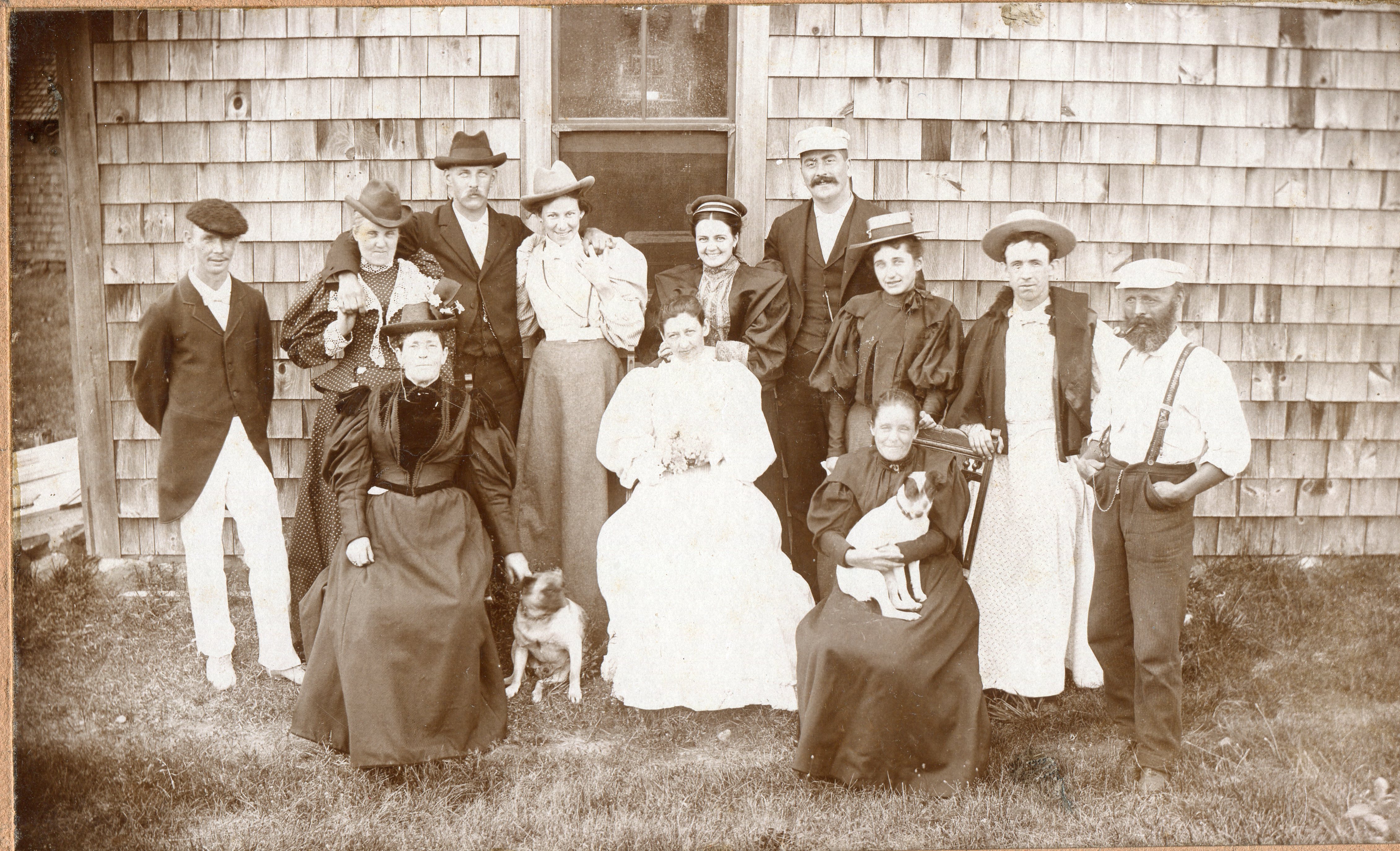
I enjoy examining old photographs and trying to tease out all the facts I can about the subject but sometimes the full meaning of what is going on eludes me.  Today I came across an image that I just can’t seem to figure out…perhaps you will have a suggestion as to its content.

The image is of a Duxbury, MA gathering. The man on the far right smoking a pipe is George Ellis Hathaway (1851-1944), the grandson of the painter, Rufus Hathaway.  George lived at 95 West Street, although the location of the photo is uncertain.  The photograph was taken by F. S. Needham of Duxbury.  Based on the style of dress on the women (the loose drooping sleeves above the elbow, for example) the photo is c. 1893-1896.  I love everything about it – the rich velvet fabric on the shoulders of the woman seated on the left; the pug and jack russell terriers, both blurred in movement; the smiling faces; the hats.  It’s all wonderful.  I wish I could identify everyone and maybe with a bit more investigation, I will be able to put names to at least one or two more individuals. 

Have you spotted my real dilemma yet?  Take a close look…closer…closer still.  Notice the man standing next to George Ellis Hathaway?  Yes, that’s the one, the one wearing the dress.  I would love to know what is going on there.  Are they a group of amateur actors just finishing a performance?  There does seem to be a certain amount of playfulness on everyone’s face – except for his.  If you have any idea what the true subject of this photograph is or can identify anyone pictured, please let me know.

Journals are here!

There is a new tab atop this page – Journals.  As we transcribe our many fascinating diaries we will be posting them online.  Currently a portion of Amherst A. Alden’s 1847 journal has been added.  Have fun reading about this adventurous 15 year old traveler and check back to see what our other diarists were up to.

Follow Amherst A. Alden on Facebook

For those of you, like me, who are simply amazed that a 15 year old young man could find his way to Illinois solo, I have a treat for you.  Amherst now has a Facebook page.  His journal entries will be updated daily.  Please “like” his page to follow him down the Erie Canal all the way to Illinois.  Read about life in a mid-nineteenth century rural western town.

“My Conscience!” The Journal of Amherst A. Alden

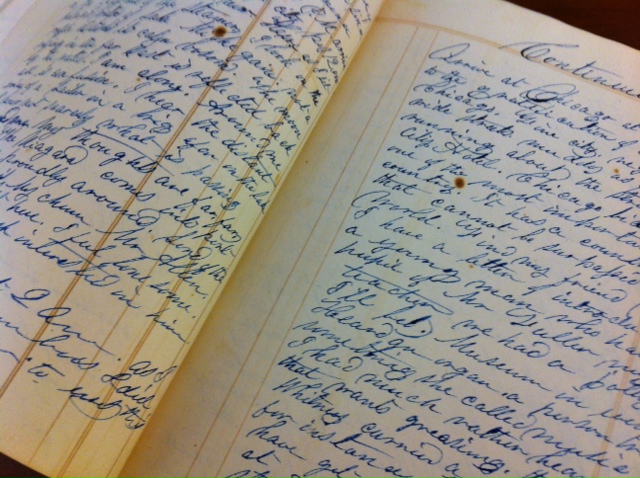
First page of Amherst A. Alden’s journal, 1847.

September 28, 1847,

Left Duxbury at 10 o’clock AM.  My birthplace; the town where I have always resided, left all friends, acquaintances, my home, to make my abode in the far West.  There is a feeling upon leaving home which no pen can describe, “there is no place like home.”

Thus begins the journal of 15 year-old Duxbury native Amherst A. Alden (1832-1909) as he embarked on his journey to Illinois.  At the time Amherst left Duxbury there was little to keep an educated young man at home. The decline of the town’s great shipbuilding era left scant employment other than the ill-paid and laborious work of shoemaking. Luckily the United States was full of places a man of ambition could make his mark.  Many moved to Boston (see previous blog post about Eugene Sampson), some went to sea and others followed the country’s manifest destiny and went west.

Prior to leaving Duxbury in the fall of 1847, Amherst was presented a journal by his neighbor, Ann Thomas Porter, the wife of the local doctor, John Porter. His travels to the “far west” took him through western New England, down the Erie Canal, and eventually to Pekin, Illinois where he became employed as a teacher.  He diligently recorded his day’s activities every evening until the book was complete on April 19, 1848.  It is a wonderful look into daily life in Illinois during this period – names, places and events are recorded that would be of interest to anyone whose ancestors founded the towns of Pekin or Tremont.  Also fascinating are his use of exclamations such as “Oh Scissors” and “My Conscience.”

After only a year in Illinois Amherst made his way back to Massachusetts.  He became the private secretary to Daniel Webster and then a clerk in the Boston Post Office.  In 1853 he married Georgina Cook, the daughter of a shipwright. They had one child, Jennie. The family split their time between Duxbury (366 Washington Street) and Boston.  Amherst A. Alden died in 1909 and is buried in Mayflower Cemetery in Duxbury.

The journal is currently being transcribed by a Duxbury High School intern, Gaby Davis.

150 Years Ago Today…

Today was a very momentous day in the life of Duxbury’s own Civil War Nurse, Charlotte Bradford.  It marked the end of her tenure as a matron aboard the United States Sanitary Commission’s Transport Ships and the beginning of her life as a U.S. Army nurse under Dorothea Dix.  Her journal entry to mark the occassion is quite simple, “Thursday 4th. Taken leave of Fortress Monroe and at 5 1/2 started in the port for Baltimore. Most beautiful evening.”  It belies the anxiety she felt just a few days earlier when she wondered what would become of her.

To read Charlotte’s daily journal entries, you can “like” her Facebook Page: http://www.facebook.com/#!/charlottebradfordnurse

John Southworth of the 18th Massachusetts

Carolyn Ravenscroft, Archivist

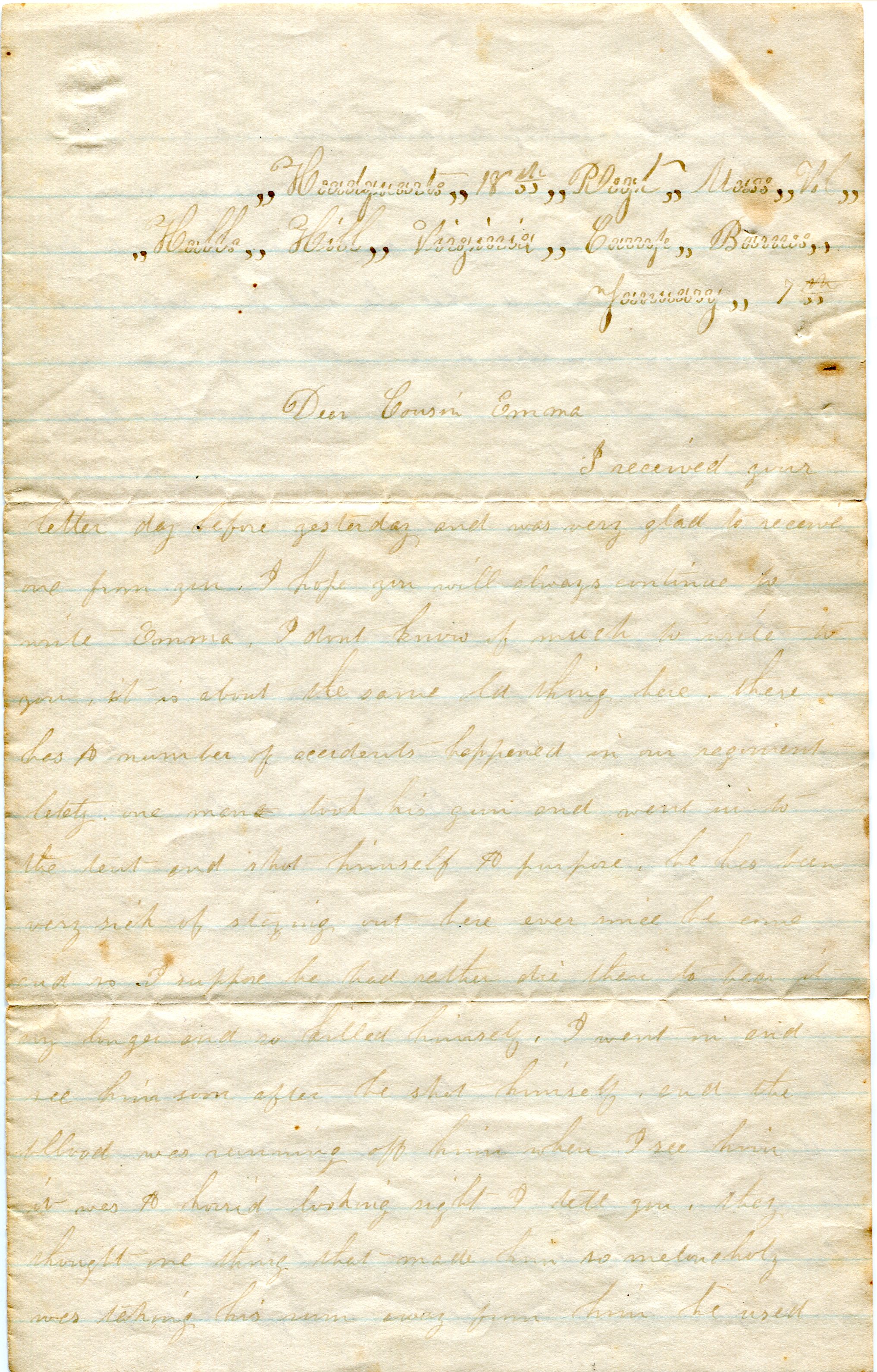
Letter from John Southworth, Hall’s Hill, Virginia, Camp Barnes, January 7, 1864.

“Cheer up Emma, it will all seem better when he comes home…”

                      – Harriet J. Fish to Emma Cushing Paulding, July 15, 1861

On a late summer day in 1861, 17 year old John Southworth of Duxbury was mustered into the 18th Massachusetts Infantry, Company E.  He was not alone, accompanying him were a number of young men from town, including his brother, 20 year old Walter.  John and Walter, like many in Duxbury at the time, were shoemakers.  The glory days of Duxbury’s shipbuilding era was a generation past and many took to making shoes, or cordwaining, as an occupation.  John’s father, James, was alternately listed as a farmer or shoemaker in the US Census Records, indicating that the Southworths owned a sustainable farm in Duxbury but required the additional income shoemaking could provide.

The Southworths belonged to a large network of families that had lived in Duxbury since its founding.  When John marched off to war he left behind his parents, James and Lucy, as well as a number of siblings, aunts, uncles and cousins.  One such relation was young Emma Cushing Paulding (b. 1843), the daughter of one of the last successful shipbuilders in town, William Paulding.  As first cousins living in a small town, Emma and John had grown up together and it is through their Civil War correspondence that we are able to glimpse the kind, wistful and serious-minded man John Southworth was.

As a member of the 18th Massachusetts, John Southworth’s tenure was three years, during which he witnessed many of the most notable battles of the Civil War, including Gettysburg.  His letters describe the cold, miserable conditions men on the picket lines had to endure, the long marches without any rest, and the fear of facing battle.  In one letter he described the suicide of a fellow soldier who was so desolate he would rather die than face another day of war.  John also writes of coming home and his wish to see his parents, to go on a sleigh ride and to attend dances once again.  Through his letters it is obvious he and his cousin Emma shared a familiarity and friendship, and perhaps, although they were cousins, a bit of romance.  Many of John’s correspondents had left off writing him and he was always grateful to receive word from Emma.

Unfortunately, John Southworth did not survive the War. He died in Andersonville Prison in Georgia during the summer of 1864.  In his last letter to Emma, written on April 10th, only a few short months before his death he wrote the following:

“You say I don’t think enough of myself, ah yes I do Emma, I think I am as good as anybody…But I don’t know as I am good enough to go with a girl.  I think they are a higher grade of human beings than men.  They don’t take part in the abominable, diabolical war.  I can’t say anything bad enough about it…I’m afraid of shot and shell, I have had too many of them sing around my head already and I never want to hear another one fired at them, don’t know how dreadful they sound.”

Although John did not make it home, his brother Walter did, marrying a local girl named Emma Chandler and raising a family in Duxbury.  As for Emma, a few years after the War, she married George Bartlett Bates of Kingston, MA and had five children.  She died in 1930 at the age of 87.

John Southworth alludes to a diary he kept as a soldier.  We can only suppose it was lost while he was a prisoner.  The six letters that Emma Paulding kept, however, allow us to know John Southworth and his experience, if only a bit.  The letters were transcribed by Dylan Kornberg as part of his Duxbury High School internship program and are available by clicking the Emma C. Paulding Papers link to the right under Small Collections.

Note: This blog post originally appeared on the Duxbury Rural and Historical Society’s Duxbury in the Civil War blog site (www.duxburyinthecivilwar.wordpress.com) in May 2011.  In light of the Southworth letters being featured on the Library of Congress’ National Union Catalog of Manuscript Collection’s Documentary Heritage of the Civil War I thought I would repost it.

John Hatfield Frazee

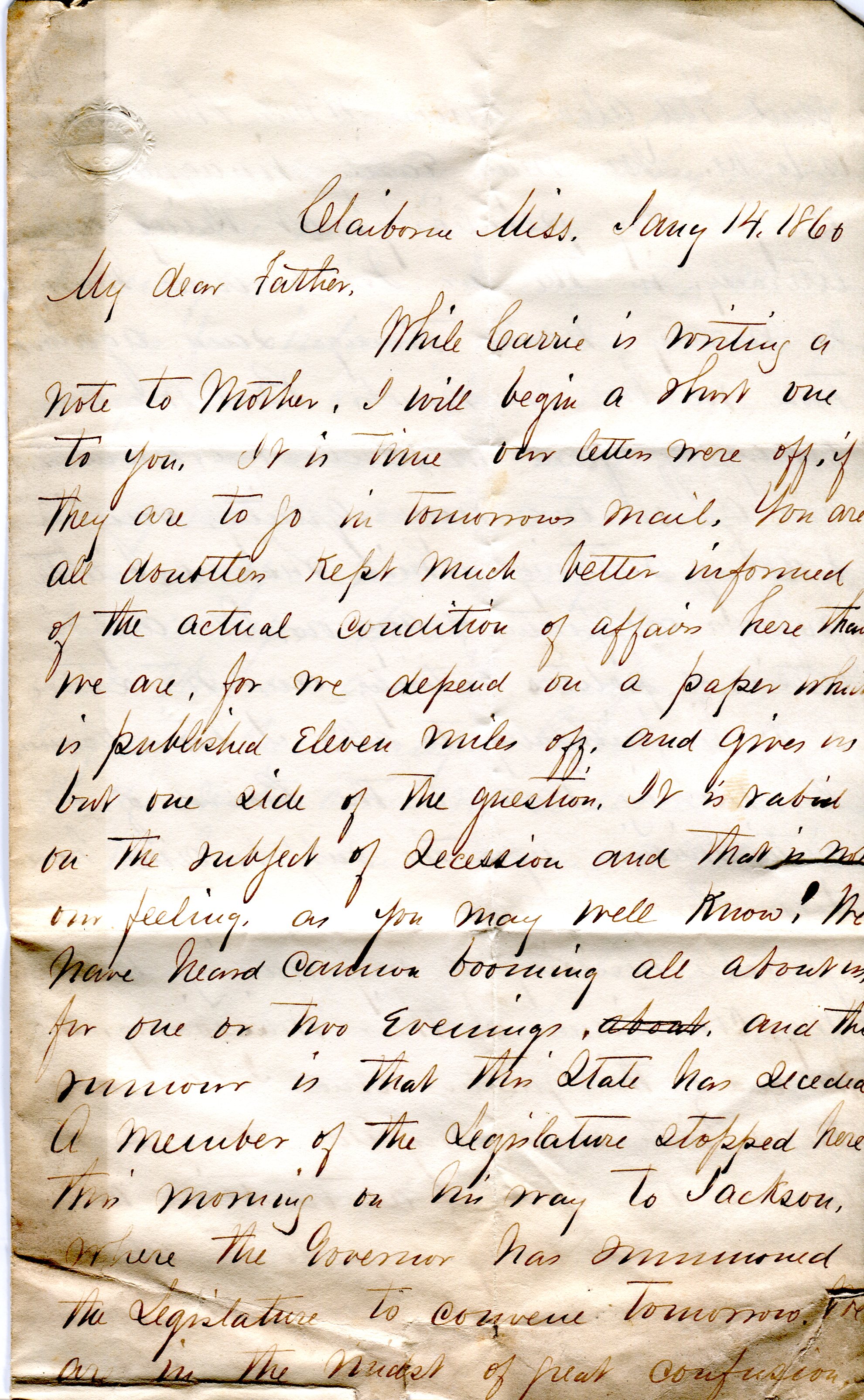
Civil War letter from John Hatfield Frazee to his father.

By Emily Hansman

I spent this fall getting to know John Hatfield Frazee.  He was an interesting man who spent much of his life in Tennessee.  He worked as a lawyer, a clergyman, a soldier, and a father.  He was born in New Brunswick New Jersey where he spent his childhood.  After attending Rutgers College he worked as a lawyer for several years, during which time he married his first wife, Christiana.  Misfortune came into his life when Chrissie passed away just three years after their son was born.  Three years later he married his second wife, Caroline, who was fated to be left anxiously at home while her husband fought in the Civil War.  Their family was living in Mississippi when the news of secession shook the country.  Included below is a letter to his father in which he expresses a feeling of isolation, torn between maintaining good relations with his neighbors and parishioners, and remaining loyal to his family, his country, and his home up north.  As the civil war progressed this sentiment drew him and his family back up north where he enlisted in the 3rd New Jersey Cavalry as the Chaplain.  As he moved from battlefield to battlefield he constantly wrote letters to Carrie at home, describing everything from his evening meal to watered down accounts of battle in which, with much skill, he conveyed the stark emotions of the battlefield without including gruesome scenes of carnage that would scare his wife.  His love for God comes through in everything he writes, as his faith was the cornerstone on which he built his life.  His letters show that despite what he was surrounded by, his faith never diminished, instead it only grew stronger.  After the war, he became a pastor in Knoxville, Tennessee where he spent the rest of his life.  His passion for his country and his family is evident in the extensive research he’s done on his family’s past, particularly his ancestor Hendrick Fisher, a soldier in the American Revolution.  He lived a long life and died in old age as a well-loved man.

As a high school student, oftentimes the only way I experience history is through the pages of a textbook. This internship added a whole other dimension.  To hold in your hands the very letter that was written a century and a half ago on the battlefield of out country’s most devastating war, is an incredible experience.  John Hatfield Frazee is such an interesting man and I was privileged to spend an hour each day getting to know him through the legacy he’s left in his letters.

Claiborne Miss.   January 14, 1860

My Dear Father,

                While Carrie is writing a note to Mother, I will begin a short one to you.  It is time our letters were off, if they are to go in tomorrow’s mail.  You are all doubtless kept much better informed of the actual condition of affairs here than we are, for we depend on a paper which is published eleven miles off and gives us but one side of the question.  It is rabid on the subject of secession and that is not our feeling, as you may well know!  We have heard cannon booming all about us for one or two evenings, and the rumour is that this state has seceded.  A member of the Legislature stopped here this morning on his way to Jackson where the Governor has summoned the Legislature to convene tomorrow.  We are in the midst of great confusion, and God alone knows what the issue is to be.  You may easily imagine that we feel very peculiarly at being alone, literally in the far south, and hearing so many hard things said against those we love so much.  But we are away off from the centre of excitement and go on our way quietly, saying and doing nothing which shall excite the prejudice or opposition of anyone.  Our duty is outside of politics entirely, and we strive to do it faithfully to all.  I have, however, this morning, written to the Board of Domestic Missions upon the subject, and have told what my views were, as to the probable necessity of my having to return my commission as their Missionary at the end of this quarter.  And I have also talked with one of my Elders and he has assured me that if at the time named we feel it is our duty to go north all will be well: we shall be paid.  You need not fear for our safety.  We feel as safe as we ever have at the south.  I cannot see any reason why the negroes should rise now, and if there is to be any collision between the states, we are so far inland that we do not fear any harm or injury.  We may very now be in a situation in which letters may not be carried either way for reason you will easily understand but if you should get none, don’t feel that we are in danger or run off into the swamps.  Continue to have Hattie write, and we will do the same.

                We have warm and damp weather just now.  A small congregation yesterday owing to rain.  The people seem to like me, and we like many of them very much. 

                Thanks for your little rubber articles.  We will have a settlement some day.  You must not hesitate to tell me of all your little difficulties and remember that I am always ready to assist those who have done so much for all mine.  I would love – oh how much I would love to see you and all at home!  I never was away from you all so long before.  Yet we are contented, striving to be useful, and satisfied that in God’s own time He will unite us.  Often pray for me, dear father, that my hand may be upheld in this ministry, and that souls may be converted through ever such a feeble instrumentality as my preaching.  We pray daily that your afflictions and bereavement may be for the purifying of your souls, even as gold is made pure by the [xxx] fire.  Love to Mother, Sister, Niece, and Brother.  I would love to get a note from your two hands.

God bless you all.

                                                                                                                                                Your Son, 

                                                                                                                                                      Hatfield

The Civil War Homefront

Charlotte Bradford (1813-1890)

Carolyn Ravenscroft, Archivist

Although the battles during the Civil War raged in the South, the thoughts of every Northerner were never far from the front.  Any first-hand account of the war was eagerly repeated to family and friends through visits and correspondence.  During the late summer of 1861 Duxbury native Charlotte Bradford shared information she had gathered about the recent battle at Bull Run with her sister, Maria, then living in Yellow Springs, Ohio with her husband, Claudius.  Charlotte wrote her sister of Dr. Josiah Bartlett’s experience assisting the wounded (Bartlett was a doctor and the husband of the Bradford’s cousin Martha).  She also described the travails of a family friend, Frank Frothingham, who had fought in the battle with the 5th Massachusetts.  Interspersed with the gruesome details of the war, were more homely accounts of day to day activities in Duxbury, such as “working for the soldiers” in the Methodist Vestry and entertaining house guests.

In future blog entries we will learn more of Charlotte Bradford as she heads off for Washington, DC to begin her career as a Civil War nurse.  The following, however, is a letter written months before she considered leaving for the South.

Duxbury, Aug. 18, [1861]

Dear Maria,

I intended to have written you long before now but we have had so much company and so much to do, and I have been so tired, that I had no chance to do it.  The middle of July Lizzie Ripley and Sarah E[llison] came down.  Lizzie spent a week.  Her mother [Sarah Alden Ripley] was coming the next week, but I had a lame knee and had to put off their visit.  The most of that week and the next we went to the Methodist vestry to work for the soldiers.  The 1st of August E[lizabeth] and I went to Abington.  There was very fine speaking there, but the seats in the ground were so wet that we came home most awfully tired…Ezra Ripley[i] has gone to Fortress Monroe. He is lieutenant of one of the companies.  How unfortunate our troops should have been beaten twice.  I am afraid it will not be quite so easy for the North to conquer as they have boasted.  Josiah [Bartlett] took a trip to Washington and was present at the Bull Run fight and assisted in dressing the wounds at the hospital at Centreville.  Frank Frothingham[ii] is here.  He was in the battle in the Mass. 5th Regiment.  They had nothing to eat from Saturday night till Monday noon.  They marched 8 miles in the morning into the battle, then 45 miles or more Sunday night and Monday morning, arrived in Washington wet through in a drenching rain, and Monday night 45 of them slept in a kitchen with a brick floor and only 2 windows which had to be kept shut on account of their being so wet with no change of clothing.  It must have been dreadful. In the morning an acquaintance found Frank in a high fever and took him to a friend’s house where he was cared for.

Mother sends her love to you and Claudius and says she wants to see you very much.  Give my love to Claudius.

Your affectionate sister,

Charlotte

This article originally appeared on the Duxbury Rural and Historical Society’s Duxbury in the Civil War blog.


[i] Ezra Ripley was the son of the noted Transcendentalist and Bradford cousin, Sarah Alden Bradford Ripley. The Ripleys lived in the Old Manse in Concord, MA.  Ezra Ripley enlisted as a 1st Lieutenant on 24 July 1861 at the age of 35 in Company B, 29th Massachusetts Infantry.  He died of disease on July 28, 1863 in Vicksburg, MS.

[ii] Frank Frothingham was from Charlestown, MA. He enlisted, at the age of 23, in the 5th Massachusetts, Company K for 30 days from May 1, 1861 until July 31, 1861.  He then served with Company A, 33rd Infantry Regiment as a Lieutenant and with Company I, 3rd Massachusetts Calvalry as a Captain.  He was mustered out of the Army on June 5, 1865.

Charles M. Smith of the 11th Massachusetts

Centreville, Va. Stone church

Carolyn Ravenscroft, Archivist

This blog post originally appreared on the Duxbury Rural and Historical Society’s Duxbury in the Civil War blog.  It is such a great letter, I thought I would share it here as well.

July 21st marked 150th anniversary of the 1st Battle of Bull Run (also known as the First Manassas). On the field that day, in the ranks of the 11th Massachusetts Infantry, commonly called the Boston Volunteers, was a carpenter’s son from Charlestown named Charles M. Smith. “Charlie” enlisted on June 13, 1861 shortly after Abraham Lincoln made his plea for troops. Two days after Bull Run Charlie sat down next to a wounded comrade and dutifully recounted all that he experienced in a letter to his mother so she “would not feel worried.” The following is hair raising letter Mrs. Harriet Smith received:
July 23 [1861]

Shooters Hill, V.A.

Dear Mother and all,
We are again at Shooter’s Hill, we started from here a week ago at 4 o’clock in the afternoon and marched till 3 o’clock the next morning and then started at sunrise and marched till sunset where we camped overnight and took some prisoners. All the houses are empty and some of them we set on fire. If we get hungry we kill hens, ducks and cattle and pigs and every thing we want to eat. We started the next morning with the intentions of cutting off the retreat [of] a rebel regiment which started from Fairfax but we was 2 hours to late. They burnt bridges and cut down big trees to stop us all they could but we pushed on as far as Centerville. There was about 8 regiments in all that went with us but when we got to Centerville there was 20 or 30 other regiments encamped there. We stopped here two days then we started for Manassas where we fought an awfull battle. Men that have been in other battles say that it was the most murderous battle they ever saw for so short a time. It only lasted 6 hours. I haven’t heard how many men we had to take the place, some say there was 40,000 but there wasn’t one half took part in it. The battle twas either sold or it was a great blunder. They had over 100,000 men and had batteries in the woods and batteries that reached 1 ½ miles. They heard we were coming and was reinforced 30,000 the very day we got there. I will give you a little description of it but I suppose you will read about it in the papers. When we got within about 1 mile of the place we heard cannon and saw the smoke they then made us urn double quick to the field where we threw off every thing that encumbered us. The shells were flying every direction and the first man I saw killed was one of our own Company. A shell struck within six feet of us killing one and knocking down two or three more. A piece tore my pants a little and that was all. We was ordered on to the hill where I saw sights that was enough to make a man grow mad. There was men laying dead and wounded and the artillery men had been killed and the horses were all dead piled together by the Cannon. The bullets were flying thick. The enemy wasn’t more than a stones throw from us. The glorious eleventh gave one fire and fell back leaving behind them many dead and wounded. A ball struck my gun but that was nothing. We loaded again but that was the last fire we gave together for the other regiments that went up after us got cut to pieces so they broke, breaking us and everything was confusion. Some of our captains got killed. Then there was so much noise we could not hear our Colonels and every man was for himself. I went again on the hill and fired but the bullets and grape fell so thick we fell back again leaving hundreds behind. Besides a lot of Ellsworth Zouves lost 3 or 400 of their men. I went down into the woods with about 100 others where we could fire into them without their seeing us and here I came the nearest to getting killed. There was some of us went deep into the woods. I saw a company of men in there and thought they were our men but when they see us they fired into us and the way the leaves and splinters flew off o the trees it made me think of home. I rushed out of the woods and our Cavelry were coming down the hill to charge into them but they had hardly got into the woods when I should think a whole regiment fired upon them. They turned their horses and fled and there was as many as 30 horses came out without a rider. I jumped into a little hole to keep clear of the bullets and there was 4 or 5 soldiers in there. I asked them some questions but I found they was all dead. Every one was leaving for the hill. I went up there where I shot about a dozen shots when I see they was retreating. I was one of the very last ones. When our Cavelry rode by us on the gallop told us to run for some woods ahead as quick as we could for their Cavelry was coming. I looked back and saw the dust and only saw about 20 behind me when I threw away my grub bag and gun and run for life if I ever did. They did not follow but a little ways and went back. I picked up another gun that was loaded and discharged it at them. Every body was going towards Centreville on a run. There was men wounded on the way crying for help but every man seemed to look out for himself. All the houses and barns were filled with the wounded but we had to leave them and I suppose they were all killed. There was 12 of our company missing this morning. The Cavelry charged on our rear when we got about 2 miles off taking some prisoners. They also fired shells into us when we got within 4 miles of Centreville killing only a few. One of them struck a rail fence about 10 feet from me and wounding 2 or 3. I was very lucky during the whole of the battle. There was men each side of me got shot dead while I wouldn’t get touched. There was hundreds of men walked to the camp at Centreville that were badly wounded about the head and body. There was only 2 of our Company that was wounded that came here with us the rest we had to leave. One is now sitting in front of me, a ball passed right into his mouth and out of his cheek taking several teeth with it. We shall stay here until we get a big enough force to take the place. Nearly all their whole army are there and you can’t see them but when you go up to fire they can pour right into us. I thought I would write to you so you would not feel worried. They told me today that we could not have any letters go but if you get this you write quick and let me know so I can write more. I don’t feel much like writing today. Give my love to all the folks. I have received two letters from you and want to get some more but good bye till I get home.
Charlie

Charles M. Smith was mustered out of the 11th Massachusetts, Company I on June 24, 1864 and promptly reenlisted six month later in the 1st Massachusetts Calvary Battalion. He finally left the Army for good at the end of the War in June, 1865. Charlie settled in Humbolt, Kansas where he married and raised a family. The Drew Archival Library of Duxbury Rural & Historical Society has 8 of his Civil War Letters all of which are as well written and detail laden as the above.

Photo above: Civil War photographs, 1861-1865 / compiled by Hirst D. Milhollen and Donald H. Mugridge, Washington, D.C. : Library of Congress, 1977. No. 0001

4th of July – 1850 Style

Letter from Eugene Sampson to Daniel Sampson, June 21, 1850

Carolyn Ravenscroft, Archivist

Apparently, “boys will be boys” even in 1850.

In preparation for a bang up 4th of July celebration in old Duxbury, a group of teenage boys were soliciting funds to purchase a keg of powder in Boston.  The plan was to ship the keg to Duxbury and  “make that cannon behind Swift’s Shop ring.”  The price of the keg and shipping was $3.00 and any contribution, no matter how small, was welcome.

The young man behind the scheme was Eugene Sampson (1833-1901), the nephew of one the wealthiest and most influential men in town, Hon. Seth Sprague.  In 1849, at the age of 16, Eugene left his home in Duxbury to board at 31 Somerset Street in Boston.  He was employed in the counting rooms of Sprague, Soule & Co (dealers in grindstones and plasters) located at No. 7  T Wharf.

Somerset Street, Boston in 1860 from Boston Public Library’s collection.

Eugene often wrote to his Duxbury cousin, Daniel Sampson (1832-1893), of his life in the city and inquire about friends at home – especially the girls. He also described all there was to see and do.  The California gold rush was on and Boston was bustling with young men (many from Duxbury) heading west.  Gene would typically get to bed at two o’clock in the morning and sleep until past breakfast.

Eventually, Eugene slowed down and became a much more respectable member of Boston society. In 1857 he married Martha Gilbert of Dorchester. The couple had five daughters.  Census records indicate he became the treasurer of a cotton mill.  His cousin, Daniel, became a ship’s captain and married Ada Gifford of Boston.

The Drew Archives have 5 entertaining letters from Gene, a.k.a “Stinking Pork” to his cousin, Daniel, a.k.a. “Fud.”  The following describes the 4th of July plans:

Boston, June 21st 1850

Fud,

We are trying to get money enough to buy a keg of Powder which will take $3.00 to pay freight and all.  Two of us have subscribed $1.75 and if you will contribute any where between 12 ½ cts and $1 it will be gratefully received, we will make that old cannon behind Swift’s shop ring.  If you think that you will contribute any thing, you can let me know by Monday’s mail and pay me when I go home.  Do not say any thing about it to anybody else.  Ichabod Sampson sent me $1 towards it but you must not let him know that I wrote to you or that you have heard any thing about it.  Be sure and answer Monday and not wait any longer because we must get all that we are going to before Thursday.  Now be sure and write Monday no matter how small you put in it will help us along, the larger the better.

 Nothing new to write,

Hot as the Devil here

 From your friend

Eugene

 If you know of any body else that would give anything why you may ask them, but I had rather you would say nothing about it.  Direct the letter to the care of Sprague Soule.

I would love to know what became of the keg of powder and the boys’ Fourth of July celebration.  I am certain it went off without a hitch…I mean really, what could possibly go wrong?