More on the Bradford Cookbook

Lucia Alden Bradford (1807-1893).

Lucia Alden Bradford (1807-1893).

Carolyn Ravenscroft, Archivist

I have mentioned the19th century cookbook (c. 1860-1890) created by Lucia Alden Bradford and her sisters in this blog before, but I couldn’t resist bringing it out once again.[1]  It is such a wonderful piece of history – a compilation of popular recipes copied from a variety of sources, including neighbors and the Ladies Almanac. The book is meticulously laid out, with chapters for Cakes and Puddings, Meats, Vegetables and “other useful Receipts of various kinds.” There is even an index.  I can only imagine the creation of this little book was a labor of love – gathering and organizing the many snippets of paper and magazine clippings that had accumulated over a lifetime.  When a recipe originated with a friend, her name is properly given.  The writing is mostly in Lucia’s neat and recognizable penmanship. Some recipes were obviously added later and these are written in the loose scrawl of a hand that had seen almost ninety years of use.

I could not tell you my favorite recipe. I am not a great cook and many of the ingredients are foreign to my modern eyes (and taste buds). In many instances there are no cooking directions as we’d expect to find today – no oven settings or baking times. Of course, 19th century hearths and later wood stoves didn’t come with temperature gauges or timers so cooks had to know their own equipment. Other recipes are incredibly explicit, e.g. I feel confident I could cure a ham if I had a freshly slaughtered pig, a smokehouse and about two months.

There is one recipe that stood out from all the others on this rainy day – Coffee. Americans today require their coffee to come at them quickly, waiting for a cup of Joe is a thing of the past. Who under the age of forty even remembers coffee percolating on the stove or could now suffer the more than ten minutes it took for it to boil and brew?  Imagine then, if creating Lucia Bradford’s perfect cup was part of your morning routine:

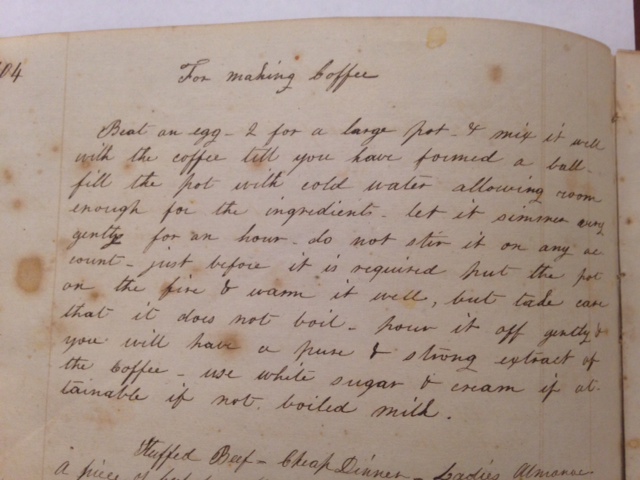
Coffee recipe from Bradford Cookbook

Coffee recipe from Bradford Cookbook

“For Making Coffee”

Beat an egg – 2 for a large pot & mix it well with the coffee till you have formed a ball – fill the pot with cold water allowing room enough for the ingredients – let it simmer very gently for an hour – do not stir it on any account – just before it is required put the pot on the fire & warm it well, but take care that it does not boil – pour it off gently & you will have a pure & strong extract of the coffee – use white sugar & cream if attainable, if not, boiled milk.

Enjoy!

[1] Lucia Alden Bradford (1807-1893) was the daughter of Capt. Gershom Bradford and Sarah Hickling Bradford. She, along with her three sisters – Maria (1803-1864), Elizabeth (1809-1890) and Charlotte (1813-1893) – was raised and learned to cook in the Bradford House on Tremont Street in Duxbury. Today the house is a museum owned by the Duxbury Rural & Historical Society.

Amasa Delano’s Ghost

ship in a stormCarolyn Ravenscroft, Archivist

Halloween is a perfect time for a supernatural story. This ghostly maritime tale comes directly from the pages of Capt. Amasa Delano’s memoir, A Narrative of Voyages and Travels in the Northern and Southern Hemisphere. Delano was born and raised in Duxbury, the son of shipbuilder Samuel Delano, Sr. and Abigail Drew. Although he was a Renaissance man in his day – a shipwright, merchant sailor, explorer and writer, Amasa Delano is perhaps best known to us as the model for a character in Herman Melville’s Benito Cereno.

In 1787 Capt. Delano and his crew were aboard the Boston-built ship, Jane, on a voyage to Cork, Ireland and St. Ubes, Portugal. The ship had reputation for being haunted and the sailors were on edge. Delano’s efforts to reason with the men and lessen their fears had been unsuccessful. So, Delano took a novel approach to curing their superstitions:

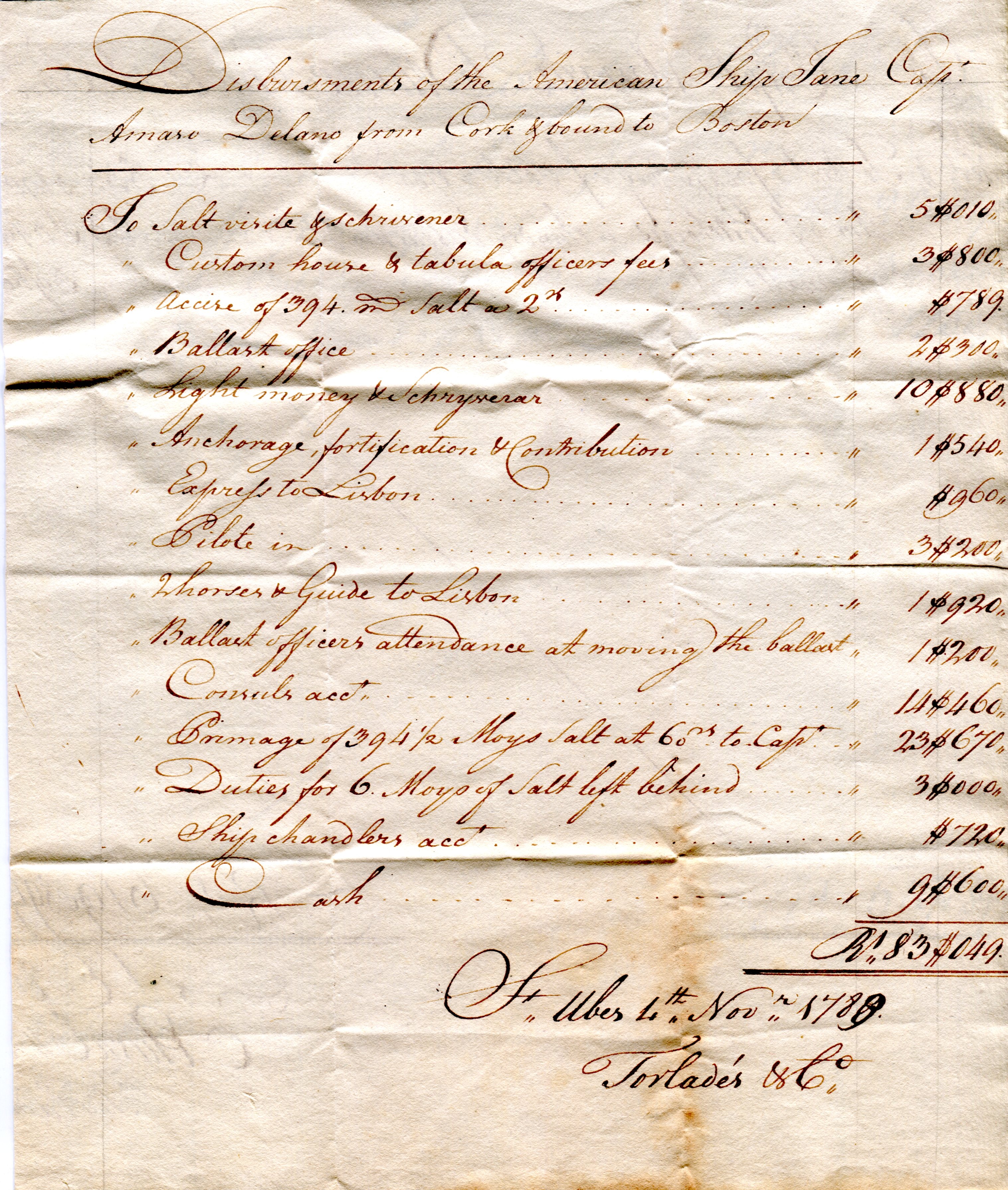
Accounts of ship Jane in the port of St. Ubes, Portugal. Nov, 1788. From Capt. Amasa and Samuel Delano Collection.

Accounts of ship Jane in the port of St. Ubes, Portugal. Nov, 1788. Capt. Amasa and Samuel Delano Collection.

“One pleasant evening, as we were running with the trade winds in latitude 25 degrees north, I heard the second mate and some of the people talking about ghosts. Although doubts were expressed of the existence of such personages, yet many were full in the faith that they were common in all ages. It occurred to me that it was a favorable time to show them a ghost, and make one more attempt to cure them of their folly. They were sitting far aft upon the quarter deck. I stepped down the companion way, went to the state room of the chief mate, and asked him to lend me a hand in showing the people a ghost. He readily consented, and we took two mops, lashed the handles together, made them long enough to reach from a cabin window to the top of the tafferel rail, put a bar across at a suitable distance from the mop-head for arms, dressed it with jackets to give it proportion and shape, put a white shirt over the whole, tied a string round the neck leaving the top of the shirt like a hood on the head, the face looking through the opening in the bosom of the shirt, and gave the whole the appearance of a woman, because this was the kind of ghost most generally expected. A string under the arms easily aided the delusion that it was the slender waist of a female. A cabin window was opened, while I took my station in the gang-way to see the people without being seen. The chief mate raised up the ghost so that it might be seen above the ship’s stern. It immediately caught the attention of the men on the quarter deck, and never did I see human beings more frightened than they were. They were struck dumb, fixed immovable with terror, and seemed like so many breathless but gazing petrifactions. The ghost gently rose and again sunk out of sight, till the chief mate was weary with the labour, and withdrew it at a given signal. I remained to hear what would be said. The men remained motionless and speechless for some time. After they recovered themselves a little, one of the boldest broke silence and began to put round the inquiry what it could be. They concluded it was a ghost, and determined to speak to it fi it should appear again. Upon this I went to the chief mate, and he agreed to hold it up once more. I resumed my station, the ghost appeared and one of them made an attempt to speak, but his courage and his voice failed him. Another attempted, and failed. A third, but without success. The sounds were inarticulate and feeble. The question was to be ‘In the name of the hold God, who are you, and what do you want?’ The image was taken down; we undressed it, and restored the mops to their proper shape. I went to bed without permitting the secret to be known. At 12 o’clock at night, the chief mate came to me, and said that the second officer and people were extremely frightened, and wanted to see me on deck. I got up, and went above, where all the crew were collected and filled with anxiety and alarm. I asked them what was the matter. They huddled round me lake a brood of chickens, and said they had seen a ghost. I inquired why they were frightened at that, since their stories taught them at that ghosts were so common, and so many had been seen already, They answered that they had never been sure of having seen any one before, but now they were sure and the evidence was irresistible…Their sufferings were extreme, and I found it difficult to tell them the trick I had played. As they had never been deceived by me in any way before, and as I feared that some embarrassment might be brought on me in return, I determined not to disclose the truth till the end of the voyage…this affair caused me a great deal of anxiety afterward, and did not accomplish the good that I designed by it.” [1]

The Jane did not make it home to Boston. It was shipwrecked off the coast of Cape Cod on December 28, 1788. All hands were saved, but the cargo was completely lost. Delano was left penniless. Perhaps the real ghosts of that haunted ship were teaching Delano a lesson…

[1] Amasa Delano, A Narrative of Voyages and Travels in the Northern and Southern Hemispheres: Three Voyages Round the World; Together with a Voyage of Survey and Discovery, in the Pacific Ocean and Oriental Islands. 2nd ed. (Boston, 1818), 30-32.

Rare Photos of Boston’s Metropolitan Works, 1893

Carolyn Ravenscroft, Archivist

As our very large Bradford Family Collection continues to be processed, unexpected items come to light.  Today, as I was organizing the many photographs in the collection, I came across an envelope addressed to Laurence Bradford (1842-1909) containing twenty-five images depicting the building of a portion of the early sewage system on Deer Island. Many of the photographs are of the dredging of Shirley Gut.  As a civil engineer, Laurence Bradford worked on the project. He was part of the initial planning phase as early as 1888 and conducted hydrographic surveys around Deer Island.  He was also in charge of building the bulkhead and “of dredging and preparing the channel across the Gut for reception of the sewer pipe.”[1]

Diver H.W. Phillips at Shirley Gut with the Deer Island Alms House in background, Oct. 1893.

Diver H.W. Phillips at Shirley Gut with the Deer Island Alms House in background, Oct. 1893.

Deer Island, so called because of the deers that swam to safety on its shores when pursued by wolves, is actually no longer an island. It is a peninsula stretching into Boston Harbor from Winthrop. The Shirley Gut that had separated the island from the mainland was filled in by beach erosion during the devastating hurricane of 1938. Today it is home to the Deer Island Waste Water Treatment Plant. In 1893, however, when these photographs were taken, it was still best known for the large gothic-looking Alms House that loomed over the shoreline. The “deserving poor” of Boston began being ferried out to the island in 1853.  In 1896 the Alms House became Deer Island House of Correction (the prison was closed in 1991).

Center Section of Siphon at Shirley Gut, Oct. 1893

Center Section of Siphon at Shirley Gut, Oct. 1893

In April, 1893 the Board of Metropolitan Sewerage Commissioners received approval for plans to construct a sewer and siphon across the Shirley Gut between Point Shirley and Deer Island.  The photographs of this work are wonderful. It was obviously no small task to dredge and create this system. The image of the diver, H.W. Phillips, suited up in his primitive (and heavy) equipment, about to don his helmet, with the Alms House in the background, is particularly interesting. Of equal note are the workers and children sitting in the large center section of the siphon.

Mason lining the siphon pipes with brickwork before launching, Shirley Gut, July 1893.

Mason lining the siphon pipes with brickwork before launching, Shirley Gut, July 1893.

Laurence Bradford, the son of Rev. Claudius Bradford and Maria Weston Bradford, was one of the owners of the Duxbury Rural & Historical Society’s Bradford House, located at 931 Tremont Street, Duxbury.  He inherited the house after his aunts, Lucia and Charlotte Bradford, passed away in 1893 – coincidentally, the same year these photographs were taken.  Laurence and his wife, Hattie Phipps Bradford, used the family homestead only during the summer months. Their sons, Gershom and Edward Bradford, donated the home, its contents and its vast archival collection to the DRHS in 1968.

[1] Letter from H. A. Carson, Chief Engineer of Metropolitan Sewerage Commission to “Whom it May Concern,” Feb. 28, 1894. Bradford Family Collection, Drew Archival Library.

The Photographic Record of the Delano Triplets

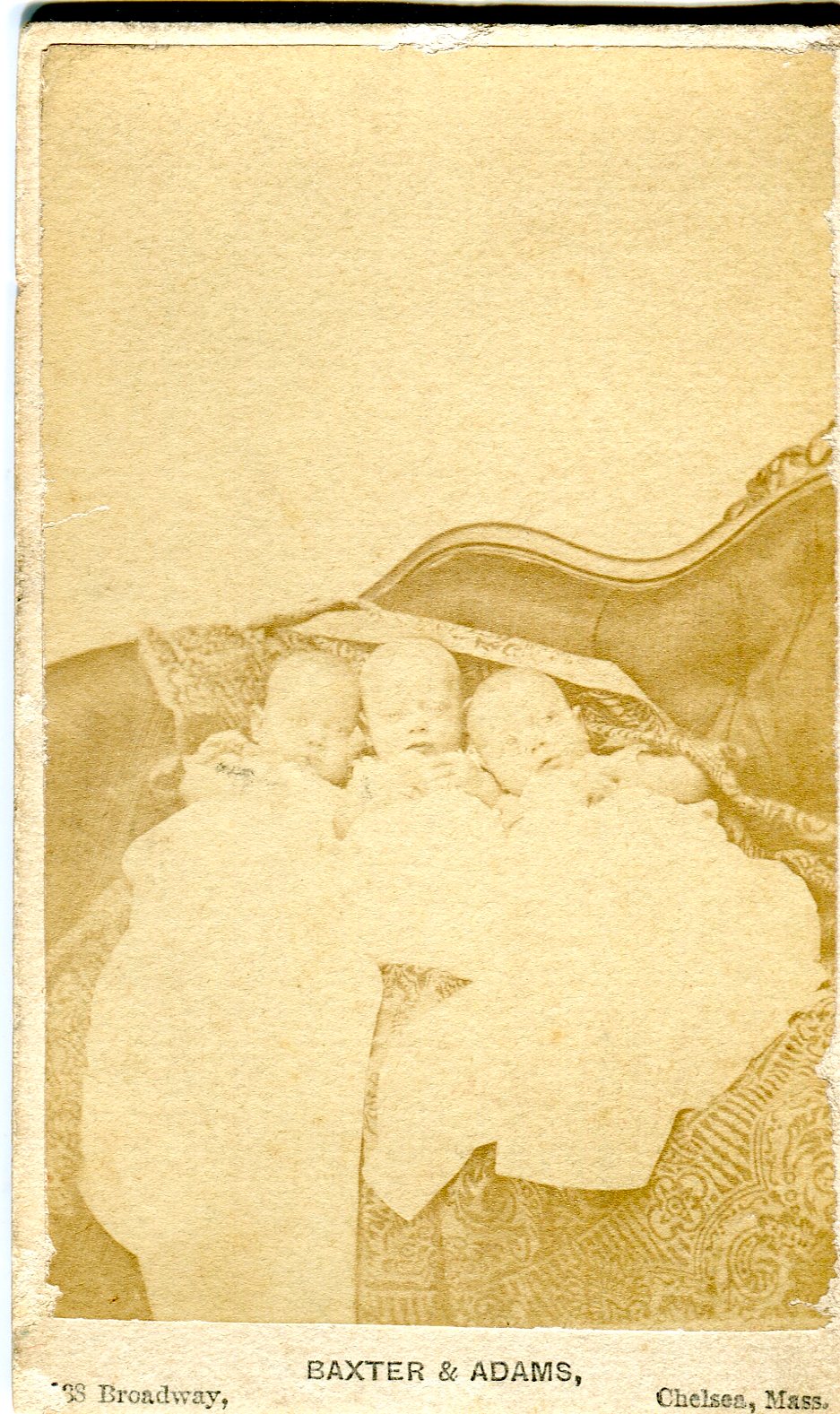
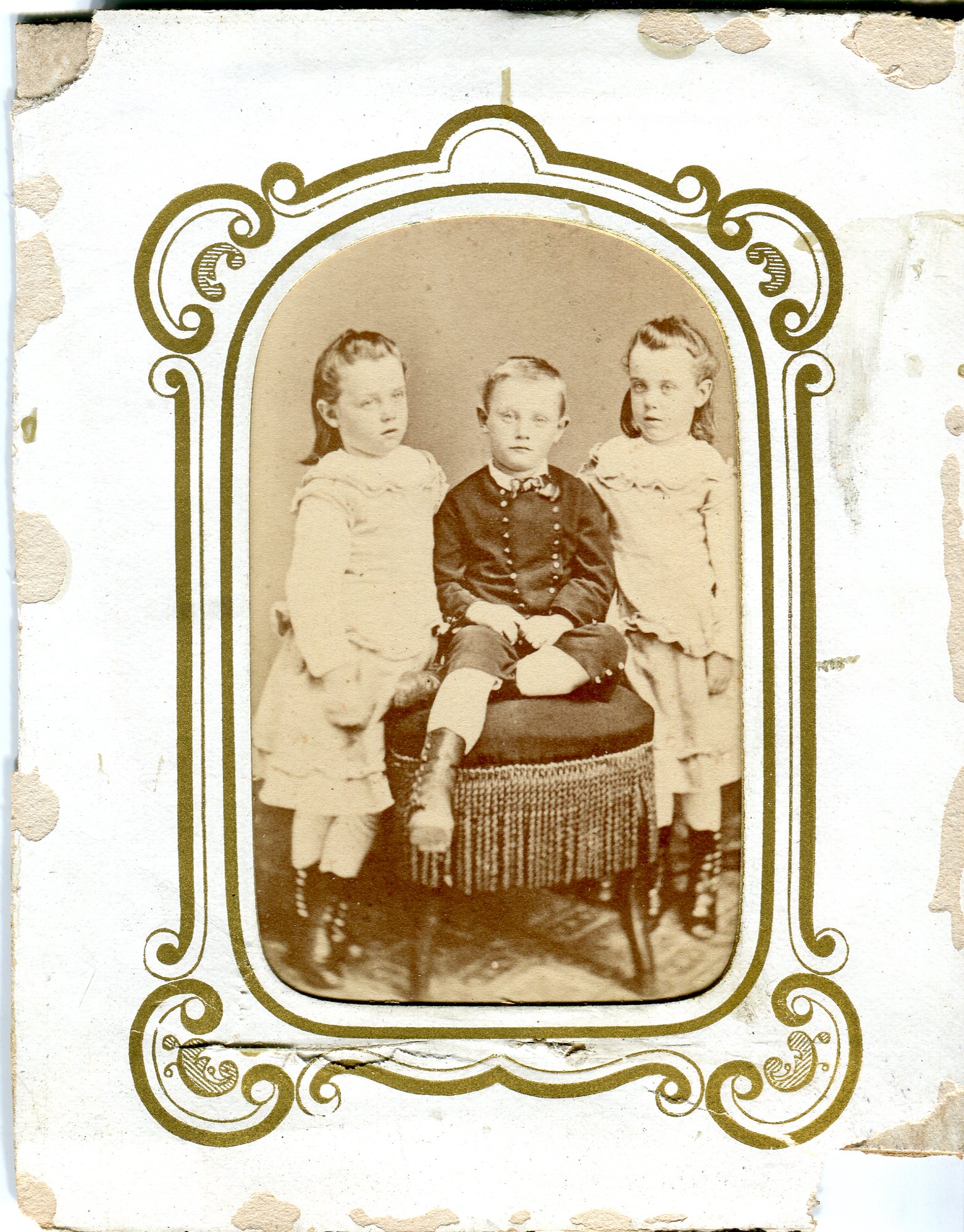
Delano Triplets, 1868 Photographer: Baxter & Adams, Chelsea, MA

Delano Triplets, 1868
Photographer: Baxter & Adams, Chelsea, MA

Carolyn Ravenscroft, Archivist

The survival rate of triplets in the mid-19th century was not high – neither for mother nor children. A home-birth with the assistance of the local doctor was dicey at best. Medicine of the day was also woefully inadequate to assist these undersized or premature babies once they were born.  So, it is surprising that Catherine Drew Delano (1833-1919) was able to produce three healthy babies on a cold winter’s day in January, 1868.  The children – two girls and a boy – were Caroline S. Delano (1868-1955), Grace T. Delano (1868-1935) and Benjamin Franklin Delano (1868-1920).  What makes their coming into the world even more special, are the four photographs that follow them from infancy to their teenage years. A remarkable record of their early life.

The triplets were born in Chelsea, MA but they are from Duxbury stock and spent much of their lives here.  Their father, Winslow T. Delano, was the son of Capt. Samuel Delano and the nephew of Capt. Amasa Delano. After a short stint following the California Gold Rush, Winslow returned east and entered is brother’s shipbuilding firm on Lincoln’s Wharf in Boston – B. F. Delano & Co. In 1855 he married Catherine D. Winslow of Duxbury.  Two sets of twins came in quick succession – Fanny and Emily in 1857 and George and Arthur in 1859. In each of these cases, a twin sadly died within three months. When the triplets arrived, therefore, they were greeted not only by their grateful parents, but also only two older siblings.  But, in a cruel twist of fate, while the triplets thrived, it was their father who did not live past three months of their birth. On April 23, 1868 Winslow died of “softening of the brain.”  This diagnosis could indicate a variety of causes, but it was most likely a cerebral hemorrhage. He was only 47 years old.  Catherine was now the widowed mother of five young children.

Delano Triplets, c. 1870 Photographer: M. Chandler [Marshfield, MA]

Delano Triplets, c. 1870
Photographer: M. Chandler [Marshfield, MA]

The 1870 census shows the family having left Chelsea and living on St. George Street in Duxbury next to the home of Catherine’s parents – George Winslow and Hannah Drew Winslow. This move ensured that Catherine had the help of not only her mother and younger sister, Georgianna Winslow, but also of a number of aunts, cousins and friends.  By 1880, however, the family had moved back to Boston and was living at 81 St. Botoloph Street. They divided their time between the city and the seaside, maintaining ownership of their St. George Street property throughout their lives.  The Delanos were active in Duxbury’s civic and social affairs of the day – Caroline S. Delano, also called “Carrie,” was one of the founding members of the Duxbury Rural & Historical Society.  Grace and Carrie never married and it does not appear that their brother did either – all are buried in their family’s plot in Duxbury’s Mayflower Cemetery.

Delano Triplets, c. 1888 Photographer: Notman, Boston, MA

Delano Triplets: Carrie, Frank & Grace, c. 1888
Photographer: Notman, Boston, MA

Delano Triplets, c. 1874 Photographer: Unknown

Delano Triplets, c. 1874
Photographer: Unknown

Journal of The Point School – Home of the First Student Government

Sketch of the Point School.

Sketch of the Point School.

In 1840-41 when this journal or “Report of the Secretary” was written, The Point School was one of nine common schools in Duxbury (there would eventually be 12 neighborhood schools throughout town). The school, built in 1800, was located on what is today the corner of Powder Point Ave. and Bay Pond Road.  The students at the Point School ranged in age from approximately 8 to 17, but it was only the older students who participated in the student government that produced this journal.

The students mentioned are: John Bradford, b. 1823; Daniel Brewster, b. 1825;  Lucy Brooks, b. 1825; Joan Chandler; John Cushman; Anna Delano, b. 1825; Henry Leach; Jane McLauthlin, b. 1925 (she married her classmate, John Bradford); Rufus McLauthlin; George F. Nickerson, b. 1824; Rueben Peterson, b, 1828;  Jane Smith; Jonathan Smith, b. 1824; Samuel Weston; Roland C. Winslow, b. 1825; and Amasa Witheral, b. 1824.

Their teacher was Mr. Edmund Gifford (1810-1883) of Pembroke. Gifford married Lucy Winsor Sampson, a Duxbury girl, in July of 1841, just a few months after this record was kept.  The Giffords moved to Elgin, Illinois where Edmund became an attorney and the superintendent of schools. Later he was a judge in New Orleans, LA.  According to a student, Mr. Gifford told them on the first day of school, “[we] must govern ourselves, or we could not help to govern our country wisely.” [1] They called themselves the “Mattakeeset Republic,” after the Native American name for the area.

In 1878 the location of the Point School was moved to an empty lot on Cedar Street. When the Alden School was built in 1927 the Point School was closed.

What follows is a portion of the journal kept by the Mattakeeset Republic. The entire journal is published under the Journals tab at the top of this page.

Report of the Secretary,
 of the
 Mattakeeset Republic

Monday morn.  December 28th  1840

This school was called to order by Mr. Edmund Gifford and it was voted to adopt the card of recitations that we used last winter.  It was then voted that George Nickerson continue in the office of secretary.   Mr. Gifford then proceeded to organize the classes which took nearly all day; George Nickerson resigned his (office) of secretary and Jane Smith was chosen in his stead.  John Bradford was chosen to keep the register, the school was then dismissed.

Marker placed at site of school during Duxbury's Tercentenary, 1937

Marker placed at site of school during Duxbury’s Tercentenary, 1937

29th.  Considerable noise today and the schoolmaster spoke of it several times.  There were a few toasts today and it was moved to have an evening school but as Mr. Gifford could not come the motion was not put.  The school was closed by reading in the testament.

30th  This afternoon we wrote compositions.  It was moved that we have an evening school but the vote was not taken as Mr. Gifford could not attend.  School was closed by reading in the testament.

31st.  Nothing of any consequence happened this day.  A motion was put in for an evening school but did not put it to vote as Mr. Gifford could not attend.

January 1, 1841  — Voted that the class in the Fourth book select pieces.  Voted that we have a debate every Wednesday afternoon and that we choose a committee to prepare questions to debate upon on said occasions.  Voted that the exercises of the school shall close at ½ past 2 on Wednesday afternoon that we can have more debating.  Voted that we choose a committee to bring in questions for debate.  Amasa Witherell, John Bradford, & Jonathan Smith were chosen.

January 2, 1841  The Committee to bring in questions brought in 3 and they were all accepted.  Voted that we accept the third one for debate on next Wednesday which was, Which is the more dangerous a sailors life or a carpenter’s?  Voted that the schoolmaster should appoint two scholars to speak on each side.  Voted that no scholar under 12 years of age shall speak in the debate.

January 4.  Voted that Mr. Gifford should not go beyond the sound of the bell.  Voted that the scholars that have writing books should write a page in them every day.  Question where was the first railroad and who was the Inventor?

5th  Voted that the basin on the stove should be cleaned out every morning by the monitor.

6th  Wednesday afternoon we debated on the question for debate and it was decided in the negative that a carpenters sailor’s life is the most dangerous.  Voted that we take up question 1st for debate.  Ought our Pilgrim fathers to be justified in their treatment of the Indians?  George Bradford & Roland C. Winslow appointed to speak in the affirmative, & Reuben Peterson & George F. Nickerson in the negative.

7th  Voted that the second class in first class book shall take turns in selecting pieces to read… Voted that the Class in third book select pieces to read….

8th  there was nothing done today of consequence.

11th  Voted that we have an evening school this evening for the purpose of spelling and ciphering and Daniel Brewster was appointed monitor.  At ½ past six the school was commenced.  At ½ past seven Mr. Gifford not coming we chose sides and spelt.  After that we took up the question for debate and after a short debate laid it on the table for debate on Wednesday afternoon.  School was then dismissed.

12th  Voted to have an evening school this evening for the purpose ciphering and spelling.

[1]Paper by  J.W. Smith, Feb. 1, 1908.

The Fire That Burned the Weston Dynasty

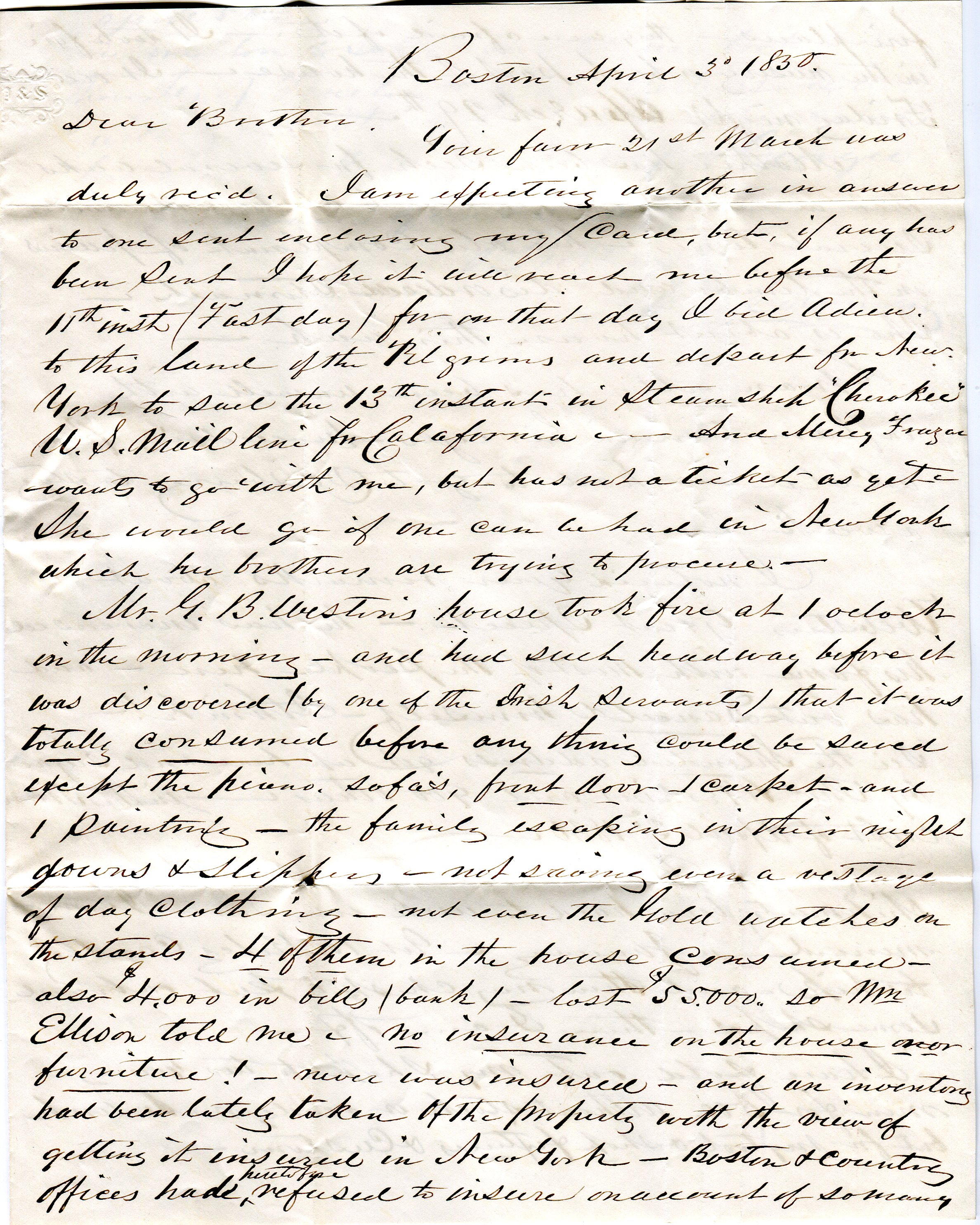
Letter written by Samuel L. Winsor to his brother in 1850 describing the fire at the Weston house.  The letter was recently acquired by the Drew Archival Library

Letter written by Samuel L. Winsor to his brother in 1850 describing the fire at the Weston house. The letter was recently acquired by the Drew Archival Library

Carolyn Ravenscroft, Archivist

Just after midnight on March 29,1850 an Irish servant in the employ of Gerhsom Bradford Weston awoke to the smell of smoke. After giving an alarm, she, along with the large Weston clan, ran from the house in their nightclothes and watched in horror as the quickly moving blaze burned the stately home on Harmony Street (today’s St. George St.). Despite the best efforts of the volunteer bucket brigade, almost nothing could be saved of the contents of the house – portraits, jewelry, furnishings, and even $4,000 in cash were all lost within a few short hours. The total loss reported by Weston’s secretary, William Ellison, was $55,000 ($1.7 million today).

Two letters at the Drew Archival Library recount the fire. One, written by Louisa Bradford Thomas, the Weston’s neighbor at 4 Cedar Street, gives an eye-witness account of the “melancholy spectacle” to her niece, Isabel Kent. The Weston family, turned out of the house without so much as stockings on their feet, made their way to a friend’s house and sent a note to Louisa Thomas for clothing, which she was able to supply. According to Mrs. Thomas, the family lost “the accumulation of thirty years, from all parts of Europe, besides portraits & treasures.” The other letter, only recently acquired by the Drew Archival Library, was written by Samuel L. Winsor to his brother, Capt. Daniel L. Winsor. It gives particulars gleaned from speaking to William Ellison about what transpired on the night of the fire. He records the only items saved from the blaze were “the piano, sofas, front door, 1 carpet and 1 painting.” Both letters refer to the fact that the house was uninsured, but Winsor gives added detail, i.e. “no insurance on the house or on furniture! Never was insured…Boston & Country offices had heretofore refused to insure on account of so many fireplaces.” Perhaps most amazing to Winsor was the loss of “gold watches on the stands – 4 of them in the house.”

Had the fire happened at a different time, perhaps a few years earlier when the great Weston shipbuilding firm begun by Ezra “King Caesar” Weston I in 1764 was still one of the most profitable and recognized in the world, the loss would not have been so catastrophic. But for Gershom Bradford Weston, the eldest son of Duxbury’s second “King Caesar,” Ezra Weston II, the house and its contents now represented almost the entirety of his net-worth.   Typical of the later generations of great merchant wealth, G. B. Weston did not produce income, instead he spent it to promote worthy causes, such as abolition and temperance, and to advance his political career. Also perhaps a bit too typically, he did not see the need to curtail his expenditures once the bulk of his inheritance had been reduced to ashes. He moved his family to temporary quarters in Boston and began the rebuilding of his estate – even larger than before. To pay for the new house he borrowed heavily from his younger brother, Alden B. Weston, and allowed him to hold the mortgage.

During the 1850’s and into the 1860’s Gershom Bradford Weston may have felt the pinch of his reduced circumstances, but to the outside world nothing had changed. He continued to be active in local and state politics, and even ran as the Free Soil Party candidate for the Congress in 1852. In 1860 he was a delegate to the Republican National Convention that nominated Abraham Lincoln. During the Civil War he tirelessly worked to recruit men from Duxbury to serve in the Union Army and was instrumental in seeing that Duxbury soldiers received the bounties that were due them.

wright estate001

Mansion rebuilt by Gershom Bradford Weston, later owned by the Wright family. It was torn down in the late 1960s

Despite his unflagging political and social career, financial troubles were on the horizon. In October, 1864 Weston mortgaged the entirety of his personal property to his son Alfred for $3,288.50 with the understanding that all property would remain in the hands of Gershom Bradford Weston and he had the right to purchase it back within five years. Included in the inventory are his horses, Charley and Poppit, a variety of carriages and buggies, livestock, and home furnishings. Nothing in the inventory is as elegant as the descriptions of those items lost in the fire 14 years earlier – there is only one gold watch this time. The following month Weston wrote out an inventory of his real estate holdings under the heading “Judgment for the sum of $11,755.54, Executed 30 Nov 1864.” But the biggest financial reversal came in 1867 when, after years of estrangement and litigation, his brother Alden called in the mortgage on the Harmony Street property. Once again Gershom Bradford Weston found himself turned out of his mansion – only this time there was no hope of getting it back.

In what could be considered a cruel twist of fate, Weston rented a house just on the edge of his former estate (21 Pine Hill Ave.). He therefore had a front row seat as he watched the new and fantastically wealthy owners, George and Georgianna Wright, take possession of it. When word reached his Boston friends that the house Weston was renting was to be sold, forcing him to move yet again, they took up a collection and purchased the property – putting the house in his wife’s name to keep it from the creditors.  Gershom Bradford Weston died in 1869 at the age of 70. When his brother Alden died in 1880, the original Weston mansion (today known as the King Caesar House), the final vestige of the once great Weston dynasty, was sold and turned into the Powder Point School for Boys.

Sources:

Browne, Patrick T.J. King Caesar of Duxbury: Exploring the World of Ezra Weston, Shipbuilder & Merchant. Duxbury, MA: Duxbury Rural & Historical Society. 2006.

Weston, Edmund Brownell. In Memorium: My Father and My Mother Hon. Gershom Bradford Weston, Deborah Brownell Weston of Duxbury, Massachusetts. Providence, RI. 1916.

Louisa B. Thomas Letter in Bradford Family Collection, DAL.MSS.024, Drew Archival Library

Samuel L. Winsor Letter (1850), DAL.SMS.068, Drew Archival Library

Financial papers, Alden B. Weston Collection, Drew Archival Library, DAL.MSS.056

Date Board House Files, Capt. George Peterson House, 1801, Drew Archival Library

Imprinted on My Heart: The Unrequited Love of Sarah Freeman Sampson

The Drew Archives recently acquired the letter of Sarah F. Sampson to Jacob Smith, Jr. (1836) DAL.SMS.063

The Drew Archives recently acquired the letter of Sarah F. Sampson to Jacob Smith, Jr. (1836) DAL.SMS.063

Carolyn Ravenscroft, Archivist

At 9pm on the night of September 11, 1836, Sarah F. Sampson sat in her bedroom and wrote one last love letter to her cousin Jacob Smith, Jr. It was Jacob’s 25th birthday but she did not mention the occasion in her letter, perhaps she had forgotten. What she did mention, repeatedly, was her devotion to him. This could not have been an easy thing to write, as Jacob was due to marry Persis “Ann” Weston, another cousin, in less than a month. At no point did Sarah implore Jacob not to marry, she even wished him well, but it is clear she would rather he had chosen her.

Sarah Freeman Sampson was born in Duxbury on March 1, 1813 in the cape-style home her father, Martin Sampson, had built in 1807 (today’s 57 South Station Ave.). Sarah’s mother died within months of her birth, leaving her father to care for her as well as her two siblings, ages 3 and 5. Not surprisingly, Martin chose to remarry rather quickly, and it was through Martin Sampson’s second wife, Sarah Smith, that Sarah F. would become related to the recipient of her letter. Jacob Smith, Jr. was Sarah Smith’s nephew. Not that their paths wouldn’t have crossed without this connection – Sarah’s house was only a stone’s throw to Jacob’s, he living at what is today 251 Harrison Street. But, the inevitable family gatherings must have made the two much more aware of each other. And young Jacob Smith was certainly someone to notice. By 1836 he was already first mate on his father’s brig, Globe. He had gone to sea when he was only eight, celebrating his ninth birthday in Malaga, Spain. According to one source, at age eleven he had been paraded in front of Russian nobility in St. Petersburg as the first American child they had ever seen. While many Duxbury sailors could tell tales of far away places to impress the ladies, Jacob had the advantage of being young, wealthy and having great prospects. His father, Capt. Jacob Smith, Sr., was an important member of the town who not only owned a number of Duxbury properties, but also a large farm in Marshfield. Is it any wonder that Sarah F.Sampson was smitten?

How Jacob received his cousin’s letter, or whether he returned her sentiments, is impossible to know. Sarah’s letter does indicate she had received an equally private one from him so there may have been complicated feelings on both sides. Regardless, he went ahead with his wedding to Persis Ann Weston in October, 1836. Persis, or Ann, as she was called, was the niece of his step-mother (like Sarah Sampson, Jacob had lost his own mother when he was very young). Married life did not keep him at home, at least not initially. As the captain of his own vessel, Jacob traveled around Cape Horn and up the western seaboard in 1837, trading with the natives for sable furs which he sold back in New England. In 1838 he was in London to see the coronation of Queen Victoria. At the age of thirty, having been aboard a ship more often than not, he retired from the sea and moved to Westford, MA. There he owned an historic tavern, became a gentleman farmer and was active in local politics – he served as a Selectman during all four years of the Civil War. He died in 1898, the oldest man in Westford at the time, leaving behind his wife, Ann, and two daughters – Miss Clara A. Smith and Mrs. Louisa D. Young. A son, Henry, had died in a tragic rail road accident at the age of 21 in 1863.

Lest you feel too badly for Sarah F. Sampson, let me assure you she married well and had a happy life (or as happy as we can surmise from the scant information left to us). In 1840 her heart was mended enough to accept the proposal of a very successful dry goods merchant from Medford named Jonas Coburn. Together they had five children: Sarah Louise (b. 1841), Charles F. (b. 1843), George M. (b. 1846), Frank (b. 1853) and William (b. 1854). All lived to adulthood but William who died at age 4. The Coburns were very active in civic affairs and were substantial members of the community. As a memorial to their parents, the children of Jonas and Sarah had a stained glass window installed in the First Parish Church in Medford that can still be seen today.

During the summer months Sarah would bring her family to Duxbury and stay with her unmarried sister, Hannah, in her childhood home. After Hannah Sampson’s death in 1882, the house was left to Sarah and her children who retained the property as a summer residence into the 20th century.  Sarah Freeman Sampson Coburn died in Medford, MA in 1890, at age 77.

The following is a transcription of the letter Sarah penned late at night to “the one person I really did love.”

Jacob Smith, Jr. Chief Mate of the Brig Globe, Boston
Duxbury Sept. 11, 1836

Coz Jacob,

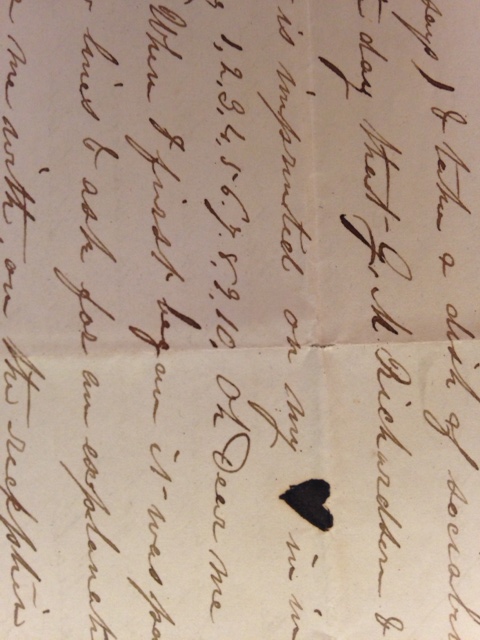
I received your letter last Saturday & was not a little surprised at its contents. You say that you heard I was keeping school & Mr. Lovell often called & stopped after school. What do you mean? I entreat of you Jacob to answer this the moment you have read it & tell me where you got your information. I now call upon you as a friend to listen impartially to a fair statement of facts. In the first place I have neither seen or heard from a Lovell since last winter, & in the second place, Mr. Lovell never was the chosen object of my affection, I liked him as a friend but I did not love him as – I can think it but I can’t say it. No Jacob there never was but one person that I thought I really did love. You undoubtedly know who I have reference too. I have loved, shall ever love him. But that love will never be returned, another will have that privilege (in other words does have) it is a privilege indeed!!! Let him go, but he carries with him the most devoted affections of one who never knew love till she saw him & who will never know – I will stop where I am for I have already said too much. But you know me too well I shall therefore entrust this to your honour, as I have done heretofore. As it was your request I have kept your letter private & I now ask the same of you. Don’t you show it at your peril for I have written it from the impulse of the moment. A few more brief sentences & I will close. Mr. Stetson & the will be Mrs. Stetson returned last night. I have not yet seen Martha, but I saw Mr. Stetson to day & dined with him. He says you are the some old six pence or I believe it is now “2 & 6 pence.” By the way I saw Sarah Loring last Sunday, but did not speak with her. Martha R. has just gone from here in all her beauty. She wished to be remembered to you. She is a friend if ever there was one. I would not part with her for all the girls there are in Duxbury. I forgot to mention that I have a letter from cousin N. F. Frothingham to day, he writes he is coming down in a few days. I shall be happy to see him & I think I should like to see you a few moments (or so) as Aunt Shere says & taken a dish of sociability. By the way have you forgotten the day that G. M. Richardson & myself spent at your house? I have not. It is imprinted on my [heart] in indelible

Portion of Sarah F. Sampson Letter

Portion of Sarah F. Sampson Letter

characters. Hark!! The clock is striking 1,2,3,4,5,6,7,8,9,10. Oh Dear me I must draw this  protracted scrawl to a close. When I first began it was past nine & I thought I would just write a few lines & ask for an explanation of your letter, which I beg you will favour me with, on the reception of this. Jacob you must excuse the writing, [editing] & orthography of this letter for I am positively half asleep. Pardon me for not previously mentioning the name of Ann. Heaven smile on you both & bless you, may your cup of happiness be ever full even to overflowing. May no cloud interrupt the sunshine of your days, & when at last you are called to part from her here, may you be reunited in that world “where the wicked cease from troubling and the weary are at rest” is the sincerest wish of

Your aff cousin
S. F. Sampson

In two minutes more I am tucked up in bed fast asleep

N.B. & P.S.
I am so sleepy that I cannot possibly read this over. If I have written anything improper I beg of you to excuse it & take it from whence it came.
Good night
Sarah
Answer this full of news
Love to all

Note: Mr. Lovell is a mystery at this time but some of the other names a known. Mr. and Mrs. Stetson are Jacob Smith’s brother-in-law, Samuel Stetson, and sister, Martha. Samuel Stetson was a lawyer and the couple lived on Tremont Street.
G. M. Richardson was most likely part of the Richardson family that owned a large estate adjacent to Sarah F. Sampson’s house. The estate was once owned by George Partridge, one of Duxbury’s most prominent citizens and inherited by George P. Richardson. Martha R may be Martha Richardson (b. 1815).
N.F. Frothingham is Nathaniel F. Frothingham of Charlestown, MA whose mother was Joanna Sampson of Duxbury. He married Margaret T. Smith, the daughter of Capt. Benjamin Smith and cousin to both Jacob Smith, Jr and Sarah F. Sampson. It is interesting to note that Frothingham married Margaret on Sept. 30, 1836, just 19 days after this letter was written.

Sources:
Drew Archival Library, House Date board Files – Martin Sampson House and Daniel Bradford House
Drew Archival Library, Capt. Jacob Smith Collection
Find A Grave, Jacob Smith, Jr, http://www.findagrave.com/cgi-bin/fg.cgi?page=gr&GRid=124241863
Unitarian Universalist Church of Medford, http://www.uumedford.org/history.html
Leading manufacturers and merchants of eastern Massachusetts: historical and descriptive review of the industrial enterprises of Bristol, Plymouth, Norfolk, and Middlesex Counties (Google eBook)

New Acquisition of Rev. John Allyn’s Sermons

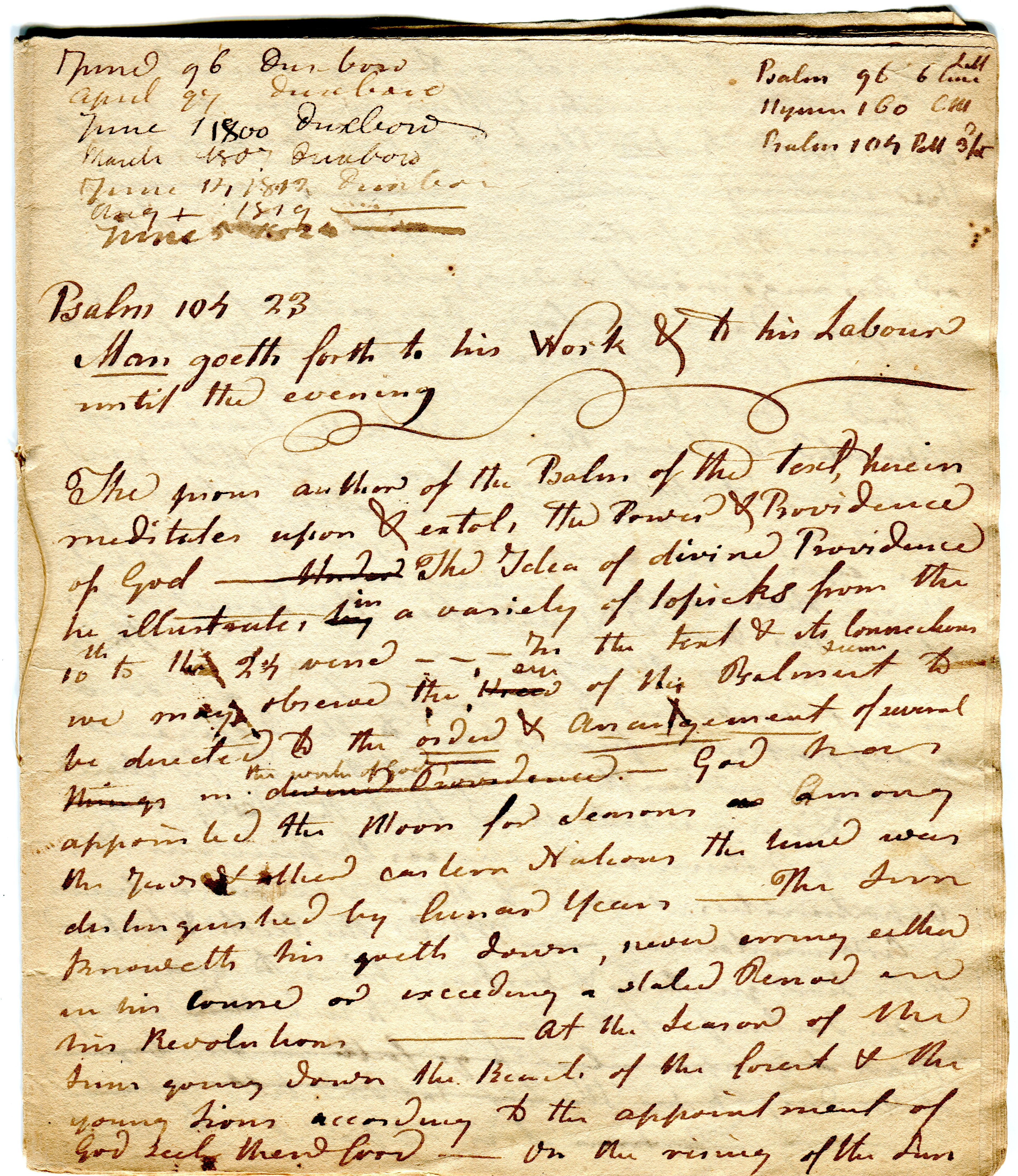
Sermon of Rev. John Allyn, delivered April 1796 in Duxbury.

Sermon of Rev. John Allyn, delivered April 1796 in Duxbury.

Carolyn Ravenscroft, Archivist

In a town as old as Duxbury, there are many men and women who can claim a prominent place in its history.  Founders such as John and Priscilla Alden; shipbuilders Ezra “King Caesar” Weston I and II; master mariner and author Amasa Delano; and stage actress Fanny Davenport, are only a few names that come to mind.  However, all towns have their less heralded, though equally significant, citizens and Duxbury is no exception.  Rev. John Allyn (pronounced Alline) falls into this second category.  Rev. Allyn was the minister of the First Parish Church for 45 years, from 1788-1833.  While the majority of his tenure was peaceful, Allyn was part of a controversy at the end of his career that divided the town and had repercussions for decades after his death. Recently the Drew Archival Library received a gift of over fifty of the Rev. Allyn’s sermons from his descendants, Faith Stimson and Emily Sugg.  These sermons will help to illuminate the life of a man who was such an integral part of the community during the early 19th century.

Rev. Allyn was born in Barnstable, MA in 1767 and educated at Harvard College, earning his A.B. in 1785.  He received his A.M. in 1788, the same year he was ordained as Duxbury’s minister. Three years later he married Abigail Bradford.  The couple settled into a lovely home at 1043 Tremont Street, an easy stroll to the First Parish Church. The church to which Rev. Allyn would have walked was not the large Greek Revival structure we see today, but a smaller, squarer building painted a light yellow.  This meeting house, built in 1787, only a year before Allyn’s arrival, was more in keeping with the limited means of the post-Revolutionary Duxbury, a town that had yet to reach its shipbuilding zenith. In addition to his ministerial duties, Allyn ran a school from his home.

The contemporary accounts we have all indicate that Rev. Allyn was kind and a bit eccentric.  It is not hard to imagine him as the disheveled benevolent scholar.  According to his son-in-law, Rev. Convers Francis, Allyn possessed a peculiar imagination and often avoided the “beaten track of thought.” During conversation he loved to “throw his thoughts out in a desultory and startling manner.”[1]  Unfortunately, this often led to him being misconstrued.  He could also be rather unorthodox in his methods, once dressing as a ghost to scare a family, who had disavowed the existence God, back into believing.[2]   The pupils boarding at his school called him uncle and recalled many happy times in Duxbury under his tutelage. They received discipline only from his daughter, Abigail, never from Allyn himself. Perhaps the most famous of his students was a young Abigail May, the mother of Louisa May Alcott.[3]

Despite years of faithful service, Rev. Allyn’s tenure as minister in Duxbury had a final, dark chapter.  Allyn was afflicted with a premature ageing of both is his mind and body.  I am sure a modern-day physician could find a diagnosis based on contemporary evidence, but for the sake of this article, it is enough to say that he found himself incapacitated during much of his later years.  In 1825 Allyn asked that the congregation hire a co-minister to assist him in his duties.  This would allow him to live out his waning years in the community he loved and continue to preach to his flock at least part of the time.  However, it would also force the congregation to pay two salaries. Had his request come a decade earlier, perhaps there would have been no discussion on the matter but a number of changes had occurred that left the First Parish Church and the town divided over this request.

The Second Great Awakening that had been sweeping the country had caused some to leave the Unitarian pews of the First Parish Church for the newly formed Methodist and Universalist churches that had been built Washington Street. The number who left included some of wealthiest men in Duxbury at the time including Hon. Seth Sprague.  This exodus coincided with disestablishment of the Churches of the Standing Order.[4]  Prior to the disestablishment everyone had to pay a tax to support the sanctioned town church whether you were a member or not.  After the disestablishment, men like Sprague were no longer beholden to help fund the First Parish Church, resulting in a loss of revenue. With enough money to spare, a second minster may have incited little comment.  A tighter budget, however, caused many within the church, including a young fledgling politician named Gershom Bradford Weston, to demand the resignation of Allyn and the hiring of a new full-time minister.

Monument to Rev. John Allyn, Mayflower Cemetery, Duxbury, MA.

Monument erected in 1861 to the memory of Rev. John Allyn in Mayflower Cemetery, Duxbury, MA.

What came to pass is not a pretty commentary.  Because Allyn was still so beloved by many the congregation, a co-minister, Rev. Benjamin Kent, was hired to assist him.  Kent moved with his young family into a house built for them at 992 Tremont Street.  But, for the next seven years both Kent and Allyn constantly battled with the faction within the First Parish Church that disagreed with supporting two salaries.  Of the conflict, Sarah Bradford, who was related to Kent and therefore not unbiased, wrote to her daughter, “we are all in trouble, the Parish won’t pay two and we fear Mr. Kent will leave us, every one is for Mr. K but Dr. A won’t quit. I don’t know what we shall do…the Parish is in a sad state…”[5] The fight took a toll on both ministers. By 1833 Kent had been carted off to an insane asylum and Allyn was dead.[6]  Years later, during another controversy within the First Parish Church, Kent wrote a letter from his Roxbury home declaring that Gershom Bradford Weston was the cause of his temporary insanity and Allyn’s death.[7]

Rev. Allyn was buried in the tomb of another prominent Duxbury leader, Hon. George Partridge.  Hiswife and daughter were forced to sell their home and move from town.  In 1861 those who recalled him fondly raised a monument to their former minister and teacher in the Mayflower Cemetery which reads:

To the Memory of John Allyn, D.D.

Who was for 45 years the learned

able, and honored minister of the

Congregational Society in

Duxbury. Born at Barnstable Mass

March 21, 1767 Died at Duxbury

July 19, 1833

 In a succeeding generation some

of those who in early life shared

his kindness, profited by his

counsels and were impressed by

his truthfulness testify their

gratitude and reverence by this

Memorial stone.


[1] Convers Francis, Memoir of Rev. John Allyn of Duxbury.  See also, Justin Winsor, History of Duxbury (Crosby & Nichols: Boston, MA), 1849 p. 209

[2] “A Ghostly Visit” in Duxbury Budget (Duxbury Rural Society: Duxubry, MA), 1900, p. 20.

[3] Edmund Burke Willson, Memorial of John Clarke Lee (Salem Press; Salem, MA) 1879, p. 10 and Eve LaPlante, Marmee & Louisa: The Untold Story of Louisa May Alcott and Her Mother (Free Press: New York), 2012, p. 26.

[4] Massachusetts broke the ties between church and state with the disestablishment of the Standing Order in 1833.  However, individual parishes ended the relationship earlier, Duxbury did so in 1828.

[5] Letter from Sarah Bradford to Maria W. Bradford, April 21 [1833], Bradford Family Collection, Drew Archival Library.  Maria W. Bradford’s husband, Claudius Bradford, was Benjamin Kent’s brother-in-law.

[6] Letter from Sarah Bradford to Lucia A. Bradford, May 5, 1833 in Bradford Family Collection, Drew Archival Library, “Mr. Kent has been in the insane hospital now nine days, his insanity came on by degrees until one day before he was carried to the hospital when he was perfectly crazy.”

[7] Letter from Benjamin Kent in Reply of a Committee of the First Parish in Duxbury, Massachusetts to the Public Answer of Hon. Gershom Weston, (Boston: C.C.P. Moody), 1851, p. 41.  Kent also contended that there was no shortage of funds during his ministry to pay two salaries.

The Day the Cable Came to Town

Cable House with trench dug for cable still visible.

Cable House with trench dug for cable still visible. Telegrapher George Green is just visible under the trees in the front of the house. He marked his upper bedroom window with a black dot.

Carolyn Ravenscroft

Many of you are no doubt are familiar with the Landing of the French Atlantic Cable in Duxbury in 1869, but for those of you who have never heard the tale, gather ‘round…

Once upon a time, before smart phones and email, before telecommunications, before even Marconi’s wireless, there was only one way to communicate immediately to those far, far away – cable telegraph lines.  You may not be surprised to learn that Samuel Morse, of “Morse Code” fame developed and patented the first electric telegraph machine in the US in 1837. But, interestingly, the code for transmitting messages could just have easily been called the “Vail Code” since Morse’s assistant, Alfred Vail, was responsible for it, but such is life when you’re not the boss.  By 1861 almost every point in the United States, from California to New York, was connected via wire.  So long Pony Express, hello telegram.

As amazing as connecting the vast North American continent by wire was, there was still a more daunting feat to be accomplished, a transatlantic cable.  With a Victorian can-do attitude and an initial $1.5 million in capital, businessman Cyrus F. Field, along a group of backers, set out to make the world a bit smaller. It took five attempts and over ten years before the ship, Great Eastern (read more about the ship), successfully laid a 2,000 mile-long cable across the ocean floor from Ireland, bringing it ashore in Newfoundland in 1866.

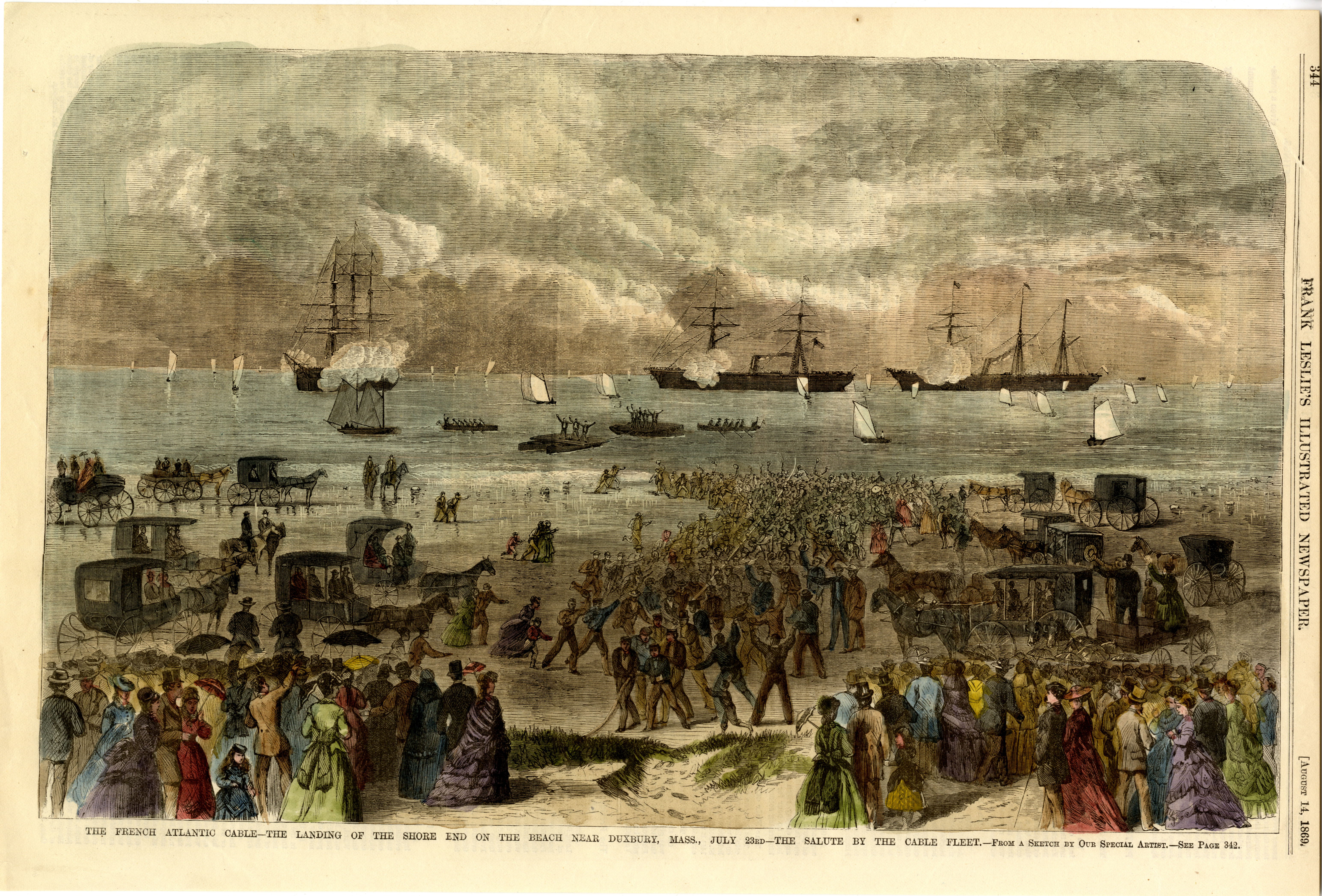
Once Great Britain and North America were connected, the French sought to have their own exclusive means of transatlantic communication.  As with the Anglo line, the French Atlantic Telegraphic Company used the now tried and true Great Eastern.  The French cable was approximately 3,500 miles long – beginning in Brest, France it would travel to the “southern edge of the ‘Grand Banks’; thence to the French island of St. Pierre off the south coast of Newfoundland and thence down past Cape Breton Island and Nova Scotia to Duxbury.”[1] On June 21, 1869 the Great Eastern, accompanied by the ships Chiltern and Scanderia set out on their voyage. Just over a month later, on July 23, 1869 the cable was landed on Duxbury Beach at Rouse’s Hummock.

Landing of the Cable from Frank Leslie's Illustrated

Landing of the Cable from Frank Leslie’s Illustrated

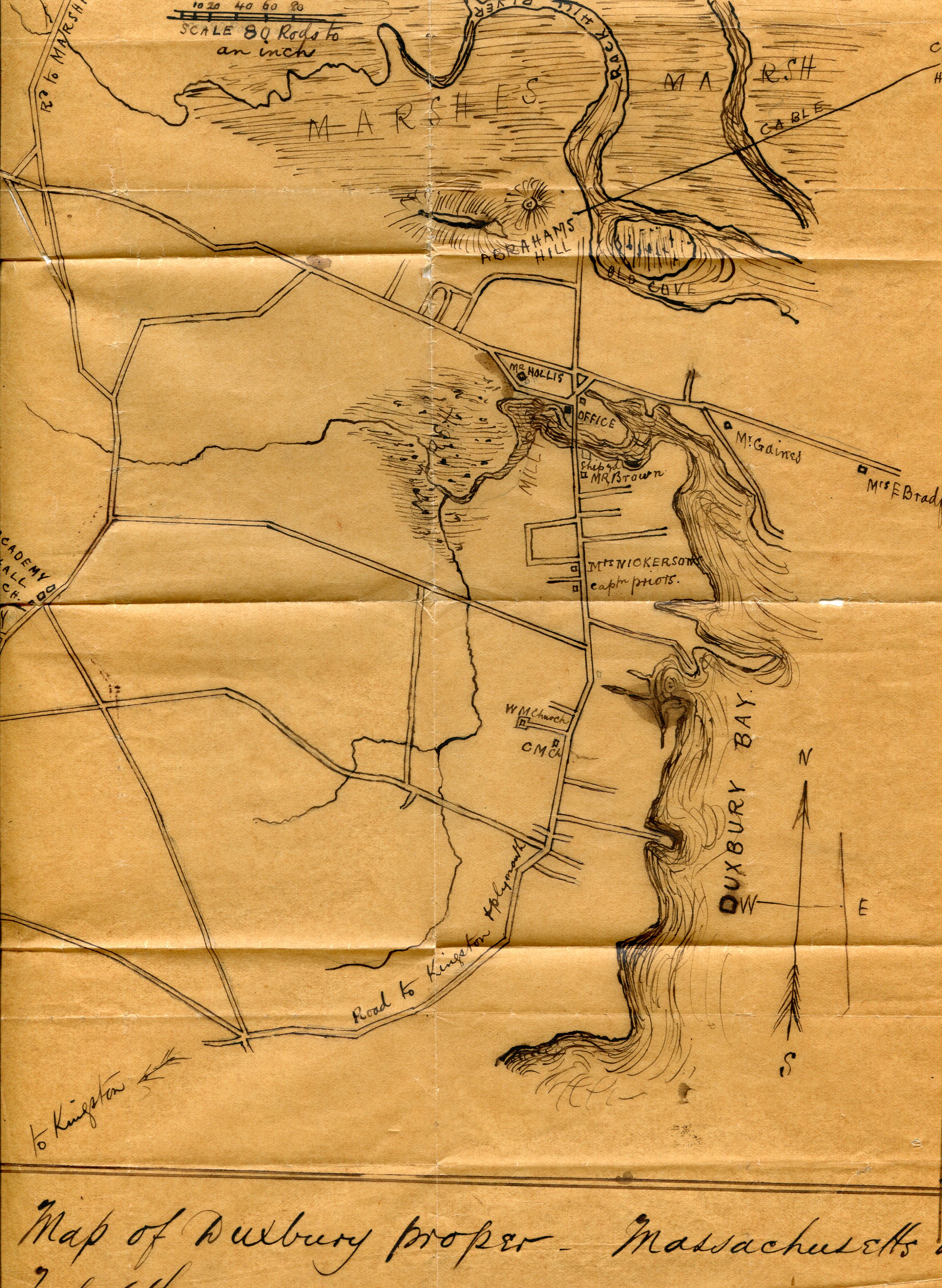
It was a time of great celebration in Duxbury.  A tent was erected on Abrams Hill with a view of the Hummock. Six hundred guests, including dignitaries from around the state, nation and world converged to wine, dine, listen to speeches and most importantly, to see first hand the wonder of sending and receiving messages from across the sea.  Included in the festivities were Mayor N. B. Shurtleff of Boston and President of the Massachusetts Sentate, George O. Brastow.[2]  Cannons of the Second Massachusetts Light Battery were fired, streamers and flags flew and for a moment the eyes of the world were on this sleepy seaside town.

Map showing the cable route into Duxbury, drawn by telegraph operator George Green, 1869.

Map showing the cable route into Duxbury, drawn by telegraph operator George Green, 1869.

The eventual terminus for the cable was the former Duxbury Bank building on the corner of Washington and St. George Streets.  As you can imagine, the early years of the cable office were quite busy and required trained operators, many of whom, like Englishmen Robert Needham and George Green, immigrated to Duxbury along with the cable. Later, Canadian William Facey, the amateur photographer responsible for one of our most-used photo collections, came to work here. These men became some of Duxbury’s most civic-minded residents. After a few years the French Atlantic Cable Company was brought under the fold of the Anglo-American Telegraph Company and later, in 1911, became Western Union.  Over the years other transatlantic cables took away Duxbury’s prominence and business waned. Duxbury’s cable house closed after WWII.

Today the stately home on the Blue Fish River that once housed the cable office is a private residence.  It is still alternately called the “Bank Building” or the “Cable Office” by folks in town…okay, that’s probably not true, it’s called that by a handful of people, including me, but nobody knows what I’m talking about when I say it.  Now you do.

If you would like to learn more about the French Atlantic Cable, you can visit the Drew Archives and view the Robert Needham Collection (DAL.MSS.043), the French Atlantic Cable Collection (DAL.MSS.044), read telegrapher George Green’s own copy of Landing of French Atlantic Cable with his notes, or see the images in the William Facey Collection online at http://www.flickr.com/photos/drewarchives/sets/72157626060922690/


[1] Franklin K. Hoyt, The French Atlantic Cable 1869, Duxbury Rural & Historical Society, 1982. p. 8

[2] The Landing of the French Atlantic Cable, Boston, Alfred Mudge & Son, 1869.


How Myles Standish Lost His Head

Sculptor John Horrigan with Myles Standish's head, 1930.

The Duxbury Rural & Historical Society recently acquired this photograph of sculptor John Horrigan with Myles Standish’s head, 1930.

Carolyn Ravenscroft, Archivist

Myles Standish was known to have a hot temper but it was not until 1922[1] that he truly lost his head.  Shortly after noon on a sultry August day an electrical storm caused lightning to strike the 116-foot monument dedicated to the former military leader of the Pilgrims. The bolt from the sky caused Myles’ head and arm to topple to the ground.

There was no great push to replace his missing granite anatomy so Myles stood headless over Duxbury for four long years.  In 1926, a new head was created by Boston sculptor John Horrigan[2].  Unfortunately the old lightening damaged legs could not support their new addition so back to the quarry it went, along with an order for stronger lower limbs.[3]  Finally, in 1930, an almost completely remade Myles Standish was placed back atop his perch (his outstretched arm and possibly torso are the only remaining parts of the original statue).

While the damage to its statue was catastrophic, the beheading of Myles Standish was only one in a series of misfortunes suffered by the Monument – and some would say it continues to suffer.  The Monument was conceived not by a Duxbury resident but rather by J. Henry Stickney of Baltimore, an admirer of Capt. Standish.  The land atop Captain’s Hill, formerly owned by Standish, was deemed the most appropriate spot to place a memorial. Architect Alden Frink’s design called for a 100′ monument topped with a 14′ statue (with two feet between the parapet and the statue, making it 116′ total). Garnering support and enough money to begin the project, the cornerstone was laid on October 7, 1872, with much fanfare and even Masonic ceremonies, in front of 10,000 onlookers.  But, after an expenditure of $27,000 the monument was still only 72 feet high.  Interest and money waned and it stood half complete until a second wave of donors saw the monument finished in 1898.  When you look at the two shades of granite, you can tell exactly where construction originally halted.

Standish Monument, c. 1900

Standish Monument, c. 1900

By 1920 the Monument and statue were in disrepair.  Dr. Horton, the President of the Standish Monument Association, sought $10,000 from the State for repairs and landscaping.  According to Thomas Weston’s autobiography, the State could offer no assistance unless it acquired the monument.  After persuading the Association deed the land over, a bill was signed by Gov. Calvin Coolidge, allowing for Massachusetts to become its owner and caretaker. [4]  Thus, when Myles lost his head, the State got the bill.

Today the State still gets the bill, but with so many other pressing responsibilities, the upkeep and opening of the Myles Standish Monument has become a bit overlooked.  Despite this, however,  Myles, with his reconstructed head and body, still stands tall.


[1] “Bolt Beheads Myles Standish Statue on Duxbury Shore,” Boston Sunday Globe, August 27, 1922.  This date has been misreported over the years as 1903, 1920 and 1924.  However the actual storm hit on August 26, 1922, two years after the State of Massachusetts took control of the monument from the town.

[2] S. J. Kelly of Boston designed the original statue.  It was sculpted by Stephano Brignoli and Luigi Limonetta of Bayeno, Italy using granite from Maine.  The Monument was designed by architect Alden Frink.

[3] The lower legs were left at Horrigan Granite Co. in Quincy and later ended up in Halifax.

[4] Excerpt from the autobiography of Thomas Weston in Don H. Ross, “The Mystery of Captain Myles Standish’s Legs”, 2001, p. 12.