The Accounts of Ardelia E. Ripley Hall

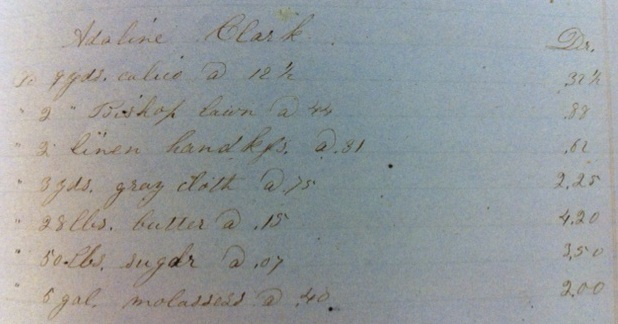
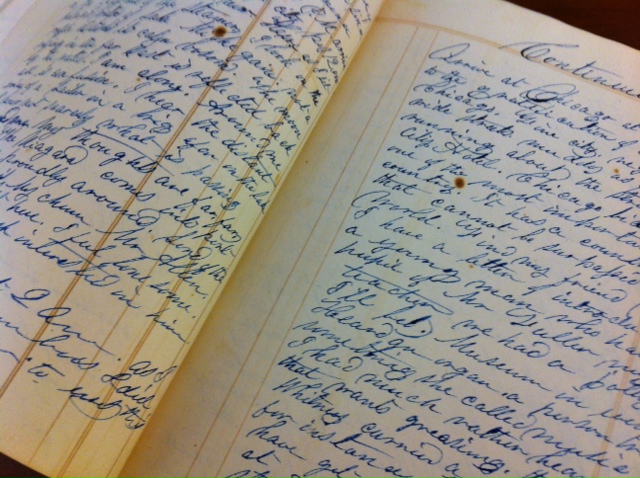
Page of Ardelia E. Ripley's Practice Account Book, 1856.

Page of Ardelia E. Ripley’s Practice Account Book, 1856.

Carolyn Ravenscroft, Archivist

In 1856 seventeen-year-old Ardelia E.Ripley (1839-1899), the daughter of Samuel E. Ripley and Sarah Cushman[1], was a student at Partridge Academy in Duxbury. Her Common School Book-Keeping Being a Practical System by Single Entry; Designed for the use of Public Schools by Charles Northend (1853) can be found at the Drew Archives. It is a wonderful example of how students learned the art of basic accounting. While we have numerous day-books and journals used by adults of the period, it is unusual to see one that demonstrates the learning process. Practice books are often thrown away long before they make it into an archival collection.

What I find fascinating about the book is what it tells us about society in the 1850’s. Here, in neat script, is a full listing of all the items a person might consider purchasing along with their cost. Duxbury was no longer the prosperous shipbuilding mecca it had once been, but that did not mean its inhabitants didn’t still pine for kid gloves and cashmere. Using her classmates and relations as fictitious “customers” Ardelia itemized a veritable Ante-bellum wish-list. Classmate Frederick Bryant, for example, lavishly spent $6.00 on “1 pair of pantaloons for my hired man” but also more sensibly required coarse salt at 1 ¾ per pound, and even a “white wash brush” for $.63. Girlfriends like Josephine Thomas bought “muslin de laine ($.31 per yard), 2 skeins of silk ($.08).” Ardelia’s young cousin, Walter F. Cushman, required a “silk handkerchief ($.50) and a cravat ($1.50).” Older family acquaintances also made it into her accounts, Capt. George P. Richardson was a regular customer, buying “kid gloves ($.75), 29 yards of carpeting ($21.00), a satin vest ($3.25), 1 yard cambric ($.10) and ½ dozen buttons ($.03)” all in one day. In total Ardelia kept her account book for four months, had eleven customers and over 150 entries with hundreds of line-items. While I have not vetted the prices she ascribed to them, the items themselves are a boon to any researcher interested in knowing what was available to purchase in America at that time.

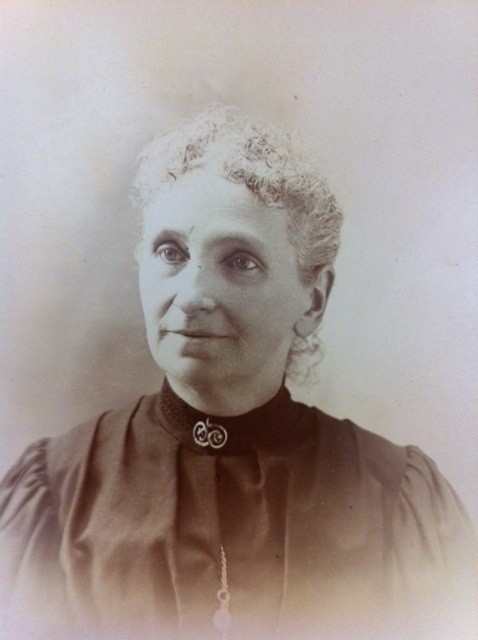
Ardelia E. Ripley (1839-1899)

Ardelia E. Ripley Hall (1839-1899)

Almost equally as fascinating to me are the people Ardelia Ripley chose to include in her assignment and how they fit into Duxbury history. For example, friend Joseph E. Simmons, who’s name is one of the most prominent in the accounts, would one day die in the Civil War at the Second Battle of Bull Run (see the Duxbury in the Civil War article). Captains George P. Richardson and Daniel L. Winsor were prominent civic leaders. Walter F. Cushman grew up to marry Ardelia’s daughter, Lucie. In 1860, Ardelia herself would marry the keeper of the Gurnet Light House, George H. Hall, and have six children. Her son, Captain Parker J. Hall, was one of the most colorful people to ever live in Duxbury (more on him in a future post).


[1] The home of Samuel E. and Sarah Ripley was described in a 1925 The House Beautiful article entitled “The Little Gray House with the Pale-Green Door: One of the Aristocrats of the Cape Cod House.” Ardelia inherited this house and passed it on to her youngest daughter, Lura Cushman Hall.

The Opposite of a Love Letter

Portrait of Lloyd Granville Sampson by Cephas Thompson, 1832.

Portrait of Lloyd Granville Sampson by Cephas Thompson, 1832.

I had fully intended to share a love poem or letter today from one of our collections in honor of Valentine’s Day. But what I found instead was simply too good to pass up.  In 1829, when he was just 21 years old, Lloyd Granville Sampson (1808-1838) penned an essay and poem about the joys of being a bachelor.  He obviously could not see 3 years into the future or he would have known he would be leaving the “state of single blessedness” by marrying the lovely Mary Winsor.  I wonder if she had any inkling of his views on marriage?

Sampson cannot be credited with his turn of phrase. The term “Single Blessedness” was used at the time to describe the lives of women who opted out of marriage. There were benefits to being a spinster in the 19th century that often outweighed those of matrimony for sure – a single woman could own her own property, run a business and sign contracts, things a married woman could not do by law. They could also come and go as they pleased and live an independent life, if they had the financial means, of course. There were also the dangers of childbirth and overbearing husbands to consider. So, remaining unattached was an attractive option (think of our fabulous Bradford Sisters of the Bradford House museum).

It seems Sampson was in favor of his own version of single blessedness. Based on his other witty writing we can assume the following is a bit tongue-in-cheek.  I hope you enjoy this very un-Valentine’s day post.

Written in behalf of the fraternity of Bachelors

Know all to whom these presents my come that I am a Bachelor, that I have lived long in a state of “single blessedness” and in that state I shall die.  I know not how happy a matrimonial life may be, yet I know how peaceful is that of a Bachelor. The former may be pleasing, the latter is well known to me to be so.  The double man may avoid many evils, the single man is sure to avoid one.  In short I know of no life so well calculated for the comfort and care of man as a single one, when evening comes and the sun has quietly gone to rest, it is then the state of single blessedness is most dear to me.  Then there is a comfort in running over past events long gone by, and a delight in anticipating the future.  The Bachelor goes to his “round-a-bout” and takes his care, look at him as he sits with his head inclined upon his elbow puffing a friendly cigar, he has not a scolding wife no disobedient child no few cents for milk, no yelping brats to distract and perplex him, but goes to his bed a quietly as the sun faces the west.  True it is the single man will have not long train to follow him to his “last home” no tears from a “better half” to wet the turf which covers his grave – yet for all this I am a Bachelor – the troubles of the double man will come upon him while the single man is at ease and without care.  When the storm beat upon our casements and  the winds whistle round our dwellings, then the troubles of the married man should be recollected.  While the Bachelor sits peacefully by his fire “now and then” disturbing the burning embers with the friendly poker.  The one may experience many anxious hours for a son at sea or for the indisposition of a child, the other is free from all these anxious hours and a deal of leisure to “patch stich [sic] and darn”

A single life the life for me,

How, dearly I do love it,

Free as the air I’ll live & die,

If I leave no heir behind me.

The man without a wife is blest

His life is one continued rest

Free from family, care & strife

He’s merry and happy without a wife

Journal of Adeline Baker now online

The journal of Adeline Baker has been transcribed and is now available under our Journals tab.  

Adeline Baker (1829-1856) grew up in the Crooked Lane neighborhood in North Duxbury, near the Marshfield line.  As a neighbor of Daniel Webster, the great statesman’s death shook her community.  She picked the day of Webster’s funeral to begin her diary: 

October 29th 1852

A more beautiful morn than this could not be desired even by the most fastidious.  And a great event has this day taken place in our own quiet county of Plymouth in our own sister town, Marshfield.  And event which will not only be pondered upon in its minutest details by our whole Nation, but the World will hear of it.

This day, this twenty-ninth of October Eighteen Hundred & Fifty-two, the mortal remains of Daniel Webster have been committed to the silent tomb…”

After such a lofty start, Adeline’s diary settles in to a more simplified tone.  She records her visits, chores and family events. Perhaps the most significant event in her own life came on January 6, 1853, the day she married William N. Jameson.  Weddings were not the extravagant affairs they are today.  Adeline’s entry of that day is rather matter of fact,  “This day has been rather a hurrying time. Jameson came over this afternoon. Daniel and Edward came home tonight. Father and Mother, Daniel, his wife, Edward, Levi, Wallace and Amanda all went to Mrs. Alden’s to see me married.”  The couple moved to Plymouth where Jameson owned a store and Adeline kept up her journal until April, 1854.

Unfortunately, any happiness she had as the wife of a young merchant was short-lived. Jameson died of consumption in 1855 and Adeline returned to her parent’s house. She died the following year at the age of 27.

Adeline Baker’s journal is part of the Capt. Edward Baker Collection (you can read Edward’s Civil War diary on his Facebook page ). Her journal spans almost two years and is wonderful glimpse into the day-to-day life of a young, 19th century woman.

200 Years Ago Today…well, yesterday

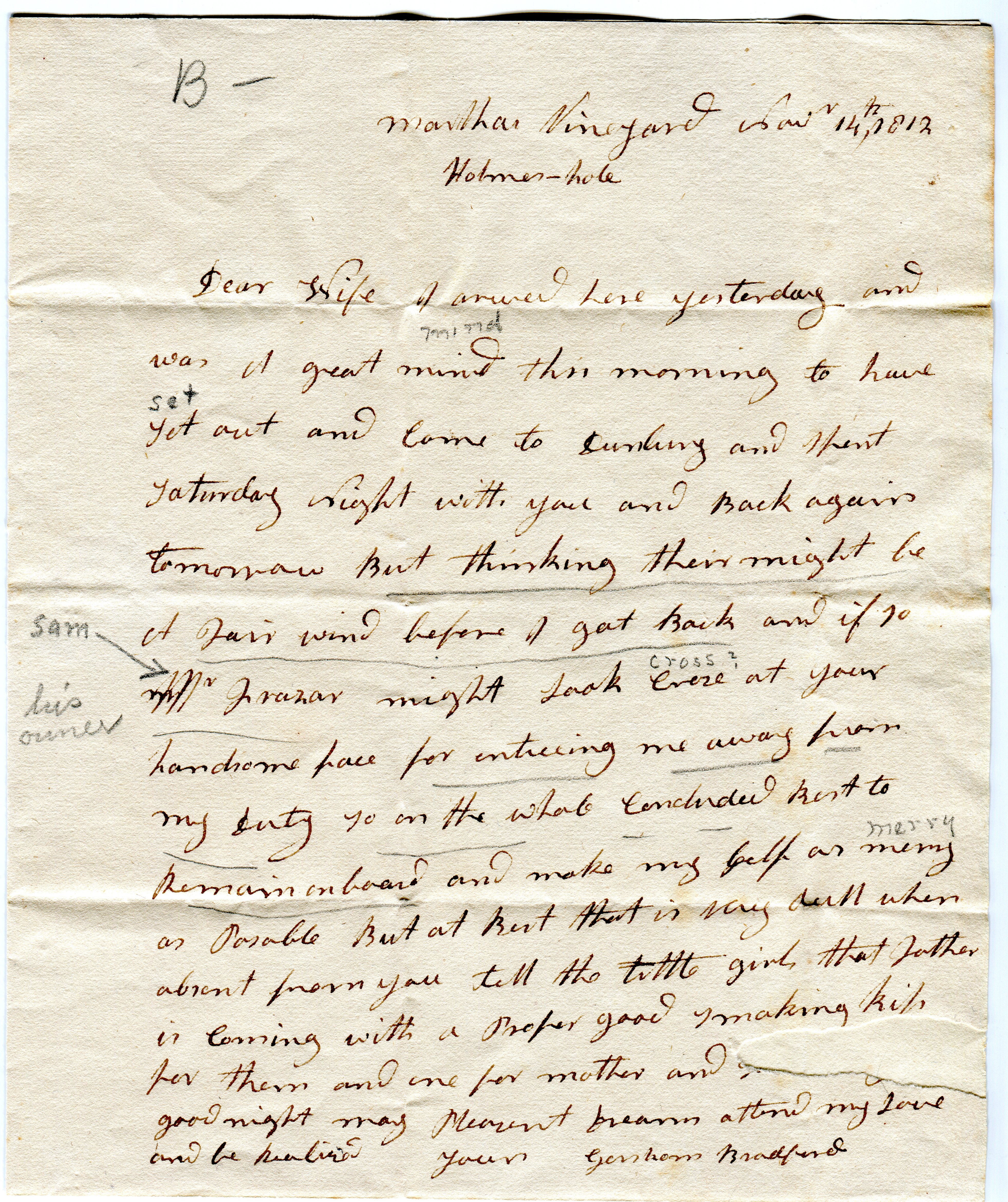
Capt. Gershom Bradford (Martha’s Vineyard) to his wife, Sarah Hickling Bradford (Duxbury, MA), November 14, 1812.


The largest collection by far held at the Drew Archival Library is that of the Bradford Family.  It spans 200 years, has hundreds of letters, photographs, shipping papers, journals, etc, etc.  It is the go-to collection here when I need to know anything about Duxbury history – each generation of the family was heavily involved in social movements, town politics and, dare I say it, gossip.  So, when I thought it might be fun to scan something from 200 years ago today, I immediately went to see what a Bradford had to say.  The following is a brief love letter Captain Gershom Bradford (1774-1844) penned to his wife, Sarah Hickling Bradford (1772-1861), before heading to Boston aboard the brig Patriot.  The Captain was away quite a bit as a master mariner during their early marriage.  At the time of this letter Sarah would have been pregnant with their fourth daughter, Charlotte (the Civil War nurse).

You will notice the “B-” written atop the scanned image.  Much of the Bradford correspondence was graded by descendent, also named Gershom Bradford. The B- might seem a poor grade for such a lovely little note but, given the length and topics of other letters, it was probably a fair assessment in his eyes.

Martha’s Vineyard

November 14th, 1812

Holmes-hole

Dear Wife,

I arrived here yesterday and was at great mind this morning to have set out and come to Duxbury and spend Saturday night with you and back again tomorrow but thinking there might be a fair wind before I got back and if so Mr. [Samuel] Frazar might look cross at your handsome face for entreeing [sic] me away from my duty so on the whole concluded best to remain onboard and make my self as merry as posable [sic] but at best that is very dull when absent from you tell the little girls that father is coming with a proper good smaking [sic] kiss for them and one for mother [page torn] goodnight may pleasant dreams attend my love and be realized

Yours, Gershom Bradford

Vote! And Thank You Judith Winsor Smith.

Judith Winsor Smtih

For two long hours on election day, not

                long ago

She stood where the voters

                streamed past in a row.

And gave suffrage leaflets to all who

                would take them

Now isn’t she plucky, and good as

                they make them?

Poem to Judith Winsor Smith on her 90th birthday  by Alice Stone Blackwell.

[I am updating this post today, November 6, 2018, as Americans all across the country are exercising their vote in what appears to be record numbers. Judith Winsor Smith would be proud.]

As I sit at the Wright Building today I can see the traffic congestion caused by voters navigating their way into a parking spot at Duxbury Middle School [in 2018 the voting location has moved across the street, and is very active].  I am happy to see so many of my fellow townsfolk coming out to exercise their right to cast a ballot.  Universal suffrage was not always the case in this country and there were many who came before us who had to struggle for what we are sometimes so blasé about today.  One such person was Judith Winsor Smith.  Smith was a Duxbury woman who fought along side Susan B. Anthony and Elizabeth Cady Stanton but, unlike them, lived to see the day when all women could vote – and did so herself at age 99.

Judith Winsor (McLauthlin) Smith was born in Marshfield, MA in 1821.  Her father, Lewis McLauthlin, was the groundskeeper for the shipbuilder Ezra “King Caesar” Weston and her mother, Polly, was the daughter of the Duxbury portrait painter/doctor, Rufus Hathaway.  Judith moved to Duxbury as a young teacher, boarding in the home of Maj. Judah Alden.  She married Sylvanus Smith in 1841 and spent her early married life here.  The couple later moved to East Boston where there were more opportunities for shipbuilders such as Sylvanus.  Much later, as an elderly widow, Judith moved to Jamaica Plain to live with her daughter, Zilpha Drew Smith.

Smith was a true 19th century reformer.  She was an abolitionist as well as a member of the Standing Committee of Theodore Parker’s society.  But it was in the fight for votes for women that she labored the longest.  She was the president for many years of the East Boston Woman Suffrage League and a member of the executive committee of the Massachusetts, New England and American Suffrage Associations.  At the age of 92 she addressed a crowd gathered together in Post Office Square by the Boston Equal Suffrage Association.  The following year she marched in Boston with Alice Stone Blackwell and Ellen Wright Garrison.  Finally, in 1920 she was able to cast her first ballot.  She died the next year at age 100.

IMG_1379

Grave of Judith Winsor McLauthlin Smith, Mayflower Cemetery, Duxbury, MA

So, today as you are getting out there and rocking the vote, take a moment to thank all those that made it possible, including Judith Winsor Smith.

Reading Photographs

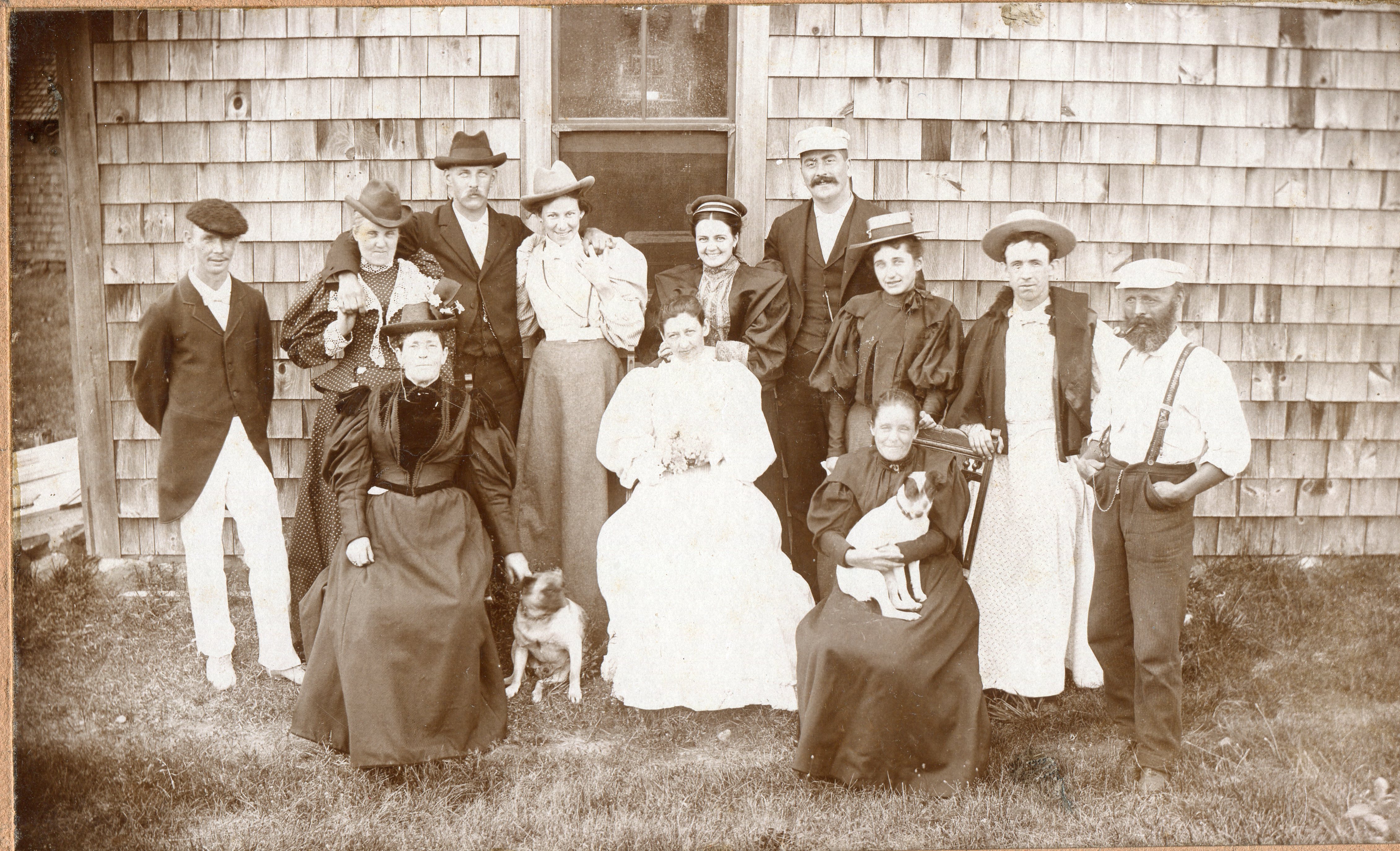
I enjoy examining old photographs and trying to tease out all the facts I can about the subject but sometimes the full meaning of what is going on eludes me.  Today I came across an image that I just can’t seem to figure out…perhaps you will have a suggestion as to its content.

The image is of a Duxbury, MA gathering. The man on the far right smoking a pipe is George Ellis Hathaway (1851-1944), the grandson of the painter, Rufus Hathaway.  George lived at 95 West Street, although the location of the photo is uncertain.  The photograph was taken by F. S. Needham of Duxbury.  Based on the style of dress on the women (the loose drooping sleeves above the elbow, for example) the photo is c. 1893-1896.  I love everything about it – the rich velvet fabric on the shoulders of the woman seated on the left; the pug and jack russell terriers, both blurred in movement; the smiling faces; the hats.  It’s all wonderful.  I wish I could identify everyone and maybe with a bit more investigation, I will be able to put names to at least one or two more individuals. 

Have you spotted my real dilemma yet?  Take a close look…closer…closer still.  Notice the man standing next to George Ellis Hathaway?  Yes, that’s the one, the one wearing the dress.  I would love to know what is going on there.  Are they a group of amateur actors just finishing a performance?  There does seem to be a certain amount of playfulness on everyone’s face – except for his.  If you have any idea what the true subject of this photograph is or can identify anyone pictured, please let me know.

Journals are here!

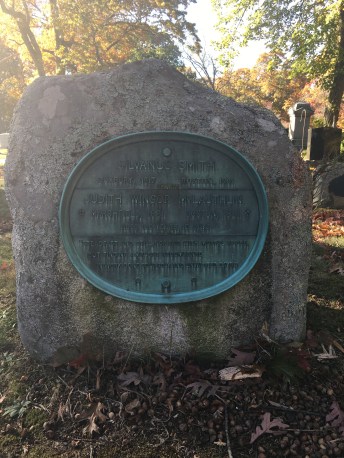
There is a new tab atop this page – Journals.  As we transcribe our many fascinating diaries we will be posting them online.  Currently a portion of Amherst A. Alden’s 1847 journal has been added.  Have fun reading about this adventurous 15 year old traveler and check back to see what our other diarists were up to.

“My Conscience!” The Journal of Amherst A. Alden

First page of Amherst A. Alden’s journal, 1847.

September 28, 1847,

Left Duxbury at 10 o’clock AM.  My birthplace; the town where I have always resided, left all friends, acquaintances, my home, to make my abode in the far West.  There is a feeling upon leaving home which no pen can describe, “there is no place like home.”

Thus begins the journal of 15 year-old Duxbury native Amherst A. Alden (1832-1909) as he embarked on his journey to Illinois.  At the time Amherst left Duxbury there was little to keep an educated young man at home. The decline of the town’s great shipbuilding era left scant employment other than the ill-paid and laborious work of shoemaking. Luckily the United States was full of places a man of ambition could make his mark.  Many moved to Boston (see previous blog post about Eugene Sampson), some went to sea and others followed the country’s manifest destiny and went west.

Prior to leaving Duxbury in the fall of 1847, Amherst was presented a journal by his neighbor, Ann Thomas Porter, the wife of the local doctor, John Porter. His travels to the “far west” took him through western New England, down the Erie Canal, and eventually to Pekin, Illinois where he became employed as a teacher.  He diligently recorded his day’s activities every evening until the book was complete on April 19, 1848.  It is a wonderful look into daily life in Illinois during this period – names, places and events are recorded that would be of interest to anyone whose ancestors founded the towns of Pekin or Tremont.  Also fascinating are his use of exclamations such as “Oh Scissors” and “My Conscience.”

After only a year in Illinois Amherst made his way back to Massachusetts.  He became the private secretary to Daniel Webster and then a clerk in the Boston Post Office.  In 1853 he married Georgina Cook, the daughter of a shipwright. They had one child, Jennie. The family split their time between Duxbury (366 Washington Street) and Boston.  Amherst A. Alden died in 1909 and is buried in Mayflower Cemetery in Duxbury.

The journal is currently being transcribed by a Duxbury High School intern, Gaby Davis.

150 Years Ago Today…

Today was a very momentous day in the life of Duxbury’s own Civil War Nurse, Charlotte Bradford.  It marked the end of her tenure as a matron aboard the United States Sanitary Commission’s Transport Ships and the beginning of her life as a U.S. Army nurse under Dorothea Dix.  Her journal entry to mark the occassion is quite simple, “Thursday 4th. Taken leave of Fortress Monroe and at 5 1/2 started in the port for Baltimore. Most beautiful evening.”  It belies the anxiety she felt just a few days earlier when she wondered what would become of her.

To read Charlotte’s daily journal entries, you can “like” her Facebook Page: http://www.facebook.com/#!/charlottebradfordnurse

John Southworth of the 18th Massachusetts

Carolyn Ravenscroft, Archivist

Letter from John Southworth, Hall’s Hill, Virginia, Camp Barnes, January 7, 1864.

“Cheer up Emma, it will all seem better when he comes home…”

                      – Harriet J. Fish to Emma Cushing Paulding, July 15, 1861

On a late summer day in 1861, 17 year old John Southworth of Duxbury was mustered into the 18th Massachusetts Infantry, Company E.  He was not alone, accompanying him were a number of young men from town, including his brother, 20 year old Walter.  John and Walter, like many in Duxbury at the time, were shoemakers.  The glory days of Duxbury’s shipbuilding era was a generation past and many took to making shoes, or cordwaining, as an occupation.  John’s father, James, was alternately listed as a farmer or shoemaker in the US Census Records, indicating that the Southworths owned a sustainable farm in Duxbury but required the additional income shoemaking could provide.

The Southworths belonged to a large network of families that had lived in Duxbury since its founding.  When John marched off to war he left behind his parents, James and Lucy, as well as a number of siblings, aunts, uncles and cousins.  One such relation was young Emma Cushing Paulding (b. 1843), the daughter of one of the last successful shipbuilders in town, William Paulding.  As first cousins living in a small town, Emma and John had grown up together and it is through their Civil War correspondence that we are able to glimpse the kind, wistful and serious-minded man John Southworth was.

As a member of the 18th Massachusetts, John Southworth’s tenure was three years, during which he witnessed many of the most notable battles of the Civil War, including Gettysburg.  His letters describe the cold, miserable conditions men on the picket lines had to endure, the long marches without any rest, and the fear of facing battle.  In one letter he described the suicide of a fellow soldier who was so desolate he would rather die than face another day of war.  John also writes of coming home and his wish to see his parents, to go on a sleigh ride and to attend dances once again.  Through his letters it is obvious he and his cousin Emma shared a familiarity and friendship, and perhaps, although they were cousins, a bit of romance.  Many of John’s correspondents had left off writing him and he was always grateful to receive word from Emma.

Unfortunately, John Southworth did not survive the War. He died in Andersonville Prison in Georgia during the summer of 1864.  In his last letter to Emma, written on April 10th, only a few short months before his death he wrote the following:

“You say I don’t think enough of myself, ah yes I do Emma, I think I am as good as anybody…But I don’t know as I am good enough to go with a girl.  I think they are a higher grade of human beings than men.  They don’t take part in the abominable, diabolical war.  I can’t say anything bad enough about it…I’m afraid of shot and shell, I have had too many of them sing around my head already and I never want to hear another one fired at them, don’t know how dreadful they sound.”

Although John did not make it home, his brother Walter did, marrying a local girl named Emma Chandler and raising a family in Duxbury.  As for Emma, a few years after the War, she married George Bartlett Bates of Kingston, MA and had five children.  She died in 1930 at the age of 87.

John Southworth alludes to a diary he kept as a soldier.  We can only suppose it was lost while he was a prisoner.  The six letters that Emma Paulding kept, however, allow us to know John Southworth and his experience, if only a bit.  The letters were transcribed by Dylan Kornberg as part of his Duxbury High School internship program and are available by clicking the Emma C. Paulding Papers link to the right under Small Collections.

Note: This blog post originally appeared on the Duxbury Rural and Historical Society’s Duxbury in the Civil War blog site (www.duxburyinthecivilwar.wordpress.com) in May 2011.  In light of the Southworth letters being featured on the Library of Congress’ National Union Catalog of Manuscript Collection’s Documentary Heritage of the Civil War I thought I would repost it.